WhatsApp Retargeting: How to Re-Engage and Convert Customers

Copied to clipboard!

A shopper discovers your product, spends several minutes browsing it, maybe even adds it to their cart, and then leaves.

That does not necessarily mean they have lost interest.

They could be comparing alternatives, checking delivery timelines, waiting until payday, looking for reviews, or simply getting distracted.

This is where WhatsApp retargeting can help.

WhatsApp retargeting is the practice of re-engaging people who have already shown intent or interacted with your business through personalized WhatsApp conversations. It can be triggered by actions such as viewing a product, abandoning a cart or checkout, clicking an ad, interacting with a campaign, or making a previous purchase.

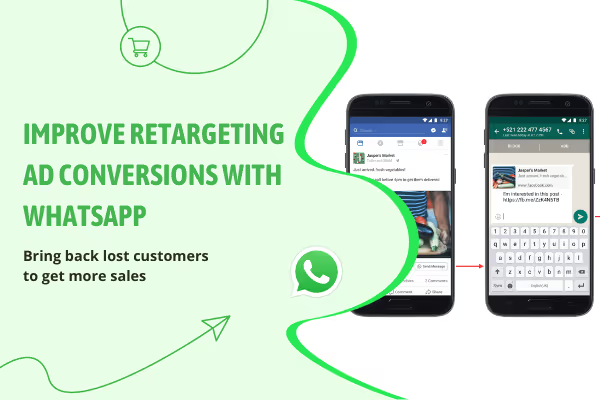
Businesses can retarget these audiences in two primary ways: by sending relevant WhatsApp messages to eligible, opted-in users, or by running Meta retargeting ads that take interested users directly into a WhatsApp conversation.

The important part is that you are not starting a conversation with a completely cold audience. You are continuing from an intent signal that already exists.

What Is WhatsApp Retargeting?

WhatsApp retargeting means identifying people who have previously interacted with your business and re-engaging them on WhatsApp based on what they did.

A simple WhatsApp retargeting flow looks like this:

Customer action → Intent signal → Audience segment → Relevant WhatsApp interaction → Conversion

For example, suppose a customer visits an ecommerce store and spends time looking at a pair of running shoes but leaves without adding them to the cart.

If the business can identify that customer and has the required permission to contact them on WhatsApp, it could trigger a personalized follow-up related to those shoes.

The message does not need to immediately offer a discount. It could:

  • remind them about the product
  • answer common questions
  • highlight reviews or benefits
  • provide delivery information
  • recommend related products
  • take them back to the product or checkout
  • connect them with a human agent

The same principle can be applied deeper in the funnel.

Someone who viewed a product has shown interest. Someone who added it to the cart has shown stronger intent. Someone who reached checkout but did not purchase is an even higher-intent prospect.

A good WhatsApp retargeting strategy treats these audiences differently.

WhatsApp Retargeting vs WhatsApp Remarketing: What's the Difference?

The terms WhatsApp retargeting and WhatsApp remarketing are often used interchangeably, but there is a useful distinction between them.

WhatsApp Business describes remarketing as the broader process of re-engaging people who have already interacted with a brand, while retargeting is more conversion-focused and typically acts on specific customer intent.

WhatsApp Retargeting WhatsApp Remarketing
Usually based on a specific customer action Broader re-engagement strategy
Often conversion-focused Can focus on engagement, retention or sales
Product views, cart exits, checkout abandonment Win-back, loyalty, renewal, new launches
Usually triggered close to the original action Can happen much later in the customer lifecycle
Goal is often to complete an interrupted journey Goal can be to restart or deepen a relationship

In practice, however, the lines overlap.

A cart recovery message can be called both retargeting and remarketing. The same is true for a personalized follow-up to someone who viewed a product.

For marketers, the more important question is not which label to use. It is:

What did this customer do, how much intent did that action show, and what is the most relevant next conversation?

How Does WhatsApp Retargeting Work?

There is more than one way to retarget a customer through WhatsApp.

For most businesses, WhatsApp retargeting can be divided into three models.

1. Behaviour-Triggered WhatsApp Retargeting

Behaviour-triggered retargeting starts with an action on your website, store, app, campaign, or conversation.

Examples include:

  • viewing a product
  • browsing a collection
  • clicking a campaign link
  • adding an item to the cart
  • interacting with a WhatsApp message
  • starting but not completing a chatbot journey

That action becomes the trigger for a follow-up.

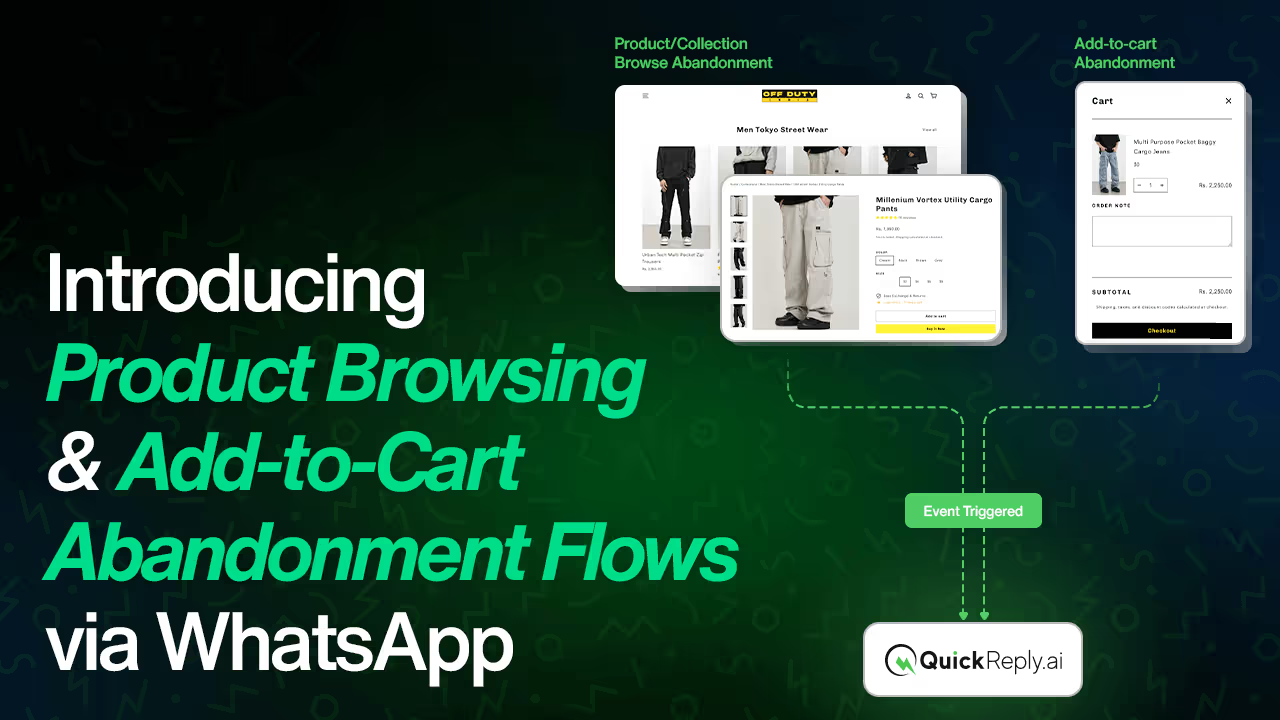
For example, QuickReply.ai can use Shopify browsing events, such as product or collection views, to trigger relevant WhatsApp follow-up journeys when a shopper leaves without progressing further. 

Customer views Product A → leaves without adding to cart → waits 30 minutes → receives Product A reminder on WhatsApp

This is different from sending the same broadcast to everyone.

The customer's behaviour determines the message.

2. Cart and Checkout Retargeting

Cart and checkout abandonment are among the highest-intent WhatsApp retargeting use cases.

The customer has already moved beyond discovery.

They have selected a product and, in the case of checkout abandonment, may have been close to purchasing it.

A typical recovery journey might look like:

Cart abandoned → Wait → Reminder → Customer does not purchase → Second nudge → Purchase → Exit journey

The important word here is journey.

One generic reminder is not always enough. A multi-step campaign can change the message based on whether the customer clicked, replied, purchased, or continued to remain inactive.

At the same time, frequency must be controlled. More reminders do not automatically mean more conversions.

3. Retargeting Ads That Click to WhatsApp

WhatsApp can also be used as the destination for paid retargeting campaigns.

Meta allows businesses to create Custom Audiences using signals such as website activity, customer lists and previous engagement.

Relevant audiences can then be shown Facebook or Instagram ads that open a WhatsApp conversation rather than another landing page.

For example:

Product visitor → Meta Custom Audience → Retargeting ad → WhatsApp conversation → Purchase

This is useful when the barrier to purchase may be a question rather than a lack of awareness.

Instead of repeatedly showing the same product page, the business gives the customer an opportunity to ask about sizing, shipping, payment options, product compatibility, returns or other purchase concerns.

Who Can You Retarget on WhatsApp?

Different customer actions represent different levels of intent.

A strong WhatsApp retargeting strategy therefore segments customers using behaviour, intent, recency and customer history.

Audience Typical intent Possible retargeting approach
Product viewers Medium Product reminder or product information
Collection browsers Medium Relevant product recommendations
Add-to-cart abandoners High Cart recovery
Checkout abandoners Very high Checkout completion
Ad clickers Medium-High Continue the ad conversation
Campaign clickers Medium-High Follow up on the clicked product or offer
Leads who stopped replying High Resume the previous conversation
Previous customers Known customer Cross-sell or replenishment
Lapsed customers Previously engaged Win-back campaign

This distinction matters because a product viewer and a checkout abandoner should not receive the same message or level of urgency.

What About Anonymous Website Visitors?

A website visit alone does not give a business permission to send a customer a WhatsApp marketing message.

For direct WhatsApp retargeting, the business needs sufficient customer identity and the appropriate WhatsApp opt-in.

Anonymous visitors may still be eligible for ad-based retargeting where supported, but direct messaging requires the necessary permission.

How to Build a WhatsApp Retargeting Strategy

Successful WhatsApp retargeting is not simply:

Abandonment → Send discount

The strategy should start much earlier.

Step 1: Decide Which Actions Should Trigger Retargeting 

Start by deciding which behaviours matter enough to trigger retargeting.

For an ecommerce business, these could include:

  • viewed the same product multiple times
  • spent meaningful time on a product page
  • added a product to cart
  • started checkout
  • clicked a promotional campaign
  • asked about a product but did not purchase
  • purchased a replenishable product previously

Avoid triggering a campaign from every possible activity.

Someone who accidentally opens a product page for two seconds is not necessarily a retargeting prospect.

Better behavioural filtering creates more relevant campaigns and reduces unnecessary messages.

Step 2: Track Those Actions Reliably

For ad-based retargeting, Meta Pixel (a small piece of JavaScript code to track website visitors) can track website visitors' actions such as page views and add-to-cart events. 

Meta also recommends using the Conversions API alongside Pixel where appropriate to create a more direct connection between business data and its ad optimization and measurement systems.

Ecommerce platforms can also provide first-party events such as:

  • product viewed
  • product added to cart
  • checkout started
  • order completed

These events can feed your WhatsApp automation system.

The goal is straightforward: Know what happened before deciding what to send next.

Step 3: Capture WhatsApp Opt-In

WhatsApp retargeting is permission-based.

WhatsApp requires businesses using the WhatsApp Business Platform to obtain the appropriate opt-in before proactively messaging customers. Businesses must also follow applicable privacy and data protection requirements.

Depending on your customer journey, opt-ins can be collected through mechanisms such as:

  • checkout
  • website forms
  • WhatsApp pop-ups
  • QR codes
  • lead forms
  • WhatsApp widgets
  • customer registration
  • ads that initiate a WhatsApp conversation

Make it clear that the person is agreeing to receive messages from your business on WhatsApp.

Step 4: Segment by Intent and Recency

Two variables should influence almost every retargeting flow:

How strong was the intent?

and

How recently did it happen?

For example:

Someone abandoning checkout 20 minutes ago may deserve immediate attention.

Someone who browsed one product three weeks ago probably does not.

Create segments such as:

High intent + recent: checkout abandoner
Medium intent + recent: product browser
High intent + older: lapsed lead
Existing customer + expected purchase cycle: replenishment audience

This makes messaging far more relevant than treating every non-buyer as a single segment.

Step 5: Continue the Context of the Previous Interaction

Good retargeting feels like a continuation, not a new campaign.

Instead of:

Hey! Check out our latest products.

Use the context you already have:

Still considering the shoes you were looking at earlier? Here are the details in case you had any questions before ordering.

The customer should immediately understand why the message is relevant to them.

Depending on available customer data, personalization can include:

  • product name
  • category
  • cart items
  • cart value
  • product image
  • checkout link
  • previous purchase
  • location
  • coupon eligibility
  • customer segment

The objective is not personalization for its own sake.

It is to reduce the gap between what the customer was trying to do and what they need to do next.

Step 6: Use Journeys Instead of Isolated Messages

A good retargeting campaign should react to customer behaviour.

Consider this flow:

Cart abandoned


Wait 30 minutes


Send cart reminder


Purchased? → Exit

Clicked but didn't purchase? → Wait and follow up

Replied? → Start conversation or route to agent

No engagement? → Suppress or send next eligible nudge

QuickReply.ai's retargeting journeys can use actions such as product views, cart exits and link clicks and adjust subsequent steps based on customer behaviour.

This creates a fundamentally different experience from repeatedly broadcasting promotional messages.

Step 7: Define Exit Conditions

This is one of the easiest parts of retargeting to overlook.

Every automated campaign should know when to stop.

If someone completes their purchase, continuing to send:

You forgot something in your cart!

creates a poor experience and wastes marketing spend.

Possible exit conditions include:

  • purchase completed
  • product becomes unavailable
  • customer opts out
  • customer enters another higher-priority journey
  • maximum campaign frequency reached
  • user becomes ineligible for the campaign

The more automation you introduce, the more important suppression and exit rules become.

Step 8: Measure the Business Outcome

Do not optimize a retargeting campaign only around message delivery.

The goal is usually not:

message sent

or even:

message clicked

It is:

customer recovered or converted.

Track what happens after engagement.

WhatsApp Retargeting Use Cases

Here are some of the most practical ways businesses can use WhatsApp retargeting.

Product Browse Abandonment

Trigger: Customer meaningfully views a product but does not proceed.

Retargeting approach: Remind them of the product, answer common objections or suggest related options.

Primary goal: Move the customer from consideration to cart.

For example, Techno Sport used QuickReply.ai to identify shoppers who spent more than 15 seconds on a product page but did not add the item to cart. After 15 minutes of inactivity, a personalized WhatsApp message was triggered based on the product they had viewed. 

Collection Browse Abandonment

Trigger: Customer spends time exploring a product category but does not select an item.

Retargeting approach: Show popular or relevant products from the collection.

Primary goal: Help the customer narrow their choice.

This is particularly useful for stores with large catalogs where choice overload can prevent customers from progressing.

Add-to-Cart Abandonment

Trigger: Product added to cart, but checkout is not completed.

Retargeting approach: Restore the cart, answer questions, add trust signals or remind the customer of what they selected.

Primary goal: Recover the cart.

Do not assume discounts are always required.

For example, Attic Salt used WhatsApp cart recovery without discounts and got a 57% increase in abandoned-cart recovery and a 24.7% conversion rate.

That matters because it shows that relevance and timing can sometimes recover customers without immediately sacrificing margin.

Checkout Abandonment

Trigger: Customer starts checkout but does not place the order.

Retargeting approach: Make returning to checkout easy and address high-friction questions around payment, delivery or trust.

Primary goal: Complete the purchase.

This audience has typically shown stronger buying intent than a simple website visitor, so the communication should reflect that.

Lead Follow-Up

WhatsApp retargeting is not limited to ecommerce carts.

A prospect might:

  • click an ad
  • ask about a service
  • complete part of a qualification flow
  • request pricing
  • stop responding before booking

Instead of restarting the entire sales journey, retargeting can continue from the last completed step.

Click-to-WhatsApp Ad Retargeting

Businesses can use Meta Custom Audiences to reach people who have already interacted with them and direct those users into WhatsApp through ads that click to message. Meta supports WhatsApp as one of the messaging destinations for these campaigns.

The conversation can then qualify intent, answer questions, recommend products or route high-intent prospects to sales.

Repeat Purchase and Replenishment

Retargeting does not have to end after the first purchase.

For products with predictable replenishment cycles, the previous transaction itself becomes an intent signal.

Examples include:

  • skincare
  • supplements
  • pet supplies
  • food products
  • contact lenses
  • recurring services

Instead of sending a generic monthly promotion, the business can reconnect when a repeat purchase is more likely to be relevant.

Win-Back Campaigns

Previous customers who have not purchased for a meaningful period can form another retargeting segment.

The message can reference:

  • previous purchase category
  • new arrivals
  • replenishment
  • loyalty benefits
  • product improvements
  • relevant offers

The key is to base the campaign on actual customer history rather than treating every inactive customer identically.

How to Improve WhatsApp Retargeting Conversion Rates

Once the targeting and journey are in place, several factors can improve campaign performance.

1. Match the Timing to the Intent

Retargeting usually works best while the original intent is still relevant.

But there is no universal best delay.

A checkout abandonment journey may require faster follow-up than a browse abandonment or replenishment campaign.

Test timing separately for each trigger.

2. Do Not Lead With a Discount Every Time

Price is only one reason customers abandon a purchase.

Other barriers may include:

  • uncertainty about the product
  • delivery timelines
  • payment options
  • product fit
  • returns
  • trust

Automatically giving every abandoner a coupon can reduce margin and train customers to wait for offers.

Use discounts when they genuinely improve the economics of the journey, rather than making them the default retargeting strategy.

3. Make the Conversation Two-Way

WhatsApp has an important advantage over many traditional retargeting channels.

The customer can reply.

Someone who asks a question about shipping, sizing, compatibility or payment has provided another intent signal.

Automation can answer straightforward questions while more complex conversations can be routed to a human agent.

4. Reduce Friction in the Next Step

The customer should not have to rebuild the journey from the beginning.

Where appropriate, take them directly back to:

  • their cart
  • checkout
  • the product they viewed
  • the relevant collection
  • an active sales conversation

The fewer unnecessary steps between the retargeting interaction and the desired action, the better.

5. Control Frequency

More messages do not automatically create more conversions.

Set limits so the same customer does not simultaneously receive:

  • cart recovery
  • promotional broadcasts
  • product recommendations
  • win-back messages

A retargeting campaign should feel relevant, not repetitive.

How to Measure WhatsApp Retargeting Performance

Message delivery alone does not tell you whether retargeting is working.

Track performance across the complete customer journey.

Metric What it measures
Delivery rate Messages successfully delivered
Click-through rate Users clicking the CTA
Reply rate Users starting a conversation
Conversion rate Retargeted users completing the goal
Cart recovery rate Abandoned carts successfully recovered
Revenue recovered Revenue attributed to recovery journeys
Cost per conversion Cost required to generate a conversion
ROAS Revenue generated relative to campaign/ad spend
Unsubscribe/opt-out rate Whether campaign frequency or relevance is causing fatigue

For example, the abandoned cart recovery program for RENÉE Cosmetics resulted in 5,703 recovered carts, a 63.56% conversion rate, and 171x ROI. This shows why you should evaluate retargeting performance using downstream outcomes such as recovered purchases, conversion rate, and revenue efficiency, not message delivery alone. 

WhatsApp Retargeting Rules: Opt-In, Templates and Messaging Windows

WhatsApp retargeting should be built around customer permission.

According to the WhatsApp Business Messaging Policy, businesses using the WhatsApp Business Platform must follow WhatsApp's requirements around user consent, messaging and approved templates.

Get the Appropriate Opt-In

Customers should understand:

  • that they are agreeing to receive WhatsApp communication
  • which business will contact them
  • what kind of communication they are agreeing to receive

Businesses should also follow the privacy and marketing regulations applicable to the markets in which they operate.

Use the Correct Message Template

Business-initiated communication may require an approved WhatsApp message template depending on the conversation context and timing.

Promotional retargeting messages should be categorized appropriately rather than being presented as transactional communication.

Respect Opt-Outs

If a customer asks not to receive promotional communication, they should be suppressed from relevant future campaigns.

Opt-out preferences should apply across journeys rather than only to the campaign in which the request was made.

Coordinate Campaign Frequency

Compliance and customer experience are closely connected.

Customers who receive expected, relevant and appropriately timed messages are less likely to perceive the communication as spam.

Turn Retargeting Into a Conversation

Traditional retargeting is primarily about getting back in front of someone.

WhatsApp adds another possibility: talking to them.

Instead of repeatedly pushing a prospect back to the same product page, a business can use behavioural data to understand their intent, start a relevant conversation, answer the questions stopping the purchase and guide them toward the next step.

For ecommerce brands, that can mean building connected journeys across product browsing, add-to-cart abandonment, checkout recovery, repeat purchase and win-back campaigns.

QuickReply.ai enables businesses to trigger retargeting journeys from actions such as product views, cart exits and link clicks, personalize messages using customer activity, and build multi-step journeys across WhatsApp and other messaging channels.

The goal is not to send more WhatsApp messages.

It is to make every follow-up more relevant to what the customer has already told you through their behaviour.

Turn 1 time visitor into repeat customer with WhatsApp marketing

Leverage the untapped growth potential of WhatsApp marketing to acquire and retain customers.

Frequently Asked Questions

What is WhatsApp retargeting?

WhatsApp retargeting is the process of re-engaging people who have already interacted with a business or shown purchase intent and continuing that journey through WhatsApp. Campaigns can be triggered by behaviours such as product views, cart abandonment, checkout abandonment, ad engagement or previous purchases.

What is the difference between WhatsApp retargeting and WhatsApp remarketing?

Remarketing is generally the broader practice of re-engaging previous prospects or customers, while retargeting is typically more conversion-focused and tied to specific intent signals. In everyday marketing usage, however, the two terms are often used interchangeably.

Can I retarget website visitors on WhatsApp?

Yes, when you can appropriately identify the visitor and have the required WhatsApp opt-in. Website behaviour such as product views, add-to-cart events and checkout abandonment can trigger automated journeys. Anonymous visitors should not be treated as if a website visit alone gives permission to message them directly.

Can WhatsApp retargeting be automated?

Yes. Businesses can connect customer events such as product browsing, add-to-cart activity, checkout abandonment and campaign interactions with automated WhatsApp journeys. Automations can include waits, conditional branches, personalized messages, exit conditions and human-agent handoffs.

Do customers need to opt in for WhatsApp retargeting?

For proactive messaging through the WhatsApp Business Platform, businesses need the appropriate user opt-in and must comply with WhatsApp's Business Messaging Policy and applicable laws.

What are Click-to-WhatsApp retargeting ads?

Click-to-WhatsApp retargeting ads are Meta ads shown to a relevant or previously engaged audience that open a conversation with the business on WhatsApp when clicked. Meta supports ads that click to WhatsApp across Facebook and Instagram placements.

Can WhatsApp be used for abandoned cart retargeting?

Yes. Businesses can trigger WhatsApp reminders when an eligible customer adds products to their cart but does not complete the purchase. Messages can restore the cart, answer questions, provide product context or help the customer return to checkout.

How soon should I retarget someone on WhatsApp?

There is no universal timing that works for every business. Timing should depend on the strength of the intent signal, product category, buying cycle and previous campaign data. High-intent events such as checkout abandonment usually justify faster follow-up than low-intent browsing.

Should I offer a discount in every WhatsApp retargeting campaign?

No. Customers abandon purchases for many reasons besides price. Test reminders, reviews, delivery information, product benefits, support and other objection-handling messages before automatically reducing the price.