What Is WhatsApp CRM? How It Works, Integrations, Features & Benefits

Copied to clipboard!

A CRM helps businesses keep customer data, conversations, sales activity, and follow-ups organized in one place. But when customer conversations happen on WhatsApp while their data lives in a separate CRM, teams lose context.

This is especially common for businesses that use WhatsApp for sales enquiries, support, bookings, order updates, and customer follow-ups.

WhatsApp CRM bridges this gap by connecting WhatsApp conversations with customer data, workflows, automation, and teams.

What Is a WhatsApp CRM?

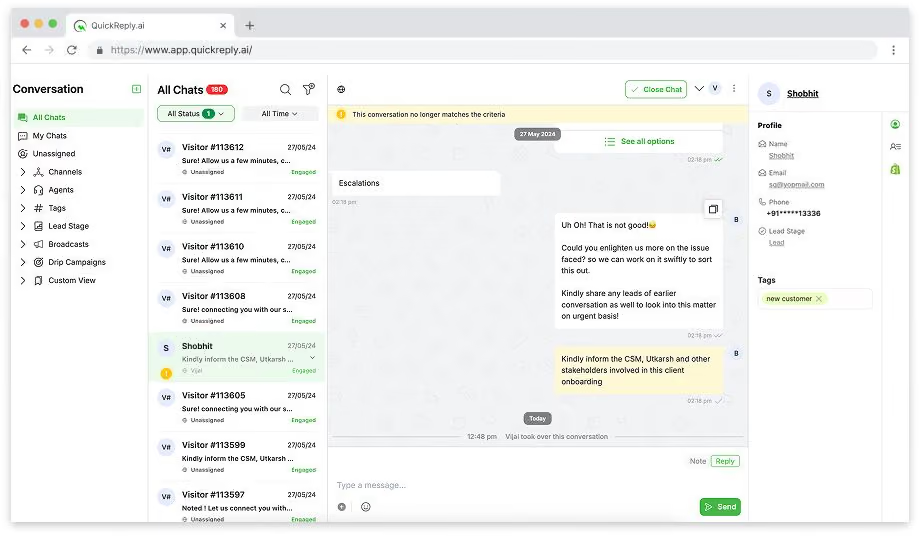
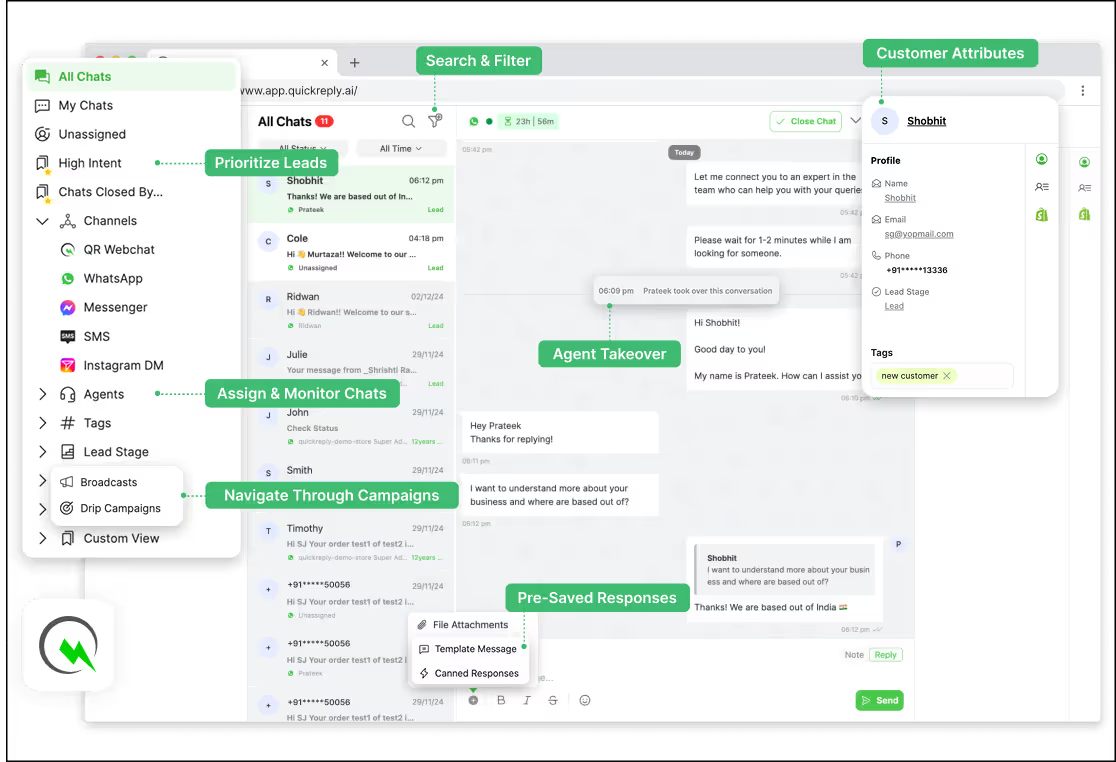
QuickReply.ai's Central WhatsApp CRM dashboard
Central WhatsApp CRM dashboard with open chats and customer information.

A WhatsApp CRM is a setup that connects WhatsApp conversations with customer relationship management capabilities.

Instead of treating every WhatsApp chat as an isolated conversation, it connects messages with customer information, conversation history, lead or customer stages, team ownership, automation, and data from other business systems.

This gives teams more context while handling a conversation. They can see who the customer is, what they have discussed or purchased before, where they are in the customer journey, and what should happen next.

In practice, businesses usually create a WhatsApp CRM setup in two ways:

1. WhatsApp-first platform with CRM capabilities

A platform built on the WhatsApp Business Platform adds CRM-like capabilities around WhatsApp, such as customer profiles, a shared team inbox, chat assignment and routing, support automation, chatbots, segmentation, analytics, and integrations.

This allows teams to manage customer relationships primarily through WhatsApp without needing every interaction to take place inside a traditional CRM.

2. Existing CRM with WhatsApp integration

WhatsApp can also be connected with an existing CRM or customer-service platform such as HubSpot, Zoho, Salesforce, or Zendesk.

In this setup, WhatsApp conversations and relevant customer activity can be linked with existing lead, deal, support, or customer records. Depending on the integration, teams may be able to sync conversation history, customer fields, statuses, assignments, or workflow events between WhatsApp and the CRM.

In both setups, the goal is the same:

Connect WhatsApp conversations with customer data and business workflows so teams can manage the relationship, not just the chat.

WhatsApp-first platform with CRM capabilities Existing CRM + WhatsApp integration
Primary workspace WhatsApp-focused platform Existing CRM or support platform
Role of WhatsApp Central customer-engagement channel Additional communication channel within the CRM
CRM capabilities Provided by the WhatsApp-focused platform Provided primarily by the existing CRM
Shared inbox Usually built into the WhatsApp platform Available inside the CRM/helpdesk when supported
Automation WhatsApp-focused workflows, chatbots and routing CRM workflows combined with WhatsApp messaging
Customer data Stored in or synchronized with the WhatsApp platform Existing CRM usually remains the primary customer system
Integrations Connects with CRM, ecommerce and other business systems WhatsApp is integrated into the existing CRM stack
Typical fit Businesses where WhatsApp is a major sales, marketing or support channel Businesses already running customer operations primarily through a CRM

How Does a WhatsApp CRM Work?

How a WhatsApp CRM works depends on the setup a business uses.

In a WhatsApp-first setup, CRM capabilities such as customer profiles, a shared inbox, chat routing, automation, and chatbots are provided by the WhatsApp CRM platform itself.

In an integration-led setup, WhatsApp conversations are connected with an existing CRM or customer-service platform such as HubSpot, Zoho, Salesforce, or Zendesk.

In both cases, the underlying flow is similar:

A WhatsApp conversation is connected with customer context, handled through automation or people, and the resulting activity can be recorded and used as context for future interactions.

1. A customer interacts with the business on WhatsApp

The conversation may begin through a direct WhatsApp message, website widget, Click-to-WhatsApp ad, QR code, campaign, or another customer touchpoint.

The WhatsApp Business Platform provides the messaging infrastructure through which connected software can send and receive WhatsApp messages programmatically.

2. The customer is identified and relevant context is retrieved

When a customer sends a message, the platform can associate the conversation with an existing customer profile or create a new one.

Depending on the setup and integrations, the team may have access to information such as:

  • customer name and contact details
  • previous WhatsApp conversations
  • lead or customer stage
  • tags and custom fields
  • assigned agent
  • purchase or order history
  • appointments or service requests
  • support history
  • campaign or lead source

In a WhatsApp-first setup, much of this information may be stored or managed within the WhatsApp platform itself.

If WhatsApp is connected with an existing CRM or another business system, relevant information can also be pulled from or synchronized with those systems.

3. Customer data adds context to the conversation

Connecting customer information with the chat helps teams avoid treating every message as a new interaction.

For example, if a customer asks: “When will my order arrive?”

An ecommerce business connected with its store data may be able to identify the customer and retrieve the relevant order rather than asking them to provide all the information again.

Similarly, a sales team may be able to see that the person is already a qualified lead and who owns the opportunity before replying.

4. Automation, chatbots, or routing determine what happens next

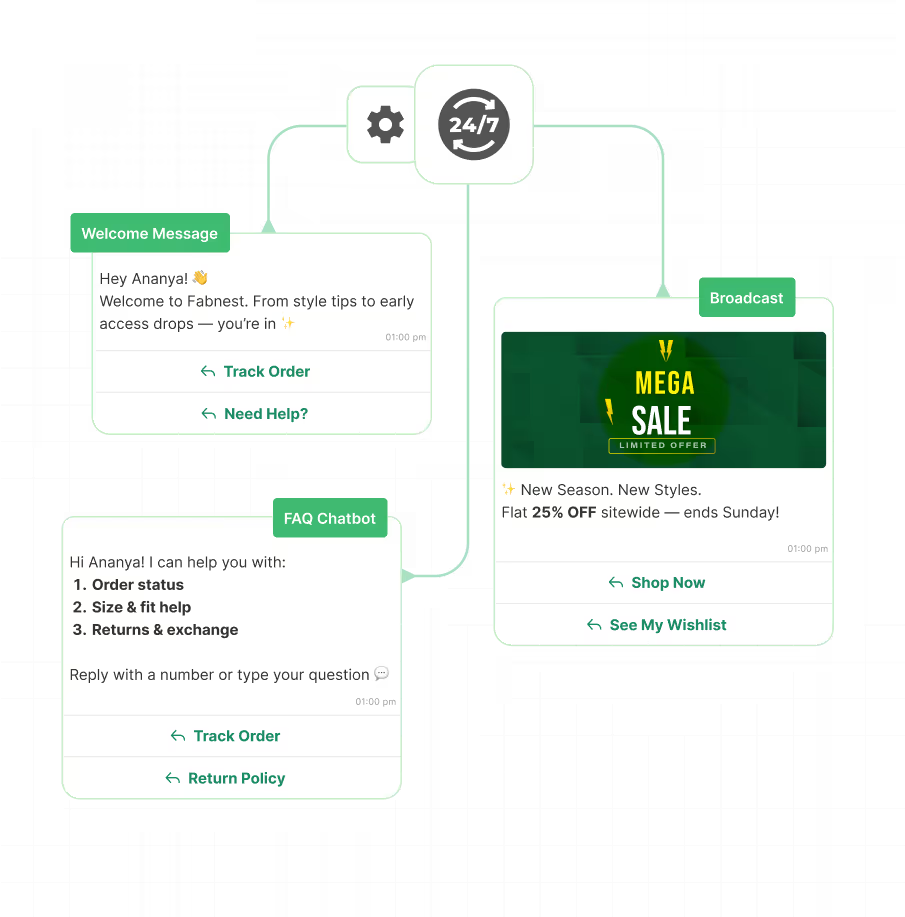
WhatsApp Chatbot Automation for Support Queries
WhatsApp Chatbot for Customer Support

Once the conversation and customer context are available, the platform can decide how the interaction should be handled.

For example:

  • a common question can be answered automatically
  • a new lead can enter a qualification workflow
  • a sales enquiry can be routed to a salesperson
  • a support request can be assigned to the support team
  • an order query can retrieve information from an ecommerce system
  • a high-intent or complex conversation can be escalated to a human agent

This is particularly useful for ecommerce and Shopify businesses that may not use a large enterprise CRM.

A WhatsApp-first CRM platform can give these businesses a practical customer-management layer around WhatsApp, allowing them to maintain customer context, manage conversations through a shared inbox, automate common queries with WhatsApp chatbots, and route conversations to employees when human assistance is required.

5. A human agent takes over when required

Automation does not need to resolve every conversation.

Suppose a salon receives: “What time do you close?”

A chatbot can answer this automatically.

But if the customer then says: “I want to book hair colouring for Saturday. Can someone confirm which stylist is available?”, then the conversation may need to move to a staff member.

A WhatsApp CRM can route the chat to the appropriate employee while retaining the conversation history and available customer context.

The customer does not need to start the conversation again simply because a human has taken over.

6. The interaction updates the customer or workflow

What happens during the conversation can then become useful for the next interaction.

Depending on the setup, the platform or connected CRM may:

  • update the customer's stage
  • assign or change an owner
  • add a tag or customer attribute
  • update a ticket
  • record conversation history
  • trigger a follow-up
  • start another automation

In a WhatsApp-first setup, these updates may happen within the WhatsApp platform.

In an integration-led setup, some or all of this information get synced with the existing CRM, depending on the integration.

The overall flow is:

WhatsApp conversation → Customer context → Automation or agent action → Customer/workflow update → Next interaction

This is what makes a WhatsApp CRM more than simply a messaging inbox or chatbot layer: every conversation can become part of an ongoing customer relationship rather than an isolated chat.

How Can WhatsApp Connect With an Existing CRM?

Businesses that already use a CRM do not necessarily need to move their customer operations to a separate system to use WhatsApp.

Instead, WhatsApp can be connected with the existing CRM so conversations and relevant customer activity become part of the workflows teams already use.

There are three common ways to do this:

Integration approach How it works Best suited for
Native CRM integration WhatsApp is connected through the CRM or customer-service platform's supported WhatsApp channel Businesses that want teams to continue working primarily inside their existing CRM
WhatsApp platform + CRM integration A WhatsApp-first platform manages conversations and WhatsApp-specific workflows while exchanging relevant data with the CRM Businesses that want deeper WhatsApp capabilities while retaining their existing CRM
Custom API integration WhatsApp Business Platform, the CRM, and other internal systems are connected through APIs and webhooks Businesses with highly customized or complex workflows

Native CRM integration

Some CRM and customer-service platforms provide their own way to connect WhatsApp.

In this setup, employees continue working primarily inside the CRM or helpdesk, while WhatsApp becomes another customer communication channel within that system.

The exact capabilities vary by platform and integration.

WhatsApp platform + CRM integration

A business can also use a WhatsApp-first platform alongside its existing CRM.

The setup typically looks like:

WhatsApp → WhatsApp-first platform ↔ Existing CRM

Here, the WhatsApp platform can manage conversations, automation, chatbots, campaigns, and routing, while relevant customer or workflow information is exchanged with the CRM.

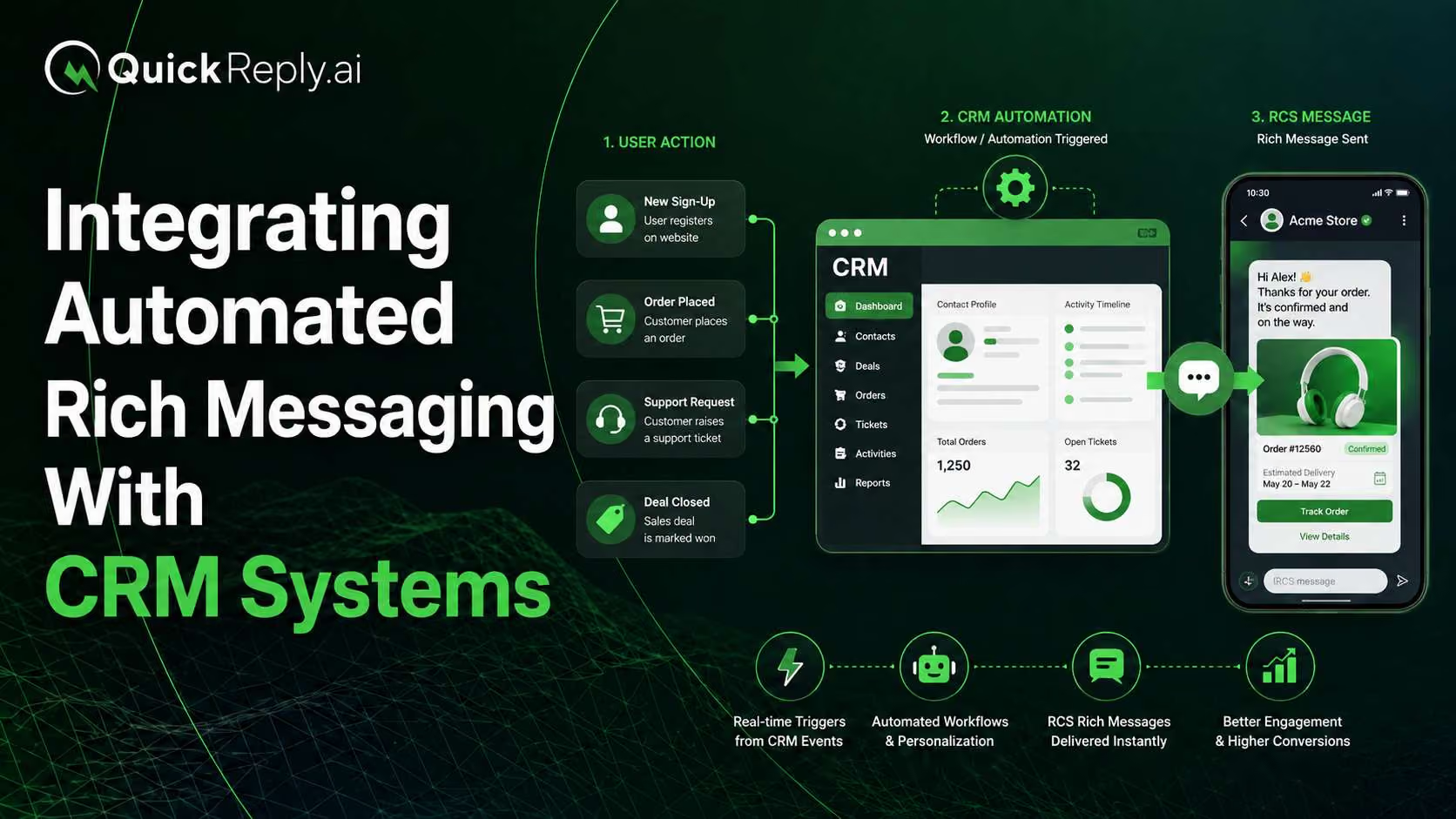
For example, QuickReply.ai's Zoho CRM integration supports workflows where CRM events can trigger WhatsApp communication. It can also sync WhatsApp conversation history and message-delivery status into the corresponding Zoho CRM timeline.

This type of setup can be useful when a business wants specialized WhatsApp capabilities without giving up the CRM it already uses.

Custom API integration

Businesses with more specific requirements can build custom connections between the WhatsApp Business Platform, their CRM, and internal systems.

This provides greater flexibility over data flows and workflows, but generally requires more engineering effort to build and maintain.

What Data Can Be Synced Between WhatsApp and a CRM?

Depending on the integration, information exchanged between WhatsApp and the CRM may include:

  • customer or contact information
  • WhatsApp conversation history
  • lead or deal status
  • assigned agent or owner
  • tags and custom fields
  • ticket information
  • campaign or lead source
  • workflow events
  • message-delivery status

The exact data flow depends on the integration being used.

Connecting WhatsApp with a CRM does not automatically mean every message, field, or event will synchronize in both directions. Businesses should check what data is supported, which direction it syncs in, and whether CRM events can trigger WhatsApp actions before choosing an integration.

What Are the Key Features of a WhatsApp CRM?

The exact capabilities vary between platforms, but most useful WhatsApp CRM setups include a combination of the following features.

Customer profiles and conversation history

WhatsApp conversations can be connected with customer details, previous interactions, lifecycle information, tags, and relevant data from other business systems.

This gives teams context before they respond.

Shared team inbox

Flowchart showing chat assignment based on keyword or tags in WhatsApp CRM

A shared inbox allows multiple employees to manage WhatsApp conversations from one workspace instead of chats being tied to a single person.

Teams can view, assign, transfer, and manage conversations collaboratively.

A shared inbox, however, is not necessarily a complete CRM by itself.

A shared inbox organizes conversations. A WhatsApp CRM connects those conversations with broader customer data and workflows.

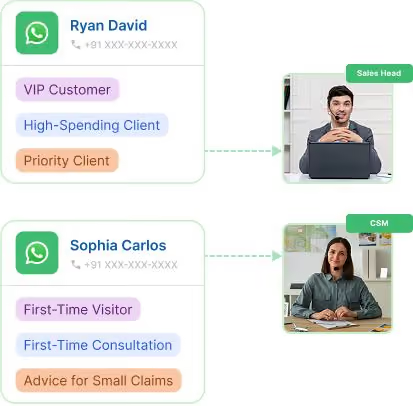
Chat assignment and routing

Incoming conversations can be assigned to the appropriate agent, team, or department based on predefined rules or customer information.

For example:

  • sales enquiry → sales team
  • support issue → support team
  • booking request → relevant staff
  • qualified lead → assigned salesperson

Automation, chatbots, and human handoff

Businesses can automate predictable interactions such as FAQs, lead qualification, reminders, and routine support queries.

When a conversation becomes more complex or requires human judgment, it can be transferred to an appropriate employee while retaining the available conversation context.

Segmentation

Customers can be grouped using information such as lifecycle stage, interests, purchase history, lead source, or other CRM attributes.

These segments can then be used for more relevant campaigns, follow-ups, and customer journeys.

CRM and business integrations

A WhatsApp CRM can connect with systems such as CRM software, ecommerce platforms, helpdesks, booking systems, and internal databases.

These integrations allow relevant customer and business information to move between WhatsApp conversations and the rest of the company's technology stack.

Analytics

Depending on the platform, businesses can measure performance around conversations, campaigns, customer journeys, and agent activity.

This can help teams understand how WhatsApp contributes to sales, support, and customer engagement.

How Can Businesses Use WhatsApp CRM?

WhatsApp CRM can support different stages of the customer relationship, from the first enquiry to post-purchase or post-service engagement.

Lead capture and qualification

Businesses can turn WhatsApp enquiries from websites, Click-to-WhatsApp ads, campaigns, QR codes, and direct messages into structured leads.

Qualification workflows can collect relevant information before the lead reaches the sales team.

For example, an education company could collect a student's course interest and location before assigning the enquiry to the appropriate counselor.

Sales and follow-ups

Sales teams can access conversation history and available customer context while speaking with prospects.

Lead ownership and automated follow-ups can also help ensure that high-intent enquiries do not get missed.

Customer support

WhatsApp can act as a structured support channel instead of simply another inbox.

Routine questions can be handled automatically, while more complex requests can reach the appropriate employee with the previous conversation context available.

For example, a car service center could automatically answer questions about opening hours while routing repair-specific enquiries to a service advisor.

Marketing and nurturing

Customer data can help businesses communicate differently with different customer groups.

Instead of sending the same message to every WhatsApp contact, businesses can create campaigns and journeys based on attributes such as customer stage, interests, purchase history, or previous engagement.

Retention and repeat engagement

WhatsApp CRM can also support customer communication after the initial sale or service.

Depending on the business, this may include:

  • renewal reminders
  • repeat-purchase communication
  • appointment reminders
  • feedback requests
  • re-engagement campaigns
  • other lifecycle-based follow-ups

This allows WhatsApp to support the customer relationship beyond the first conversation or transaction.

What Are the Benefits of WhatsApp CRM?

The main value of a WhatsApp CRM is not simply having more WhatsApp features. It is bringing customer conversations, context, and business workflows together.

  1. More contextual customer interactions: Teams can use previous conversations and relevant customer information when responding instead of treating every WhatsApp message as a new interaction.
  2. More efficient customer operations: Automation, routing, and shared workflows can reduce repetitive work and make it easier to manage growing conversation volumes without manually handling every step.
  3. Better continuity across teams: Sales, support, and other teams can work with shared customer context, making handoffs smoother and reducing the risk of conversations being missed or duplicated.
  4. More relevant customer engagement: Customer data and lifecycle information can be used to make follow-ups, campaigns, and other WhatsApp communication more relevant to each customer.

Which WhatsApp CRM Setup Should You Choose?

The right setup depends mainly on how important WhatsApp is to your customer journey and where your customer data already lives.

Choose a WhatsApp-first platform when… Integrate WhatsApp into your existing CRM when…
WhatsApp is a major customer communication channel Your CRM is already the main system used by sales or support teams
You need deeper WhatsApp automation, chatbots, and campaigns You want WhatsApp to become another communication channel inside existing CRM workflows
Sales, marketing, or support happen heavily on WhatsApp Existing CRM processes and customer records are already well established
You need a specialized shared inbox and chat-routing experience Agents should continue working primarily inside the existing CRM
You do not rely heavily on a traditional enterprise CRM Your CRM should remain the primary system of record

These approaches are not mutually exclusive. A business can use a WhatsApp-first platform to manage WhatsApp conversations and automation while synchronizing relevant customer information with its existing CRM.

So the decision is less about choosing WhatsApp CRM versus traditional CRM and more about deciding:

Where should WhatsApp conversations be managed, where should customer data live, and what information needs to move between the two systems?

Manage Your WhatsApp CRM with QuickReply.ai

QuickReply.ai gives businesses both ways to build a WhatsApp CRM setup.

For businesses that primarily manage customer relationships through WhatsApp, QuickReply.ai can act as the WhatsApp-first CRM layer. It combines customer profiles, conversation history, tags and custom fields, lead management, workflow automation, chatbots, routing, a multi-agent inbox, pipeline management, campaigns, and analytics in one platform.

This can be particularly useful for ecommerce, Shopify, and other WhatsApp-heavy businesses that may not need to introduce a separate enterprise CRM just to manage customer conversations and workflows.

QuickReply.ai connects WhatsApp interactions with customer and commerce data as well. Its WhatsApp CRM currently supports unified customer profiles, importing customer and order information from platforms such as Shopify and WooCommerce, lead-source tracking, segmentation, notes, and other customer context.

For businesses that already use an enterprise CRM, QuickReply.ai can work alongside it rather than replace it. QuickReply.ai currently supports integrations with CRM platforms including Zoho CRM, HubSpot, Salesforce, and LeadSquared.

This gives businesses the flexibility to use QuickReply.ai either as their primary WhatsApp customer-management platform or as the WhatsApp engagement layer connected to their existing CRM.

Turn 1 time visitor into repeat customer with WhatsApp marketing

Leverage the untapped growth potential of WhatsApp marketing to acquire and retain customers.

Frequently Asked Questions

What is the difference between WhatsApp Business Platform and WhatsApp CRM

The WhatsApp Business Platform provides the APIs and infrastructure required for software to send and receive WhatsApp messages programmatically.

A WhatsApp CRM adds the customer-management layer around those conversations, including customer profiles, conversation history, assignments, automation, segmentation, integrations, and workflows.

Can WhatsApp be integrated with an existing CRM?

Yes. WhatsApp can be connected with existing CRM and customer-service systems either through native integrations, a WhatsApp-first platform that integrates with the CRM, or custom APIs. The exact data and workflows that can be synchronized depend on the particular integration.

Do I need an enterprise CRM to use WhatsApp as a CRM?

Not necessarily.

Businesses that rely heavily on WhatsApp can use a WhatsApp-first platform with CRM capabilities to manage customer profiles, conversations, automation, routing, and team workflows.

Businesses that already rely on an enterprise CRM can instead connect WhatsApp with that system.

Is a WhatsApp shared inbox the same as a WhatsApp CRM?

No. A shared inbox primarily helps multiple employees manage conversations from one workspace.

A WhatsApp CRM goes further by connecting those conversations with customer profiles, segmentation, automation, lifecycle data, integrations, and other customer-management workflows.

Can multiple agents use a WhatsApp CRM?

Yes, when the platform provides multi-agent inbox capabilities.

For example, QuickReply.ai includes team collaboration capabilities as part of its WhatsApp CRM offering, including shared inbox functionality and customer context for conversation management.

Can I integrate WhatsApp CRM with my existing business tools?

Yes, leading WhatsApp CRM solutions integrate with popular CRMs (like Zoho, HubSpot), ecommerce platforms (like Shopify), and productivity apps (like Google Sheets).

Can WhatsApp CRM automate customer support?

WhatsApp CRM platforms can use automation or chatbots to handle repetitive queries, collect customer information, and route conversations that require human assistance to the appropriate agent.

Can I use a WhatsApp-first CRM and an existing CRM together?

Yes. The two approaches are not mutually exclusive.

A business can use a WhatsApp-first platform for WhatsApp conversations, campaigns, automation, and customer engagement while synchronizing relevant information with an existing CRM.

QuickReply.ai, for example, supports CRM integrations including Zoho CRM, HubSpot, Salesforce, and LeadSquared.