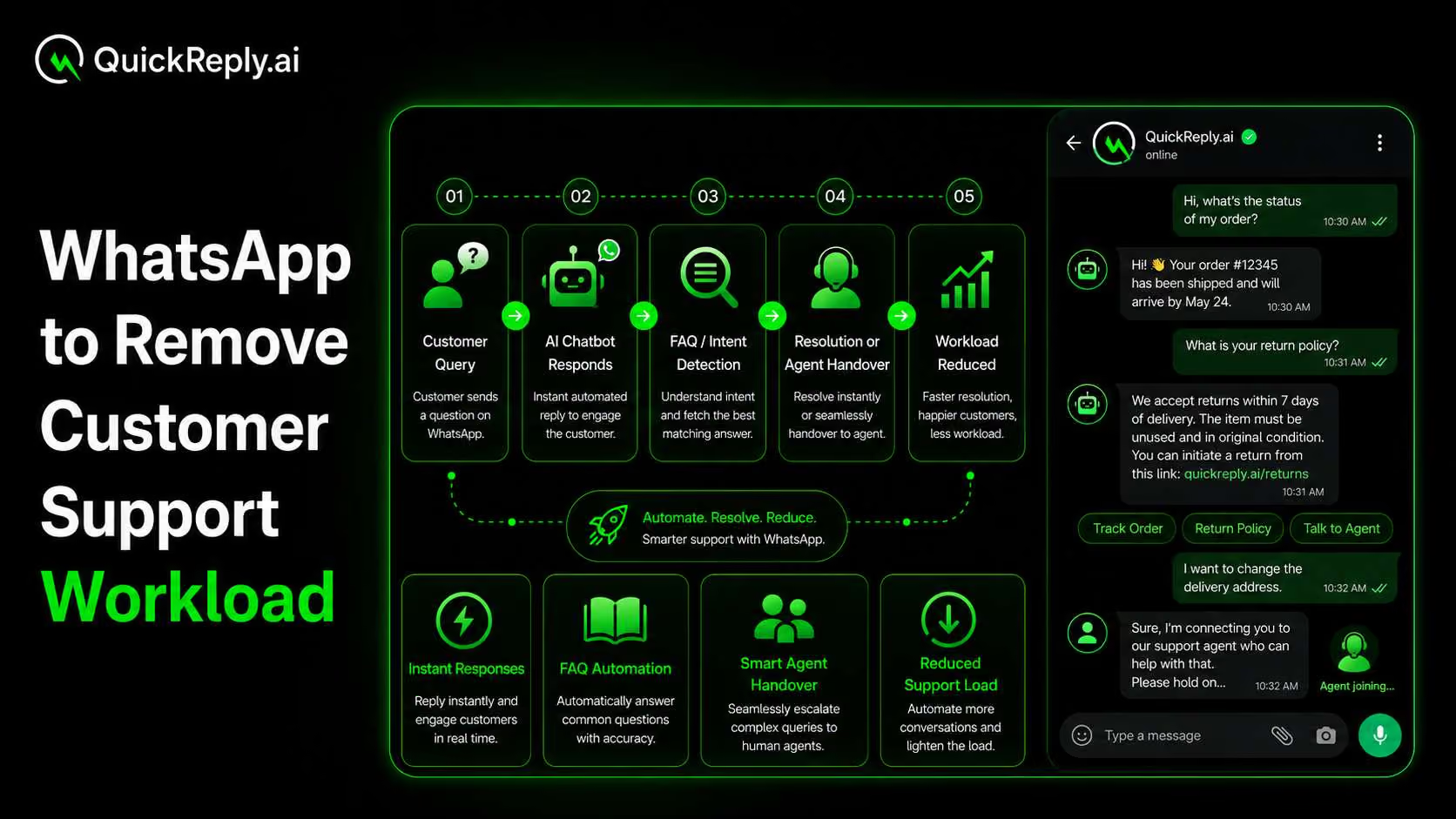
How to Set Up WhatsApp Quick Replies and Boost Customer Engagement

Copied to clipboard!

Answering the same customer questions again and again can quickly take up a large part of a support team's day.

What are your business hours? Where is my order? Do you accept returns? Is this product available? What payment methods do you support?

Typing a new response every time is inefficient, especially when the answer is largely the same.

This is where WhatsApp Quick Replies can help.

Quick Replies in the WhatsApp Business app let businesses save frequently used responses and pull them into customer conversations using simple shortcuts. Instead of writing the same message repeatedly, an agent can select a saved response, personalise it if required, and send it within seconds.

In this guide, we will explain what WhatsApp Quick Replies are, how they work, how to add quick replies on WhatsApp, their benefits, and some ready-to-use WhatsApp Quick Reply examples. We will also look at when growing businesses may need to move beyond manual Quick Replies to WhatsApp chatbot automation.

What are WhatsApp Business Quick Replies?

WhatsApp Quick Replies are pre-saved text messages and media that businesses can reuse to answer common customer questions.

For example, if customers frequently ask about your return policy, you could save a response explaining the policy and assign it a shortcut such as:

/returns

When the question comes up, the support agent can use the shortcut to retrieve the response instead of typing the complete answer again.

Quick Replies can also include media such as images and videos, although WhatsApp notes that media files are not supported in Quick Replies on WhatsApp Web or Desktop. The WhatsApp Business app currently allows businesses to store up to 50 Quick Replies.

One important point to understand is that Quick Replies are not automatically sent whenever a customer asks a question.

An agent still selects the appropriate saved response and sends it. This gives the agent an opportunity to check the customer's question, personalise the response, or make changes before sending it.

If you want responses to be automatically triggered based on customer questions, actions, orders, or other conditions, that falls under WhatsApp automation, which we will cover later in this guide.

How do WhatsApp Quick Replies work?

WhatsApp Quick Replies are built around a simple combination of a saved response and a shortcut.

Suppose customers regularly ask:

How long does delivery take?

Instead of writing the answer every time, you could save:

Shortcut: /delivery

Saved reply:
Hi! We usually dispatch orders within [X] working days. Once your order has been shipped, we'll share the tracking details with you.

When the question comes up:

  1. The agent opens the customer conversation.
  2. The agent types / or enters the relevant shortcut.
  3. WhatsApp displays the corresponding saved Quick Reply.
  4. The agent selects the response.
  5. The message can be reviewed or edited if required.
  6. The agent sends it to the customer.

WhatsApp also creates some default Quick Replies using information from your completed business profile, such as your business hours and address. These can be accessed while replying to a customer.

This makes Quick Replies particularly useful for questions where the core information remains consistent but may occasionally need some personalisation.

For example:

Saved reply:
Hi! Your order has been dispatched and should reach you within [X] days. You can track it here: [tracking link]

Before sending the message, an agent can add the customer's name or replace the placeholder with the actual tracking information.

That small edit keeps the efficiency of a saved response without making the conversation feel completely scripted.

Benefits of using WhatsApp Business Quick Replies

Quick Replies are a simple WhatsApp Business feature, but they can make repetitive customer conversations much easier to manage.

1. Respond faster to repetitive questions

Customer support teams often receive the same questions repeatedly:

  • What are your business hours?
  • Do you offer Cash on Delivery?
  • How do I track my order?
  • What is your return policy?
  • When will my refund arrive?
  • Is this product available?

With WhatsApp Quick Replies, agents do not need to type the complete response every time.

They can pull up a saved response using a shortcut, make any necessary edits, and send it within seconds. This reduces repetitive typing for the agent and helps customers get answers faster.

2. Maintain consistent and accurate responses

When multiple agents handle customer conversations, answers can vary.

One agent may explain a return policy in detail, while another may leave out an important condition. Tone, terminology, links, and next steps may also differ between conversations.

Creating approved Quick Replies for common questions gives the team a reliable starting point and helps maintain consistency across:

  • tone of voice
  • product information
  • policies
  • support instructions
  • links and resources
  • next steps

Agents can still personalise the response whenever the situation requires it.

3. Help agents handle more conversations

Not every customer query needs the same level of attention.

Straightforward questions about business hours, shipping, payment methods, or order tracking can usually be resolved quickly with a saved response.

By reducing the effort required for these routine conversations, agents can spend more of their time on queries that need investigation, judgement, or personalised assistance.

This becomes particularly useful as the volume of WhatsApp conversations grows.

4. Deliver a better customer experience

Customers expect support to be quick, clear, and reliable.

A well-maintained library of Quick Replies helps agents provide relevant information without repeatedly searching for policies or reconstructing responses from memory.

It can also reduce unnecessary back-and-forth by making sure important details, links, and next steps are included from the start.

The result is a more consistent customer experience while still allowing agents to step in personally when a conversation requires more attention.

How to set up Quick Replies in WhatsApp Business

Setting up WhatsApp Business Quick Replies is straightforward. Here are the steps to add a quick reply on WhatsApp:

Step 1: Open WhatsApp Business App

Open the WhatsApp Business app associated with your business account.

Step 2: Go to Quick Replies

Navigate to Tools → Quick Replies

Depending on your device and app version, the placement or wording of the menu may vary slightly.

Step 3: Add a new Quick Reply

Tap the Add (+) option to create a new saved response.

Step 4: Write your message

Enter the response you want your team to reuse. For example,

Hi,

Our customer support team is available Monday to Saturday from 9 AM to 6 PM. Please leave your query here, and we'll be happy to help.

Quick Replies can also include media such as images and videos when supported. WhatsApp currently does not support adding media files to Quick Replies on Web or Desktop.

Step 5: Create a shortcut

Assign an easy-to-remember shortcut.

For the business-hours response above, you could use:

/hours

Try to use straightforward shortcut names that your team can recall without referring to a separate document.

Step 6: Save the Quick Reply

Once the message and shortcut are ready, tap Save.

Your response can now be reused in future customer conversations.

How to send a WhatsApp Quick Reply

There are two convenient ways to access saved Quick Replies.

Using the message field

Open a customer chat and type:

/

Your available Quick Replies will appear. Select the relevant response, edit it if necessary, and send it.

You can also begin typing the shortcut itself to locate the response faster.

Using attachments

WhatsApp also allows Quick Replies to be accessed from the attachment options in supported versions of the Business app.

The response is added to the message field before sending, giving the agent an opportunity to make any necessary changes.

Bonus tip: Complete your WhatsApp Business profile

WhatsApp can create default Quick Replies using information from your business profile. Make sure details such as your business address, business hours, and description are complete and up to date. This makes it easier to quickly share accurate business information with customers during conversations.

WhatsApp Quick Reply examples and templates

The best Quick Replies are the ones your team actually needs every day.

Start by looking at your existing conversations and identifying questions that repeatedly require almost the same response.

Here are some WhatsApp Quick Reply templates you can customise for your business.

1. Greeting message

Shortcut: /welcome

Hi [Name]! Thanks for reaching out to [Business Name]. How can we help you today?

Another option:

Shortcut: /hello

Hello! Welcome to [Business Name]. Let us know what you're looking for and we'll be happy to help.

2. Business hours

Shortcut: /hours

Hi! Our customer support team is available from [opening time] to [closing time], [days]. Please leave your query here and we'll get back to you as soon as possible.

For businesses that accept online orders around the clock:

Shortcut: /storehours

Our online store is open 24/7. Our support team is available from [time] to [time] if you need any assistance with your order.

3. Delayed response

Shortcut: /delay

Thanks for your patience. We're currently experiencing a higher volume of queries, but our team has received your message and will get back to you as soon as possible.

Or:

Shortcut: /checking

Thanks for sharing the details. We're checking this for you and will update you shortly.

4. Return policy

Shortcut: /returns

We accept returns within [X] days of delivery for eligible products. You can view our complete return policy here: [link]. If you'd like help with a specific order, please share your order number.

5. Refund status

Shortcut: /refund

Hi [Name], your refund has been initiated to your original payment method. It may take [X] business days to reflect, depending on your payment provider. Please let us know if you need any further help.

6. Payment methods

Shortcut: /payment

We currently accept [credit/debit cards, UPI, net banking, wallets, COD, etc.]. You can select your preferred payment option during checkout.

7. Payment issue

Shortcut: /paymentissue

Sorry about that. Could you please share the error message or a screenshot of the issue you're seeing during payment? We'll check it for you.

8. Order confirmation

Shortcut: /orderconfirmed

Thank you for your order! Your order has been successfully received and is now being processed. We'll share another update once it has been shipped.

While businesses can use this as a manual Quick Reply when customers ask for confirmation, order-confirmation messages are also a good example of communication that can eventually be automated at higher volumes.

9. Order tracking

Shortcut: /track

Sure! Please share your order number and we'll help you check the latest status.

If the tracking information is already available:

Shortcut: /trackinglink

Your order is on the way. You can track the latest delivery status here: [tracking link].

10. Shipping update

Shortcut: /shipped

Good news! Your order has been shipped and is on its way. You can follow its journey here: [tracking link].

For delivery timelines:

Shortcut: /delivery

We usually dispatch orders within [X] working days. Delivery typically takes another [X–Y] days depending on your location.

11. Product out of stock

Shortcut: /outofstock

This product is currently out of stock. If you'd like, we can help you find a similar option or let you know once it becomes available again.

12. Product back in stock

Shortcut: /backinstock

Good news! The product you were looking for is back in stock. You can view it here: [product link].

13. New product information

Shortcut: /newproduct

We've just launched [Product Name]. You can explore the product, pricing and available variants here: [product link]. Let us know if you'd like help choosing the right option.

14. Asking for a review

Shortcut: /review

Thanks for choosing [Business Name]. We'd love to hear about your experience. If you have a moment, you can leave us a review here: [review link].

15. Closing a conversation

Shortcut: /close

Glad we could help! If you have any other questions, just message us here. Have a great day.

Or:

Shortcut: /anythingelse

Is there anything else we can help you with today?

These templates should be treated as starting points.

A good Quick Reply should reduce repetitive work without making every customer conversation sound identical.

Best practices for WhatsApp Quick Replies

Creating a large list of saved messages is easy. Creating a Quick Reply library that actually improves productivity requires a little more thought.

Here are some practices worth following.

1. Use shortcuts your team can remember

Avoid shortcuts such as:

/rp01
/msg27
/cust2

Unless your team already knows what they mean, these defeat the purpose of Quick Replies.

Use descriptive shortcuts such as:

/returns
/refund
/hours
/track
/payment
/delivery

An agent should be able to guess the shortcut without searching for it.

2. Build Quick Replies around real customer questions

Do not create messages simply because they might be useful someday.

Review actual WhatsApp conversations and identify questions your team repeatedly answers.

For example, if 20% of your conversations involve delivery timelines, /delivery should probably be one of the first Quick Replies you create.

This keeps your saved-response library practical instead of cluttered.

3. Personalise before sending

Quick Replies save time, but they should not make customer support feel mechanical.

Where appropriate, add details such as:

  • customer name
  • product name
  • order number
  • delivery date
  • refund amount
  • relevant link
  • next action

Compare:

Your order has been shipped.

with:

Hi Riya, your Linen Co-ord order has been shipped and should reach you by Friday. You can track it here: [link].

The second response still uses a saved structure, but provides considerably more context.

4. Keep Quick Replies concise

A Quick Reply should solve the immediate question as efficiently as possible.

Avoid turning every response into a large paragraph containing your entire policy.

If a customer asks about returns, explain the important point and link them to the complete return policy if necessary.

5. Keep policies and information updated

A saved response can quickly become harmful if the information inside it is outdated.

Review Quick Replies whenever you change:

  • shipping timelines
  • refund policies
  • return windows
  • business hours
  • payment methods
  • pricing
  • discounts
  • support numbers
  • website URLs

It is useful to periodically audit your complete Quick Reply library and remove responses that are no longer required.

6. Maintain your brand voice

Quick Replies should sound like the rest of your communication.

A premium fashion brand may use a different tone from a healthcare provider, educational institution, automotive dealership, or food-delivery business.

Define how your brand communicates and build Quick Replies around that style.

7. Know when not to use a Quick Reply

Not every query should receive a standard response.

If a customer is:

  • highly dissatisfied
  • reporting an unusual problem
  • discussing a sensitive issue
  • asking something that requires investigation
  • already frustrated by previous responses

the agent should respond according to the specific situation rather than forcing a pre-written answer.

Quick Replies work best for repetitive questions where the underlying answer remains largely consistent.

When businesses should move from Quick Replies to WhatsApp automation

WhatsApp Quick Replies work well when agents need to answer repetitive questions faster.

But they remain manual.

The agent still needs to:

  1. receive the message,
  2. identify what the customer needs,
  3. find the correct response,
  4. make any required changes,
  5. and send it.

For a small number of customer conversations, that may be perfectly adequate.

As message volumes increase, however, businesses may start encountering situations where saved replies alone do not solve the underlying operational problem.

Consider moving from manual Quick Replies towards WhatsApp automation when:

Your team is answering the same FAQs at high volume

If hundreds of customers repeatedly ask about delivery, order tracking, store locations, payment options, eligibility, appointments, or return policies, manually selecting the same response still consumes agent time.

An automated chatbot can handle suitable repetitive queries immediately and transfer the conversation to an agent when human assistance is required.

Customers expect responses outside business hours

Quick Replies help an agent respond faster, but only when someone is available to use them.

Automation can help handle suitable customer queries even when the support team is offline.

Responses depend on customer data

A generic Quick Reply can say:

Please share your order number and we'll check.

A more connected system may be able to use customer and order information to provide contextual assistance around areas such as order tracking, purchases or other account-specific queries.

Multiple agents are handling customer conversations

As customer-support teams expand, businesses need more than saved responses.

They may also need:

  • a shared inbox
  • conversation assignment
  • agent handovers
  • conversation history
  • tags
  • customer context
  • chatbot-to-agent transfers

You need to automate entire customer journeys

Quick Replies are designed to help agents reply to incoming conversations faster.

They are not designed to run complete customer journeys such as:

These use cases require WhatsApp automation rather than manually selected saved responses.

In other words:

Quick Replies reduce repetitive typing. Automation reduces repetitive work.

That is usually the point at which a growing business should start looking beyond the native WhatsApp Business app.

Turn Quick Replies into a productivity booster with QuickReply.ai

WhatsApp Quick Replies are a useful starting point for businesses that want to handle customer conversations faster.

But as customer communication grows, your support team should not have to manually handle every repetitive interaction.

QuickReply.ai helps businesses automate and manage customer conversations across WhatsApp and other messaging channels.

With QuickReply.ai, businesses can use chatbots to welcome customers, answer common questions and collect information before handing a conversation to an agent. Its omnichannel inbox brings customer conversations into a shared workspace and supports the transition between automated and human conversations.

This means your team can use the right approach for different types of customer queries:

  • simple repetitive questions: automate where appropriate
  • structured customer journeys: use chatbot or journey automation
  • complex queries: hand over to a support agent with context
  • customer conversations across channels: manage them from a shared inbox

QuickReply.ai also supports automated journeys for use cases such as customer support, lead qualification, order communication, reminders and ecommerce engagement.

For example, Ayurvedic health and wellness brand Auric used QuickReply.ai to automate customer communication on WhatsApp. Auric automated 70% of its customer support queries using chatbot workflows while also using WhatsApp for campaigns, abandoned cart recovery and COD-to-prepaid journeys. The brand reported a 74.84% cart recovery rate on WhatsApp, 34% CTR and 55% conversion rate on one of its campaign types.

Quick Replies can make agents faster. Combining automation with human support can help businesses reduce the amount of repetitive work that reaches those agents in the first place.

Turn 1 time visitor into repeat customer with WhatsApp marketing

Leverage the untapped growth potential of WhatsApp marketing to acquire and retain customers.

Frequently Asked Questions

What are WhatsApp Quick Replies?

WhatsApp Quick Replies are pre-saved responses that businesses can reuse for messages they frequently send to customers. Agents can retrieve them using shortcuts instead of typing the same response from scratch every time. WhatsApp also allows Quick Replies to include media such as images and videos.

How do I set up Quick Replies in WhatsApp Business?

Open the WhatsApp Business app and go to Tools → Quick Replies. Tap the Add (+) option, enter the message you want to save, assign it an easy-to-remember shortcut such as /returns or /shipping, and save it. 

How do I send a Quick Reply on WhatsApp?

Open a customer conversation and type / in the message field to view your saved Quick Replies. Select the appropriate response, edit or personalise it if required, and then send it to the customer.

How many Quick Replies can I save in WhatsApp Business?

The WhatsApp Business app currently allows businesses to save up to 50 Quick Replies. Since product limits can change, businesses should refer to WhatsApp's latest documentation for the most current information.

Can WhatsApp Quick Replies include images and videos?

Yes. Quick Replies can include media such as images and videos in addition to text. However, WhatsApp notes that media files are not supported in Quick Replies on WhatsApp Web or Desktop

Are WhatsApp Quick Replies sent automatically?

No. Native WhatsApp Quick Replies are saved responses that an agent selects and sends manually. If you want messages to be triggered automatically based on customer questions, actions, orders, or other conditions, you need WhatsApp automation rather than standard Quick Replies.

Are Quick Replies available on the WhatsApp Business Platform?

The /shortcut-based saved Quick Replies discussed in this guide are a WhatsApp Business app feature. The WhatsApp Business Platform supports other messaging capabilities, including interactive reply buttons, but these are different from the saved responses agents access through Quick Replies in the Business app.

When should a business move from Quick Replies to WhatsApp automation?

Quick Replies work well when agents need a faster way to answer recurring questions. Businesses should consider WhatsApp automation when conversation volumes increase, customers expect round-the-clock responses, replies depend on customer or order data, or repetitive journeys such as order updates, lead qualification, reminders, and support FAQs need to run automatically.