How to Use Generative AI for Lead Generation

Copied to clipboard!

Lead generation has changed. Earlier, businesses could depend on website forms, basic landing pages, cold emails, and manual follow-ups to collect leads. That approach still works in some cases, but it is no longer enough for customers who expect quick replies, relevant recommendations, and easy next steps.

Today, a potential lead may come from a website visit, an Instagram ad, a WhatsApp campaign, an RCS message, a Messenger chat, an SMS link, or even a support conversation. The challenge is not only to capture that lead. The real challenge is to understand what the person wants, qualify the intent, respond instantly, and guide the lead toward the right action.

This is where generative AI for lead generation becomes useful.

Generative AI can help businesses create personalized conversations, answer questions, qualify prospects, recommend next steps, and automate follow-ups across multiple channels. Instead of making every customer fill out the same form, businesses can use AI-powered conversations to collect useful information naturally and convert more interest into qualified leads.

For businesses using WhatsApp, Instagram, Messenger, RCS, SMS, and website chat, generative AI can turn everyday customer conversations into a powerful lead generation engine.

What is generative AI for lead generation?

Generative AI for lead generation means using AI to create, personalize, and automate conversations that help businesses attract, qualify, and convert potential customers.

It can write messages, answer FAQs, ask qualification questions, understand intent, summarize customer conversations, recommend products or services, and trigger the right follow-up based on customer behavior.

The biggest difference is that generative AI does not only collect contact details. It helps businesses understand the lead better.

For example, a normal lead form may ask:

  • Name
  • Phone number
  • Email
  • City
  • Requirement

An AI-powered chatbot can go deeper and ask questions based on the customer’s answers.

For a real estate business, the chatbot can ask about location preference, budget, family size, buying timeline, and site visit availability.

For an ecommerce brand, the chatbot can ask about product preference, size, delivery location, payment preference, and urgency.

For an education company, the chatbot can ask about the course of interest, academic background, exam goal, preferred batch, and counselling requirements.

This makes the lead more useful for sales and marketing teams. Instead of receiving a half-filled form, the team receives a clear conversation with context, intent, and the next best action.

Why traditional lead generation is no longer enough

Traditional lead generation depends heavily on forms and manual follow-ups. The problem is that many customers do not want to fill out long forms before they get value. They may want to ask a question first. They may want to compare options. They may want to check pricing, delivery, availability, appointment slots, or product suitability.

If the business does not respond quickly, the lead may move to a competitor.

There are a few common gaps in traditional lead generation:

  • Website forms feel static and one-sided.
  • Manual follow-ups are slow and inconsistent.
  • Sales teams may not know which leads are urgent.
  • Customer questions remain unanswered outside working hours.
  • Leads from WhatsApp, Instagram, website chat, and SMS stay scattered.
  • Generic campaigns do not match the customer’s actual needs.
  • Support conversations are rarely used to identify sales opportunities.

This is why businesses need a more conversational approach to lead generation.

A customer who asks, “Is this available in my city?” is showing intent.

A shopper who asks, “Can I get this delivered tomorrow?” is showing urgency.

A student who asks, “Can I speak to a counsellor today?” is closer to conversion than someone who has only downloaded a brochure.

Generative AI helps businesses identify these signals in real time and take action before the lead goes cold.

7 practical ways to use generative AI for lead generation

1. Capture leads through conversational chatbots

The first and most practical use of generative AI is lead capture through chatbots.

Instead of asking users to fill a static form, businesses can start a conversation through a WhatsApp chatbot, website chatbot, Instagram DM, Messenger chat, or RCS message. The chatbot can ask simple questions, understand the user’s need, and collect the right details step by step.

For example, a website visitor may type the following query in the web chatbot:

“I am looking for a sofa under ₹50,000.”

A generative AI chatbot can respond with:

“Sure. Are you looking for a 2-seater, 3-seater, or sectional sofa? Also, which city should delivery be checked for?”

This feels more natural than a form. It also helps the business collect better information.

For lead generation, conversational chatbots can collect:

  • Name
  • Phone number
  • Email
  • Location
  • Product or service interest
  • Budget
  • Purchase timeline
  • Appointment preference
  • Preferred communication channel

The advantage is simple. The customer gets help, and the business gets a qualified lead.

2. Qualify leads automatically based on intent

Not every lead has the same value. Some people are casually browsing. Some are comparing options. Some are ready to buy. Some need support before making a decision.

Generative AI can help businesses identify intent from the conversation.

For example:

  • “What is the price?” may show early interest.
  • “Can I get this delivered today/tomorrow?” may show urgency.
  • “Can I book a demo today?” may show high buying intent.
  • “Do you offer EMI?” may show payment-related intent.
  • “Is there a consultant available?” may show a need for human assistance.

AI can ask follow-up questions and qualify the lead based on responses.

A real estate chatbot can ask:

  • Which city or area are you interested in?
  • What is your budget?
  • Are you looking for a ready-to-move or an under-construction property?
  • When would you like to schedule a site visit?

An education chatbot can ask:

  • Which course are you interested in?
  • Are you a student, working professional, or parent?
  • When do you want to start?
  • Would you like to speak with a counsellor?

This helps the sales team focus on serious leads instead of manually filtering every inquiry.

3. Personalize responses in real time

Personalization is one of the strongest use cases of generative AI for sales and marketing.

Most businesses already have customer data across campaigns, chats, website activity, orders, and previous interactions. Generative AI can use this context to create more relevant responses.

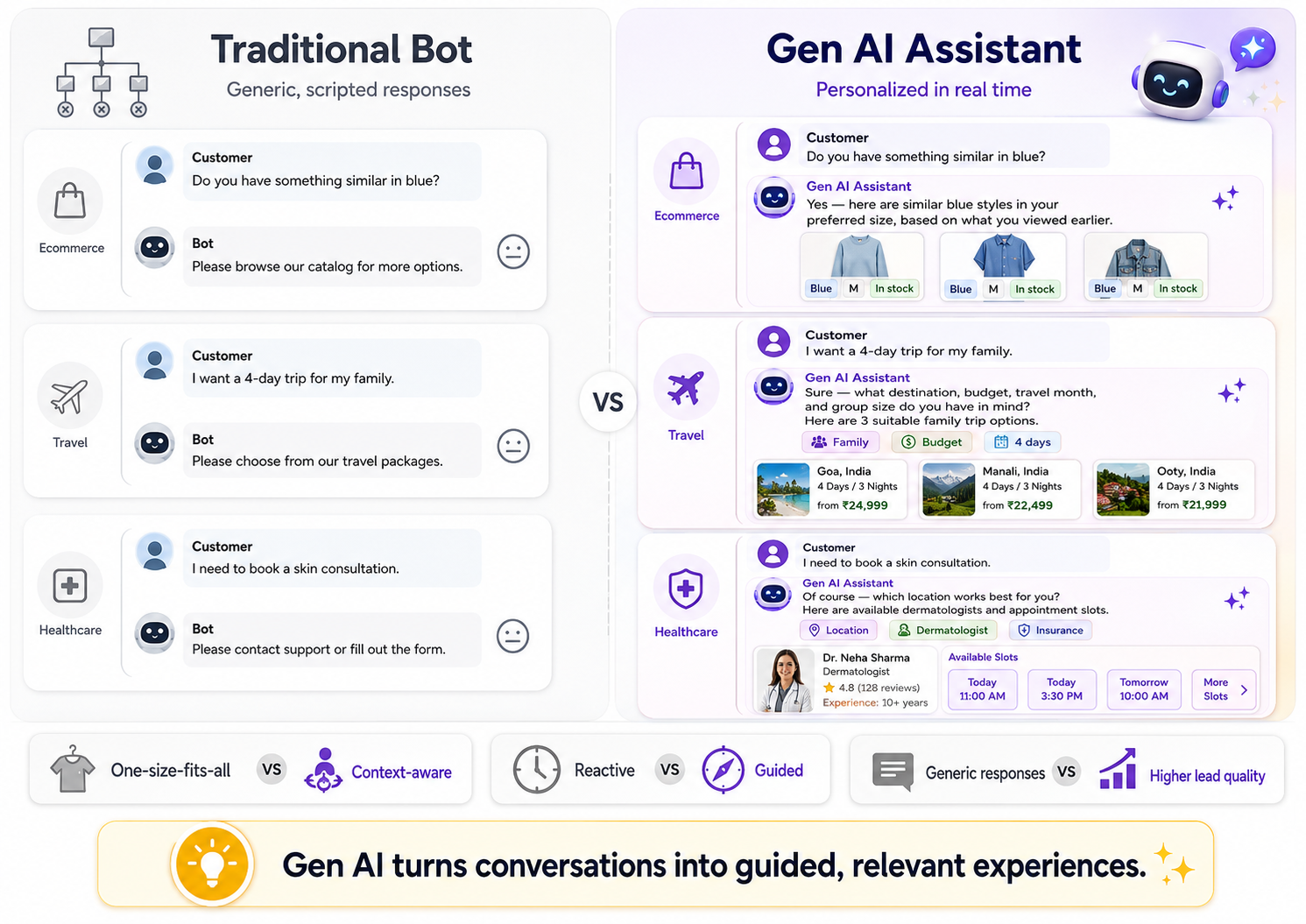
For example, an ecommerce customer asks:

“Do you have something similar in blue?”

Instead of giving a generic reply, an AI chatbot can recommend similar products based on the customer’s previous browsing history, size preference, and availability.

Traditional Chatbot vs. Gen AI Assistant

This type of personalization improves lead quality because the conversation becomes more relevant. The customer does not feel like they are talking to a generic bot. They feel guided.

4. Recommend the Next Best Action Before the Lead Drops

Many leads do not convert because they get stuck at small but important questions.

A visitor may be interested in a product, service, appointment, course, or plan, but they may still want to know:

  • What is the price?
  • Is COD available?
  • How long will delivery take?
  • Can I reschedule an appointment?
  • Is this available in my city?
  • What documents are required?
  • Can I pay through WhatsApp?
  • Can I speak with an expert?
  • Is there a discount available?
  • What happens after I book?

Most websites do have FAQ pages, but expecting the customer to leave the current page and search for answers creates extra friction.

And in lead generation, friction is dangerous.

If the customer does not get the answer quickly, they may drop off, compare another brand, or simply forget why they were interested in the first place.

This is where generative AI becomes more useful than a basic FAQ bot.

A traditional chatbot may only answer the question. A generative AI chatbot can understand the customer’s intent, answer the question, and recommend the next best action.

Customer Intent GenAI Can Answer Next Best Action
A shopper asks, “Is COD available?” Confirms COD availability based on location or order value. Shows eligible products, shares checkout link, or suggests prepaid discount.
A real estate lead asks, “Is this project near metro?” Answers using project location details. Offers to book a site visit or share the brochure.
A patient asks, “Can I book a skin consultation?” Checks service, location, and doctor availability. Suggests appointment slots and confirms booking.
A student asks, “What is the course fee?” Shares fee, duration, batch details, and eligibility. Offers counselling, brochure download, or payment link.
A travel lead asks, “Do you have a 4-day family package?” Asks about budget, destination, travel month, and number of people. Recommends suitable packages and captures lead details.
A logistics customer asks, “Where is my order?” Shares shipment status or expected delivery date. Offers support, rescheduling, or reorder options if relevant.

This is especially useful because customer support and lead generation often overlap.

  • A customer asking about shipping status may also be open to buying again.
  • A patient asking about appointment availability may become a qualified booking lead.
  • A student asking about course fees may need counselling.
  • A shopper asking about exchange policy may be close to placing an order.

Generative AI helps businesses handle these moments without waiting for a human agent every time.

This is where conversational lead generation becomes powerful.

5. Automate follow-ups across channels

Lead generation does not end after the first interaction.

Many customers need reminders, reassurance, and repeated touchpoints before they convert. A customer may have asked for pricing, added a product to the cart, booked an appointment, checked a product multiple times, or clicked on a campaign, but still not taken the next step.

This is where generative AI can help businesses create contextual follow-ups based on what the customer already did.

Instead of sending the same message to every lead, AI can help create follow-ups based on the customer’s behavior, interest, and stage in the journey.

Customer Action Follow-up Message Example
The customer asked for pricing but did not buy. After 12 hours: “Hi Riya, you had asked about our pricing yesterday. Would you like me to share the best plan based on your requirement?”
Shopper added products to cart but did not complete checkout. After 2 hours: “Hi Riya, you left a few items in your cart. They are still available. Would you like to complete your order now?”
Lead booked an appointment but did not show up. After missed slot: “Hi Riya, we noticed you missed your appointment today. Would you like to reschedule it for tomorrow or later this week?”
Visitor checked the same product multiple times but did not ask a question. After 24 hours: “Hi Riya, you were exploring our advanced skincare consultation. Would you like help choosing the right service?”
Student asked about course fees but did not schedule counselling. After 1 day: “Hi Riya, you had asked about the course fee. Would you like to speak with a counsellor and understand the next batch details?”
Customer clicked on a campaign but did not respond. After 6 hours: “Hi Riya, looks like you checked our latest offer. Would you like me to help you pick the right option?”
Customer asked about delivery but did not place the order. After 12 hours: “Hi Riya, you had asked about delivery timelines. Your area is serviceable, and delivery usually takes 2–3 days. Would you like to place the order?”
Lead asked for a demo but did not confirm a slot. After 1 day: “Hi Riya, you had shown interest in a demo. We have slots available this week. Should I help you book one?”

These follow-ups feel more natural because they are connected to what the customer actually did.

Businesses can use WhatsApp, RCS, SMS, Messenger, Instagram, or website chat for these follow-ups, depending on the customer’s preferred channel and opt-in status.

6. Segment leads using conversation data

Most businesses segment leads using basic information such as city, age, campaign source, or website activity.

That is useful, but it does not always show what the customer actually wants.

Conversation data can make segmentation much sharper.

When customers chat with a business, they reveal intent. They ask about price, delivery, availability, appointments, discounts, product details, payment options, documents, or support. Generative AI can read these conversations and help group leads based on interest, urgency, and readiness to buy.

This helps businesses send more relevant campaigns instead of sending the same message to every lead.

Lead Segment What the Customer Usually Says or Does Campaign or Follow-up You Can Send
High-intent leads Asked about price, availability, booking, demo, or payment. Send a payment link, booking link, demo slot, or sales follow-up.
Price-sensitive leads Asked for discounts, offers, EMI, COD, or lower-priced options. Send a limited-time offer, bundle deal, EMI option, or discount reminder.
Appointment-ready leads Asked about doctor, counsellor, salon, clinic, or consultation availability. Send available slots, appointment reminders, or rescheduling options.
Product-specific leads Asked about a specific product, size, variant, service, course, or property. Send product recommendations, comparison guides, brochures, or related options.
Location-based leads Asked whether the service is available in their city, area, or pin code. Send location-specific availability, store details, service area updates, or nearby options.
Repeat visitors Came back to the website or chat multiple times without converting. Send a reminder, helpful guide, offer, or human agent follow-up.
Support-led sales opportunities Asked about delivery, exchange, payment, warranty, or order status. Resolve the query and then send a reorder, upsell, cross-sell, or loyalty campaign.
Leads needing human assistance Asked complex questions or showed confusion in the chat. Route to a sales agent, counsellor, support executive, or relationship manager.
Offer-interested leads Asked about discounts, festival offers, coupon codes, or deals. Send offer-based campaigns, urgency reminders, or deal expiry messages.
Delivery or payment-focused leads Asked about shipping time, COD, payment link, refund, or invoice. Send payment assistance, fast delivery campaigns, COD confirmation, or checkout reminders.

This kind of segmentation improves both lead generation and campaign performance.

For example, customers who asked about discounts can get a limited-time offer. Customers who asked about delivery can get a fast-shipping campaign. Customers who abandoned checkout can get a cart reminder. Customers who completed a purchase can get an upsell or cross-sell message. Customers who asked about appointments can get available slots.

Generative AI helps businesses understand what the customer is trying to do, not just where the customer came from. And once you understand intent, your campaigns become more relevant, timely, and conversion-focused. 

7. Help sales and support teams prioritize better

Generative AI does not need to replace human teams. It should help them work better.

Sales and support agents often spend a lot of time reading long conversations, asking repeated questions, and figuring out which leads need urgent attention. AI can reduce this effort by summarizing conversations and tagging lead intent.

For example, the system can show:

  • Customer wants a demo this week.
  • Customer is interested in the Plus plan.
  • Customer asked for delivery by Friday.
  • Customer wants a doctor appointment tomorrow.
  • Customer is comparing two products.
  • Customer asked for pricing and payment options.
  • Customer needs agent support before purchase.

This gives the team context before they enter the chat.

The sales team can prioritize hot leads. The support team can handle complex cases. Marketing teams can understand what customers are asking before they convert.

This is especially useful for businesses that get leads from multiple channels. Without AI, WhatsApp leads, Instagram leads, website chat leads, and SMS responses can become difficult to manage. With AI-assisted summaries, tagging, and routing, teams can respond faster and with better context.

Generative AI lead generation use cases by industry

Generative AI can support lead generation across many industries. The use case may change, but the core idea remains the same: understand the customer, qualify intent, and guide the person toward the next action.

Industry How generative AI can support lead generation
Ecommerce
  • Product discovery
  • Cart recovery
  • Personalized offers
  • Shipping FAQs
  • Payment links
  • Upsell and cross-sell
Education
  • Course counselling
  • Eligibility checks
  • Fee queries
  • Demo class booking
  • Application follow-ups
Healthcare
  • Appointment booking
  • Department routing
  • Patient FAQs
  • Reminders
  • Follow-up consultations
Real estate
  • Budget qualification
  • Project recommendations
  • Brochure sharing
  • Site visit booking
Travel
  • Package discovery
  • Itinerary questions
  • Booking support
  • Payment reminders
Automotive
  • Test drive booking
  • Model comparison
  • Dealership appointment scheduling
  • Offer sharing
BFSI
  • Product eligibility checks
  • Document guidance
  • Callback booking
  • Policy or plan recommendations
Retail
  • Store visit assistance
  • Offer campaigns
  • Product availability checks
  • Loyalty-based promotions

The same workflow can run across different channels. A lead may start from an Instagram ad, continue on WhatsApp, receive an RCS follow-up, and later get an SMS reminder. The business does not need to treat every channel separately if the lead journey is connected.

What to look for in AI tools for lead generation

There are many AI tools for lead generation, but not every tool solves the same problem. Some tools focus on writing emails. Some focus on lead scoring. Some focus on CRM enrichment. Some focus on chatbots.

For businesses that depend on customer conversations, the right tool should support the complete journey from capture to conversion.

Here are the key things to look for:

  • Omnichannel support across WhatsApp, Instagram, Messenger, RCS, SMS, and website chat
  • AI chatbot and rule-based flow support
  • Lead qualification workflows
  • CRM and ecommerce integrations
  • Customer segmentation based on behavior and conversation data
  • Bulk broadcast and campaign automation
  • Appointment booking and reminder flows
  • FAQ automation
  • Payment link support
  • Order and shipping update support
  • Agent handoff for complex or high-intent leads
  • Conversation history and customer context
  • Analytics and reporting
  • Data privacy and access controls
  • Ability to customize workflows for different industries

The best AI tools for lead generation should not only generate messages. They should help businesses manage the full lead journey.

How to build a generative AI lead generation workflow

A good AI lead generation workflow starts with clarity. Businesses should not begin by asking, “How do we use AI?” They should begin by asking, “Where are leads dropping today?”

Here is a simple workflow to follow.

Step 1: Define the lead generation goal

Start with the business goal.

For example:

  • Capture more website visitors
  • Qualify inbound leads
  • Convert ad clicks into conversations
  • Book appointments
  • Recover abandoned carts
  • Increase demo requests
  • Improve repeat purchases
  • Reduce manual lead filtering

The goal will decide the chatbot flow, questions, channel, and follow-up logic.

Step 2: Choose the entry channels

Identify where leads currently come from.

Common entry points include:

  • WhatsApp click-to-chat ads
  • Instagram DMs
  • Website chatbot
  • Messenger
  • RCS campaigns
  • SMS links
  • QR codes
  • Landing pages
  • Product pages
  • Customer support chats

For many businesses, the customer journey does not happen on one channel. A customer may discover a product on Instagram, ask questions on WhatsApp, and complete payment through a link. The lead generation workflow should support this movement.

Step 3: Map qualification questions

The chatbot should ask only the questions needed to move the lead forward.

Examples:

  • What are you looking for?
  • Which city are you in?
  • What is your budget?
  • When do you want to buy?
  • Which product or service are you interested in?
  • Would you like to book a slot?
  • Do you want to speak with an expert?

Avoid asking too many questions too early. Give value first, then collect information.

Step 4: Create AI responses and fallback paths

Generative AI should be trained or configured to answer common questions accurately.

This can include:

  • Product details
  • Pricing
  • Delivery timelines
  • Return policy
  • Appointment availability
  • Course details
  • Service availability
  • Documents required
  • Payment process
  • Human support rules

Also define fallback paths. If the chatbot does not understand something, the conversation should move to an agent or ask a clarifying question.

Step 5: Set follow-up rules

Follow-ups should be based on behavior.

For example:

  • If payment is not completed, send a reminder.
  • If appointment is not booked, offer available slots.
  • If the customer asks about price, send a relevant offer.
  • If cart is abandoned, send a recovery message.
  • If the lead is high-intent, assign it to a sales agent.
  • If the lead asks a repeated support question, trigger FAQ automation.

This keeps the journey active without making the customer feel spammed.

Step 6: Measure and improve

Track how the workflow performs.

Important metrics include:

  • Number of leads captured
  • Lead qualification rate
  • Chatbot completion rate
  • Drop-off points
  • Appointment bookings
  • Payment completions
  • Agent handoff rate
  • Response time
  • Conversion rate
  • Revenue from automated campaigns

Use these insights to improve questions, messages, segmentation, and follow-ups.

Common mistakes to avoid when using generative AI for lead generation

Generative AI can improve lead generation, but only when used with the right strategy. Here are some mistakes businesses should avoid.

1. Using AI only for generic copywriting

AI can write messages, but lead generation needs more than message generation. The real value comes from understanding intent, qualifying leads, and moving customers toward the next step.

2. Asking too many questions too early

A chatbot should not feel like a long form. Ask only what is needed. Give helpful answers before asking for more information.

3. Ignoring human handoff

Not every conversation should be automated fully. High-intent, complex, or sensitive queries should move to a human agent with full context.

4. Treating every lead the same

A customer who wants to buy today should not receive the same journey as someone casually exploring. Use AI to segment and prioritize.

5. Not connecting AI with CRM or sales workflows

If qualified leads do not reach the right team, the workflow will fail. AI should connect with the tools your sales, marketing, and support teams already use.

6. Sending irrelevant bulk campaigns

Bulk messaging works only when the message is relevant. Segment leads based on intent, behavior, and conversation history before broadcasting.

7. Not measuring lead quality

More leads are not always better. Track conversion, qualification, appointment bookings, payment completions, and revenue impact.

How QuickReply.ai helps businesses use generative AI for lead generation

QuickReply.ai helps businesses create AI-powered lead generation journeys across WhatsApp, Instagram, Messenger, RCS, SMS, and website chat.

Businesses can use QuickReply.ai to capture leads through chatbots, qualify customers through automated questions, answer FAQs, send personalized campaigns, recover abandoned carts, book appointments, share payment links, and hand over high-intent conversations to agents.

For ecommerce brands, QuickReply.ai can support product discovery, cart recovery, shipping updates, payment reminders, and repeat purchase campaigns.

For education businesses, QuickReply.ai can help qualify students, answer course-related questions, book counselling sessions, and send follow-up reminders.

For healthcare businesses, QuickReply.ai can support appointment booking, patient FAQs, reminders, and department routing.

For real estate, travel, retail, and other industries, QuickReply.ai can help businesses convert ad clicks, website visitors, and chat inquiries into qualified leads.

The main benefit is that marketing, sales, and support conversations stay interconnected. QuickReply.ai gives businesses one connected way to engage leads across channels and guide them from interest to action.

Turn 1 time visitor into repeat customer with WhatsApp marketing

Leverage the untapped growth potential of WhatsApp marketing to acquire and retain customers.

Frequently Asked Questions

What is generative AI for lead generation?

Generative AI for lead generation uses AI to create personalized conversations, qualify prospects, answer questions, recommend next steps, and automate follow-ups across different customer communication channels.

How does generative AI improve lead quality?

Generative AI improves lead quality by asking relevant questions, understanding customer intent, segmenting leads, and helping sales teams focus on prospects who are more likely to convert.

Can generative AI replace sales teams?

No. Generative AI supports sales teams by handling repetitive tasks such as FAQs, qualification, lead capture, and follow-ups. Human teams are still important for complex queries, negotiations, and relationship-building.

What are the best AI tools for lead generation?

The best AI tools for lead generation should support automation, personalization, chatbot workflows, CRM integration, omnichannel messaging, analytics, and human handoff.

How does WhatsApp help in AI lead generation?

WhatsApp helps businesses engage leads in a familiar messaging environment. With a WhatsApp chatbot, businesses can qualify leads, answer FAQs, share catalogs, book appointments, send payment links, and follow up automatically.

Can generative AI be used for customer support and lead generation together?

Yes. Many support conversations also contain buying intent. Generative AI can answer support questions while identifying upsell, cross-sell, appointment, renewal, or callback opportunities.

Which channels can businesses use for AI-powered lead generation?

Businesses can use WhatsApp, Instagram, Messenger, RCS, SMS, and website chat for AI-powered lead generation. The best channel depends on where the customer starts the conversation and how they prefer to engage.