You plan the campaign. You get the audience right, the creative right, the timing right. None of it matters if the message never lands.
We recently asked a room full of marketers what their average WhatsApp delivery rate looks like, not their best campaign, their normal one. 53% said only 40-60% of their messages get delivered. Only 1% said they consistently cross 90%.
That 1% isn't luck. They've fixed a few specific things, and you can too.
Here's the reassuring part: the biggest cause — the healthy-ecosystem cap — is temporary. That same user becomes reachable again once their 24-hour quota resets.
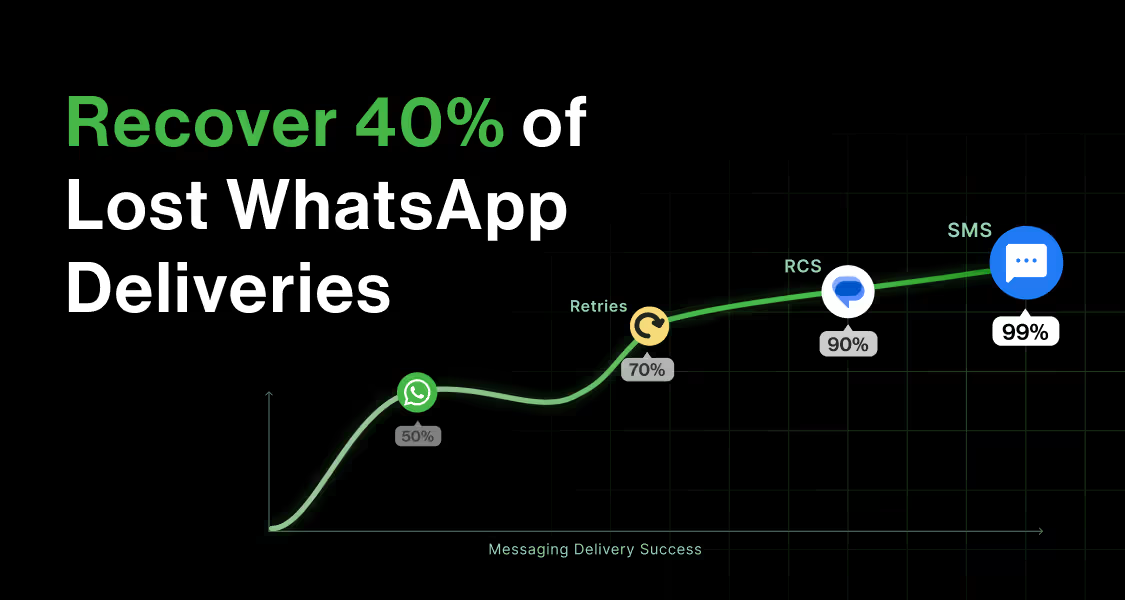
These three fixes recover a meaningful share of failures. But all three are still trying to deliver on WhatsApp, and some users simply won't be reachable there that day, no matter how many times you retry.
This is where RCS and SMS come in, not as occasional backups, but as part of one connected delivery system alongside WhatsApp.
No channel has to go "first" by default, brands sequence this differently based on their audience. What matters is that a single failure never becomes the end of the story for a contact.
A pet nutrition D2C brand ran a festive broadcast exactly this way, WhatsApp, RCS and SMS working together as one system instead of three separate campaigns.
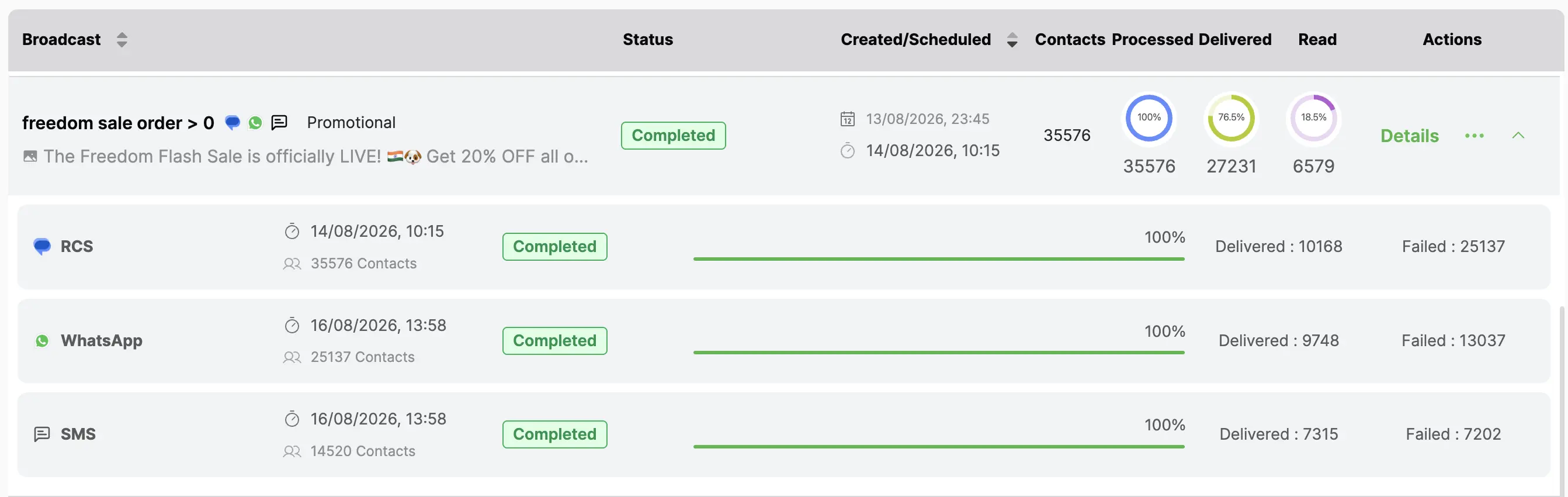
The broadcast was sent to 35,576 contacts. Here's how that played out:

The number to sit with is 17,059. On a single-channel send, those are the contacts who'd have received nothing at all, no message, no chance to buy. Instead, they got reached, and a meaningful share of the ₹2.1L in revenue came directly from that recovery.
The takeaway isn't about which channel worked hardest. It's that stopping at one channel is what leaves revenue like this on the table.
Retries, utility fallback, template variants, and instant channel fallback are all just settings you turn on, not a rebuild of your campaigns. But configuring all of this by hand, broadcast after broadcast, across three channels, is exactly the kind of work that eats a marketing team's week right when festive season needs them fastest.
This is the gap QuickReply.ai closes. WhatsApp, RCS, and SMS run as a single broadcast on our platform, with fallback triggering automatically for each contact the moment one channel fails. The result: the 40-60% delivery rate most brands live with becomes the exception, not the average.
Want to see this on your own audience? Book a demo.
Tool and strategies modern teams need to help their companies grow.
Leverage the untapped growth potential of WhatsApp marketing to acquire and retain customers.