WhatsApp Business API Pricing in 2026: A Complete Guide to Per-Message Pricing

Copied to clipboard!

WhatsApp Business API pricing has changed significantly over the years.

If you remember WhatsApp charging businesses for 24-hour “conversations”, with separate rates for user-initiated and business-initiated conversations, that pricing model is no longer applicable.

Since July 1, 2025, Meta has charged businesses using the WhatsApp Business Platform primarily on a per-message basis. Businesses are charged when a message is delivered, not simply when it is sent. The amount charged depends on the recipient’s market and the category of the message.

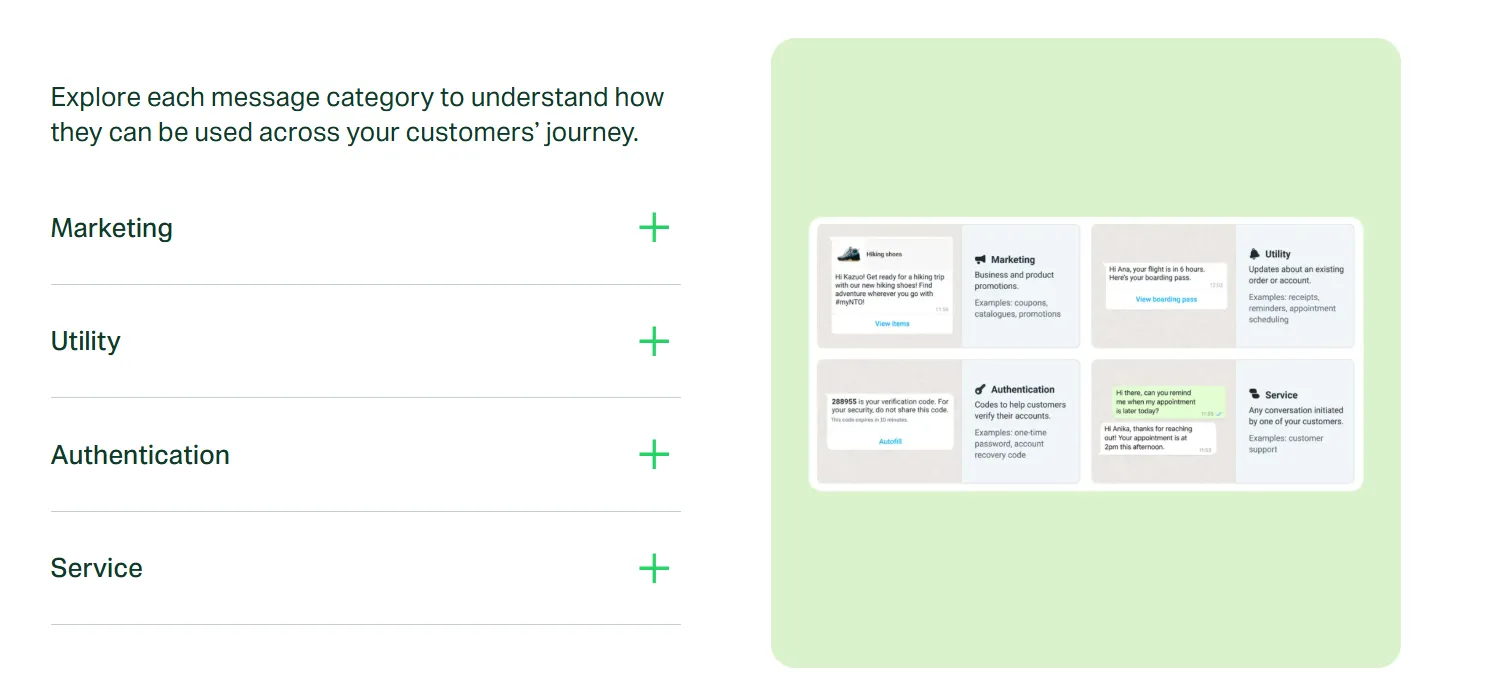
There are currently four WhatsApp message categories:

  • Marketing
  • Utility
  • Authentication
  • Service

There are also important exceptions, including free service messages, free utility messages sent in response to users, volume-based pricing for certain categories and a 72-hour free-entry-point window.

And another major change is coming.

From October 1, 2026, Meta will begin charging for all service messages and for utility messages sent within an open 24-hour customer service window.

This guide explains how WhatsApp Business API pricing works today, what businesses actually pay for, which messages can currently be sent for free and what is changing next.

Note: Pricing information in this article is verified against current official Meta and WhatsApp documentation.

How Does WhatsApp Business API Pricing Work in 2026?

The current WhatsApp Business Platform pricing model is much simpler to understand if you start with one basic principle:

Meta charges primarily per delivered message.

Meta does not charge simply because your system attempted to send a message. The message needs to be delivered to the WhatsApp user for the applicable message fee to be charged.

The amount you pay can depend on:

  1. The recipient’s market
  2. The category of the message
  3. The number of eligible Utility or Authentication messages your business sends
  4. Whether a free customer-service or free-entry-point window applies

Meta publishes different rates for different market-category combinations. For example, a Marketing message delivered to a user in India can have a different rate from a Marketing message delivered to a user in the UAE or the United Kingdom.

WhatsApp Has Moved From Conversation-Based to Per-Message Pricing

WhatsApp previously charged businesses using a conversation-based pricing model, where charges were associated with 24-hour conversation sessions.

That model is no longer applicable. Since July 1, 2025, Meta has used per-message pricing for the WhatsApp Business Platform, where applicable charges are based on delivered messages, their category and the recipient's market.

The 24-hour customer service window still exists, but it no longer represents a billable “conversation” under WhatsApp’s current pricing model. 

What Are the Four WhatsApp Message Categories?

Four Categories of WhatsApp Business Messages
WhatsApp Messeging Categories

WhatsApp Business Platform messages fall into four main categories:

Category Common Use Cases Current Meta Pricing
Marketing Offers, promotions, product recommendations, cart recovery, re-engagement Charged per delivered message
Utility Order confirmations, shipping updates, transaction and account updates Usually charged, but currently free when sent in response to users within the customer service window
Authentication OTPs and identity verification Charged per delivered message
Service Replies to customer-initiated conversations Currently free within the 24-hour customer service window

Meta officially defines these four categories as Marketing, Utility, Authentication and Service.

Let us understand each category in more detail.

Marketing Messages

Marketing messages are used when the primary purpose of the communication is promotional, commercial or designed to encourage a customer to take an action.

Common examples include:

Meta specifically includes use cases such as offers, promotions, related product suggestions and abandoned-cart reminders under Marketing messages.

Marketing messages are charged on a per-delivered-message basis unless they qualify for a free-entry-point exception that we discuss later in this guide.

Utility Messages

Utility messages are generally non-promotional messages related to a specific transaction, request or action taken by a customer.

For example:

  • Order confirmation
  • Order cancellation
  • Shipping update
  • Delivery update
  • Payment reminder
  • Transaction update
  • Account alert
  • Subscription update
  • Appointment update
  • Post-purchase feedback request

Meta describes Utility messages as messages typically triggered by a user action, such as placing an order or making a payment. They must be non-promotional and generally relate to something specific to, requested by or important to the user.

Utility messages are particularly important for ecommerce businesses because order and delivery automations often fall under this category.

However, adding promotional content to a transactional message can affect how Meta categorises the template. Businesses should therefore avoid attempting to classify promotional communication as Utility simply to obtain a lower messaging rate. Meta can review and change template categorisation.

Authentication Messages

Authentication messages are designed primarily for identity verification using one-time passwords or OTPs.

They can be used for:

  • Account registration
  • Login verification
  • Account recovery
  • Transaction verification
  • Purchase authentication
  • Other identity-verification workflows

Meta provides specific Authentication templates and features such as one-tap, autofill and zero-tap authentication experiences.

Authentication messages are charged per delivered message, subject to applicable market rates and volume tiers.

What Is the Authentication International Rate?

You may also see Authentication International listed separately in Meta's WhatsApp pricing rate card.

Authentication International is not a fifth WhatsApp message category. WhatsApp still has four primary message categories: Marketing, Utility, Authentication, and Service. 

Authentication International is a separate pricing treatment that can apply to qualifying Authentication messages based on Meta's applicable criteria.

This distinction is particularly important for businesses using WhatsApp for OTPs and identity verification across markets because the Authentication International rate can be significantly different from the standard Authentication rate.

For India, Meta's current rate card shows:

  • Standard Authentication list rate: ₹0.1150 per delivered message
  • Authentication International list rate: ₹2.4971 per delivered message

Meta also provides volume tiers for Authentication International messages, allowing the applicable rate to decrease as eligible monthly message volume increases.

Authentication International Rates for India

Messages per month Rate per delivered message Discount vs. list rate
0–750,000 ₹2.4971 0%
750,001–15,000,000 ₹2.3473 -6%
15,000,001–20,000,000 ₹2.1974 -12%
20,000,001–50,000,000 ₹2.0476 -18%
50,000,001–100,000,000 ₹1.8978 -24%
100,000,001+ ₹1.7480 -30%

Businesses using Authentication templates internationally should therefore check whether the standard Authentication rate or the Authentication International rate applies to their specific messaging setup instead of assuming all OTP messages have the same price.

Service Messages

Service messages are messages sent by a business in response to a customer who has initiated a conversation.

For example:

Customer: Is this product available in size M?

Business: Yes, size M is currently available.

The business response can be considered a Service message when it is sent during the open customer service window.

Meta allows businesses to use Service messages for use cases including customer support, product queries, order assistance, payments, bookings and other customer-initiated interactions.

According to current Meta messaging charges, Service messages sent during the 24-hour customer service window are free. However, this will change from October 1, 2026.

How Does the 24-Hour Customer Service Window Work?

The 24-hour customer service window continues to be an important concept within the WhatsApp Business Platform, even though WhatsApp no longer uses conversation-based pricing.

When a customer messages your business, a 24-hour customer service window opens.

During this window, your business can respond with free-form Service messages instead of being limited to approved message templates.

Every new message received from the customer resets the 24-hour window.

For example:

A customer messages your business at 2 PM on Monday.

Your customer service window remains open until 2 PM on Tuesday.

If the customer sends another message at 10 AM on Tuesday, the window resets and stays open until 10 AM on Wednesday.

Outside this 24-hour window, the WhatsApp Business Platform generally requires businesses to initiate communication using approved Message Templates.

Are Messages Inside the 24-Hour Window Free?

Yes, some of them are.

Meta currently does not charge for:

  • Service messages sent within the 24-hour customer service window
  • Utility messages sent in response to users

Marketing and Authentication messages do not automatically become free simply because the 24-hour window is open.

This distinction is important.

The old assumption that “once the customer replies, everything for the next 24 hours is effectively covered by one conversation charge” is no longer valid.

WhatsApp now looks at individual messages and their categories.

Major WhatsApp Pricing Update From October 1, 2026

Businesses using WhatsApp for customer service need to pay particular attention to the next pricing change.

Meta has announced that from October 1, 2026, it will charge on a per-message basis for all Service messages.

Meta is also ending the current free treatment of Utility messages sent in response to users within an open 24-hour customer service window. These messages will also become chargeable per delivered message.

Therefore:

Until September 30, 2026

Within an open customer service window:

  • Service messages: Free
  • Qualifying Utility messages sent in response to users: Free
  • Marketing messages: Charged
  • Authentication messages: Charged

From October 1, 2026

Within the same customer service window:

  • Service messages: Charged per delivered message
  • Utility messages: Charged per delivered message
  • Marketing messages: Charged per delivered message
  • Authentication messages: Charged per delivered message

Meta says Service-message rates will be the same as the applicable Utility and Authentication message rates for that market.

This means businesses running support bots, AI agents, live-agent inboxes or other high-volume customer-service operations should account for the number of outbound replies they generate, not only their promotional template volume.

What Does This Mean for the Current ₹0 Service Rate?

Meta's India pricing page currently displays a ₹0.0000 Service message rate because Service messages within an open customer service window are free under the pricing rules applicable as of August 2026.

Businesses should not interpret ₹0.0000 as a permanent Service message rate.

Meta has announced that from October 1, 2026, Service messages will become chargeable on a per-message basis. Utility messages sent in response to users within an open 24-hour customer service window will also become chargeable.

Therefore, businesses forecasting WhatsApp customer-support costs beyond September 2026 should account for this upcoming change rather than relying on the current ₹0 Service rate.

The 72-hour Free Entry Point window is not affected by this October 1, 2026 pricing change and will continue to remain free for qualifying conversations. 

When Are WhatsApp Business API Messages Free?

Per-message pricing does not mean every message sent through the WhatsApp Business Platform is necessarily chargeable.

There are currently two important cases to understand.

1. Service and In-Window Utility Messages

As explained above, until October 1, 2026, Meta currently does not charge for Service messages or qualifying Utility messages sent in response to users during the 24-hour customer service window.

This exemption ends on October 1, 2026.

2. The 72-Hour Free Entry Point Window

A separate free-entry-point mechanism exists for conversations originating from certain Meta properties.

When a customer messages a business through:

  • An Ad that Clicks to WhatsApp, or
  • A Facebook Page call-to-action button

Meta provides a 72-hour free-entry-point window.

During this period, Meta currently does not charge for messages across message categories.

Importantly, Meta has confirmed that this 72-hour free-entry-point window will remain free even after the October 1, 2026 pricing update.

For businesses using Click-to-WhatsApp ads, this free-entry window can reduce messaging costs because messages sent during the qualifying 72-hour period are not charged by Meta. 

WhatsApp Utility Volume Tiers in India 

Meta's current India rate card provides the following Utility message tiers:

Monthly Utility messages Rate per delivered message Discount vs. list rate
0–25,000,000 ₹0.1150 0%
25,000,001–50,000,000 ₹0.1081 -6%
50,000,001–100,000,000 ₹0.1012 -12%
100,000,001–200,000,000 ₹0.0943 -18%
200,000,001–300,000,000 ₹0.0874 -24%
300,000,001+ ₹0.0805 -30%

WhatsApp Authentication Volume Tiers in India

For standard Authentication messages, Meta currently shows:

Monthly Authentication messages Rate per delivered message Discount vs. list rate
0–750,000 ₹0.1150 0%
750,001–15,000,000 ₹0.1081 -6%
15,000,001–20,000,000 ₹0.1012 -12%
20,000,001–50,000,000 ₹0.0943 -18%
50,000,001–100,000,000 ₹0.0874 -24%
100,000,001+ ₹0.0805 -30%

Meta applies these rates incrementally by tier. Reaching a higher volume tier does not mean that every message sent earlier in the month is retroactively charged at the lower rate. Only the messages falling within a particular tier receive that tier's applicable rate.

Also note that the thresholds for Utility and Authentication messages are different. A business therefore should not use the Authentication thresholds to estimate Utility messaging costs, or vice versa.

How Much Does WhatsApp Business API Cost?

There is no single universal price for a WhatsApp Business API message.

Meta's messaging cost depends primarily on:

Number of delivered messages × applicable category/market rate

For Utility and Authentication traffic, volume tiers can further affect the final rate.

For example:

If you deliver 50,000 Marketing messages to customers in India, the Meta component of your messaging cost would broadly be:

50,000 delivered Marketing messages × applicable India Marketing rate

If only 47,000 of those messages are actually delivered, Meta's pricing documentation states that charges are based on delivered messages rather than merely attempted sends.

WhatsApp Business API Pricing in India

If you’re messaging customers in India, your WhatsApp Business Platform charges are calculated using Meta’s India-specific rates in INR.

Currently, Meta lists the following rates for messages delivered to users in India:

Message pricing type Rate per delivered message
Marketing ₹0.8631
Utility ₹0.1150
Authentication ₹0.1150
Authentication International ₹2.4971
Service ₹0.0000 currently

These are Meta's messaging rates, not necessarily the total amount a business may pay to a WhatsApp platform, BSP or Solution Provider.

The ₹0.0000 Service rate also requires an important qualification: Service messages are currently free, but Meta has announced that this will change from October 1, 2026.

Meta charges based on delivered messages and states that rates vary by the recipient's market and message category.

Example: Cost of a Marketing Campaign in India

If 90,000 Marketing messages are delivered to users in India, at the current rate of ₹0.8631 per delivered message, the Meta messaging cost would be:

90,000 × ₹0.8631 = ₹77,679

Meta charges based on delivered messages, so unsuccessful delivery attempts are not included in this calculation.

That is enough.

I would remove the longer setup about sending to 100,000 customers and 90,000 being delivered. It adds unnecessary detail.

Meta Messaging Fees vs Platform Or BSP Fees

The rates mentioned above are Meta’s WhatsApp Business Platform messaging charges.

If you use a BSP, Solution Provider or WhatsApp software platform, you may also pay separate charges for the platform or services you use. Depending on the provider, these may include subscription, agent, automation, implementation or other platform fees.

So when calculating your total WhatsApp Business API cost, consider both:

  • Meta’s messaging charges
  • Your WhatsApp platform or provider charges

These are separate costs and can vary depending on the provider you choose.

How to Reduce WhatsApp Business API Messaging Costs

With per-message pricing, messaging efficiency matters more than before.

The goal is not simply to send fewer messages. It is to avoid unnecessary communication while making sure the messages you do send are relevant and useful.

1. Segment Marketing Campaigns Carefully

Every delivered Marketing message can add to your messaging cost.

Instead of broadcasting the same campaign to your entire database, use customer behaviour, purchase history, engagement, interests and lifecycle stage to identify the audience most likely to respond.

Better targeting can help you reduce unnecessary sends while improving campaign efficiency.

2. Avoid Unnecessary Follow-Up Messages

Under per-message pricing, splitting one communication into several unnecessary outbound messages can increase costs.

This becomes even more important from October 1, 2026, when Service messages also become chargeable.

Review your chatbot, automation and agent workflows to identify places where multiple short messages can reasonably be combined into one clear response.

3. Keep Utility Messages Truly Transactional

Utility messages should remain non-promotional and relate to a specific customer action, request or transaction.

Adding discounts, offers, upsells or promotional calls-to-action to a transactional template can affect its categorisation.

Keeping Utility communication genuinely transactional helps you maintain correct message categorisation and avoid unnecessary pricing implications.

4. Use Volume Tiers Where Applicable

Businesses sending large volumes of Utility or Authentication messages should understand Meta's volume tiers instead of forecasting every message at the base list rate.

Meta specifically provides more attractive pricing as eligible Utility and Authentication volume grows.

5. Track Delivered Messages and Their Outcomes

Since Meta charges applicable messages when they are delivered, your reporting should go beyond the number of messages attempted. Track metrics such as:

  • Messages delivered
  • Message category
  • Recipient market
  • Applicable pricing tier
  • Conversions or revenue generated
  • Customer-service outcomes

This gives you a clearer picture of what you are spending and what each type of WhatsApp communication is delivering in return.

6. Make Use of the 72-Hour Free Entry Point Window

If Click-to-WhatsApp ads are part of your acquisition strategy, account for the 72-hour Free Entry Point window in your messaging journeys.

Once a customer initiates a qualifying conversation through an Ad that Clicks to WhatsApp or a Facebook Page call-to-action button, messages sent during the qualifying 72-hour window remain free of Meta messaging charges.

Designing the follow-up journey carefully can help you make better use of this free messaging period.

Make Every WhatsApp Message Count With QuickReply.ai

With per-message pricing, the cost of irrelevant or unnecessary communication adds up quickly. The focus should be on sending fewer wasted messages and getting more value from the messages you do send.

QuickReply.ai helps you build a more efficient WhatsApp strategy by helping you:

  • Target the right customers using segmentation based on behaviour, purchase history and engagement
  • Trigger messages at the right moment with automated journeys across browsing, cart, checkout and post-purchase stages
  • Measure what is working with campaign and revenue analytics that connect WhatsApp activity to business outcomes
  • Continue conversations seamlessly through a shared inbox where sales and support teams can take over when needed

As Meta moves further towards per-message pricing, better targeting, smarter automation and clearer measurement become increasingly important.

Make every WhatsApp message count. Book a Free demo with QuickReply.ai.

Turn 1 time visitor into repeat customer with WhatsApp marketing

Leverage the untapped growth potential of WhatsApp marketing to acquire and retain customers.

Frequently Asked Questions

How much does WhatsApp Business API cost in India in 2026?

Currently, Meta's India rate card lists the base rate at ₹0.8631 per delivered Marketing message, ₹0.1150 per Utility message and ₹0.1150 per standard Authentication message. Authentication International has a separate base rate of ₹2.4971 per delivered message. Service messages currently have a ₹0.0000 rate, but Meta has announced changes from October 1, 2026.

Is WhatsApp Business API free?

No. The WhatsApp Business Platform uses per-message pricing for applicable messages, with Meta charging when a message is delivered. Certain messages can currently qualify for free treatment, such as Service messages within the customer service window and messages within a qualifying free-entry-point window.

A WhatsApp platform, BSP or Solution Provider may also charge separate platform or service fees.

Does WhatsApp charge for sent, delivered or read messages?

Meta charges applicable WhatsApp Business Platform messages when they are delivered to the recipient, not simply when the business attempts to send them. A message does not need to be read by the customer for the applicable delivery charge to apply.

Is WhatsApp API pricing based on the business's country or the customer's country?

WhatsApp messaging rates are based on who the message is being sent to and the applicable message category. This means businesses communicating with customers across different markets can pay different Meta rates for the same type of message.

Are Marketing messages free during the 24-hour customer service window?

No. Opening a 24-hour customer service window does not automatically make Marketing messages free.

Under the current pricing rules, Service messages and qualifying Utility messages sent in response to users can be free within the customer service window, while Marketing messages remain chargeable. This changes further from October 1, 2026, when Meta will also begin charging for Service and in-window Utility messages.

Are the first 1,000 WhatsApp conversations still free?

No. The allowance for the first 1,000 service conversations belonged to WhatsApp's older conversation-based pricing model.

Meta replaced conversation-based pricing with per-message pricing on July 1, 2025, so the 1,000-free-conversations rule should no longer be used to calculate current WhatsApp Business Platform costs.

What is WhatsApp Authentication International pricing?

Authentication International is not a fifth WhatsApp message category. It is a separate pricing treatment that can apply to qualifying Authentication messages under Meta's applicable international authentication rules.

For India, Meta's current rate card shows a base Authentication International rate of ₹2.4971 per delivered message, compared with ₹0.1150 for standard Authentication messages.

Are BSP or WhatsApp platform fees included in Meta's message rates?

Not necessarily. Meta's published rates represent WhatsApp Business Platform messaging charges.

A BSP, Solution Provider or WhatsApp software platform may separately charge subscription, platform, agent, implementation or other service fees depending on its commercial model. Businesses should therefore distinguish Meta messaging charges from provider charges when calculating their total WhatsApp cost.

How do I calculate the cost of a WhatsApp marketing campaign?

A simple starting calculation is:

Delivered messages × applicable Meta message rate = Meta messaging cost

For example, if 100,000 Marketing messages are attempted in India but only 90,000 are delivered, Meta's messaging charge is calculated using the 90,000 delivered messages and the applicable India Marketing rate.

Any separate platform or provider fees should then be added to calculate the total campaign cost.

Will WhatsApp Service messages remain free after October 1, 2026?

No. Meta has announced that from October 1, 2026, Service messages will become chargeable on a per-message basis. Utility messages sent within the open 24-hour customer service window will also become chargeable.

The qualifying 72-hour free-entry-point window will continue to provide an important exception under Meta's announced pricing rules.