





%201.svg)


Copied to clipboard!
How does an agency earn from a white-label messaging solution?
The agency can earn through platform subscriptions, onboarding, campaign management, chatbot development, integrations and support services.
Messaging is becoming an important part of how Indian businesses acquire leads, complete sales, and support customers. According to a 2025 Kantar study cited by Meta, 91% of online adults in India interact with a business through messaging every week.
This creates an opportunity for digital marketing, ecommerce, CRM and technology agencies. Instead of limiting their services to advertising, website development or software implementation, they can also help clients manage WhatsApp campaigns, customer journeys, chatbots and sales conversations.
A white-label messaging solution allows an agency to offer these capabilities under its own brand without developing the platform internally.
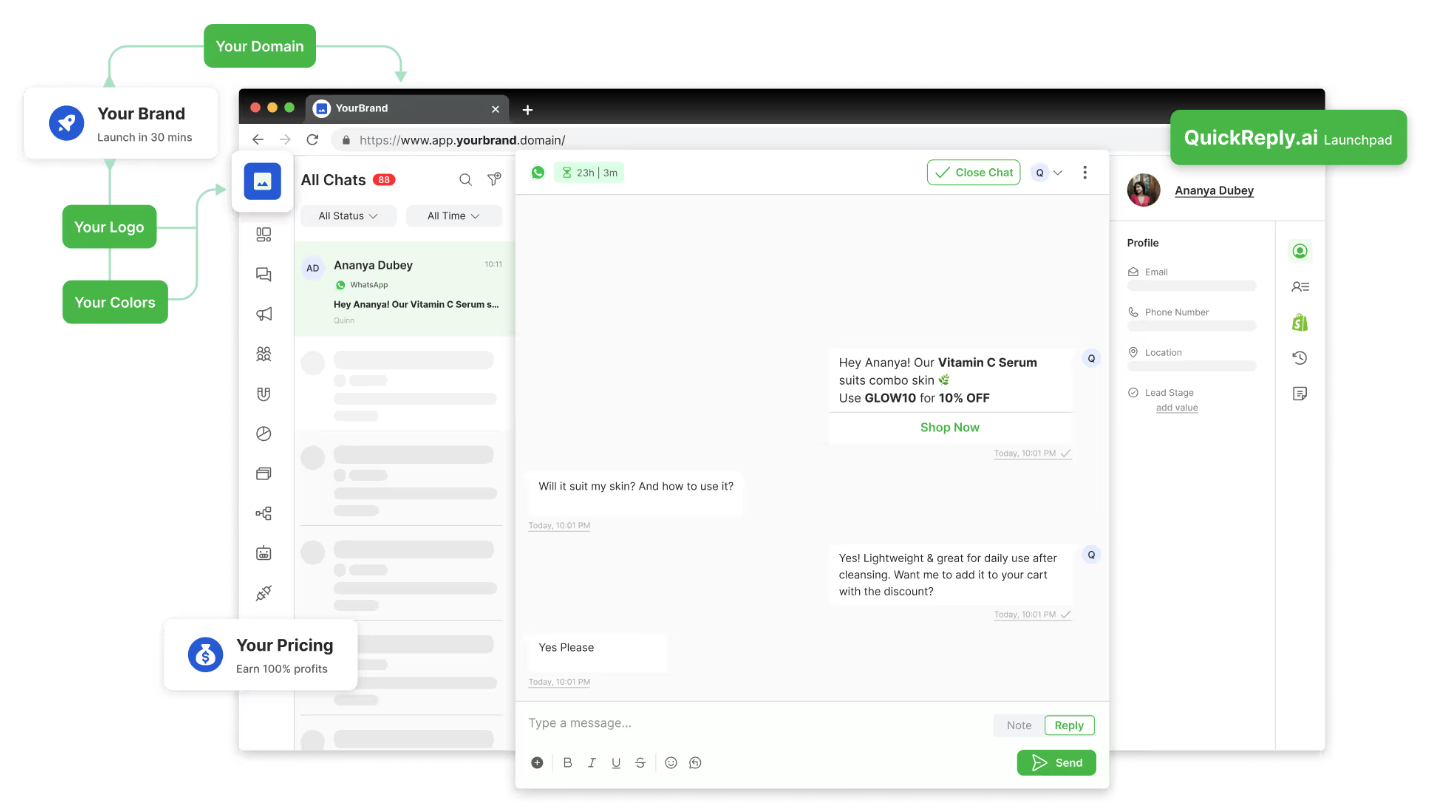
A white-label messaging solution is developed and maintained by a technology provider but branded and sold by an agency as part of its own service offering.
Depending on the provider, the agency may be able to use its own:
The technology provider manages the underlying software and infrastructure, while the agency manages sales, client relationships and service delivery.
For an Indian agency, this means it can launch a messaging product without becoming a software-development company.
Indian agencies frequently work with businesses that want better results from customer acquisition but do not have the internal resources to build automated messaging journeys.
An ecommerce client may need cart-recovery campaigns. An education company may want to qualify student enquiries. A healthcare provider may require appointment reminders, while a real-estate business may want to route leads according to location, budget or property preference.
A white-label platform gives the agency the technology required to deliver these solutions while retaining control over how they are packaged and presented.
Building a messaging platform requires much more than connecting to an API.
The agency would need to develop and maintain:
It would also need a separate dedicated team to maintain the platform as messaging APIs, policies, and technical requirements change.
White-labelling removes most of this product-development burden. The agency can focus on client acquisition, campaign strategy, implementation, and support while the provider maintains the software.
Many agencies depend on project fees or monthly retainers. Revenue may fluctuate when campaigns end, websites are delivered, or advertising budgets change.
A white-label messaging platform adds a subscription-based revenue opportunity.
The agency can earn through:
This allows the agency to combine software revenue with its existing consulting and execution services.
Instead of earning a one-time referral commission, the agency can build an ongoing commercial relationship around the platform.
Indian agencies serve businesses with very different requirements and budgets. A growing Shopify store does not need the same package as an enterprise, educational institution or multi-location service company.
A flexible white-label arrangement allows the agency to create suitable plans for each segment.
For example:
The agency can also bundle the platform with its own services rather than competing only on the underlying software price.
Pricing flexibility is important because it allows agencies to design an offering around the value they deliver, not simply resell a provider’s standard plan.
When an agency sends a customer directly to an external software company, the software provider often becomes the visible technology partner.
The client logs into the provider’s dashboard, receives communication from its team and may eventually purchase additional services directly from it.
White-labelling changes this relationship.
The platform can carry the agency’s name, branding and domain. The agency remains present throughout the client journey, including:
This strengthens the agency’s position as a long-term technology and growth partner rather than a temporary campaign vendor.
Referral programmes are easy to operate, but they usually provide limited control. The original provider may decide the pricing, manage billing and own most of the product relationship.
A white-label arrangement gives the agency greater control over:
This does not automatically mean the agency owns every account, business asset or piece of client data. Those responsibilities must be clearly defined in the commercial agreement.
However, white-labelling generally gives the agency more influence over the customer experience than a standard referral model.
Many Indian agencies primarily help clients generate traffic and leads through paid advertising, search marketing, social media or website development.
Messaging allows them to extend their involvement beyond lead generation.
They can help clients with:
This creates a more complete service offering. The agency is no longer responsible only for bringing customers to the business; it can also help convert and retain them.
A generic messaging platform can be difficult to sell because clients may not immediately understand how it applies to their business.
Agencies can make the offering more valuable by packaging it around industry-specific outcomes.
The underlying platform may remain the same, but the agency’s industry knowledge turns it into a more relevant solution.
Indian businesses often serve customers across different regions and languages.
A white-label platform can help agencies build localised campaigns and automated journeys according to the client’s audience. A business may use English for one customer segment and Hindi, Tamil, Arabic, or a regional language for another.
Meta has also been expanding business messaging capabilities in India, including multilingual AI assistance for eligible small businesses on WhatsApp.
Localisation should not mean translating the same promotional message word for word. Agencies can add value by adapting the tone, timing, offers, and conversation structure to the customer segment.
As the agency adds more messaging clients, it must manage onboarding, troubleshooting and technical escalations consistently.
A strong white-label provider can support the agency with:
This allows the agency to build internal expertise gradually without maintaining a large platform-engineering team from the beginning.
The agency should still be prepared to manage client communication and first-level support. White-labelling reduces technical complexity, but it does not remove the need for a capable service team.
A white-label platform gives an agency branding and commercial control, but it does not allow it to bypass channel policies.
For WhatsApp, Meta continues to govern areas such as business accounts, phone numbers, message templates and platform-level policies.
For commercial SMS in India, businesses must also follow TRAI’s applicable sender-registration, consent and content-template requirements. TRAI states that commercial communication should be sent to customers who have provided consent or set preferences allowing such communication.
The agency should therefore select a provider that communicates compliance requirements clearly rather than promising unrestricted messaging access.
QuickReply.ai enables agencies, software resellers and solution providers to launch a WhatsApp marketing platform under their own brand.
Partners can customise the platform with their business name, logo, colours and domain. QuickReply.ai also allows partners to set their own pricing, manage their clients and retain the commercial difference between the partner cost and client price.
The platform provides capabilities across the customer journey, including:
QuickReply.ai also provides onboarding, implementation guidance and ongoing technical support for partners.
This makes it suitable for Indian agencies that want to add WhatsApp marketing and automation to their existing services without developing and maintaining the complete platform internally.

Tool and strategies modern teams need to help their companies grow.
Leverage the untapped growth potential of WhatsApp marketing to acquire and retain customers.
The agency can earn through platform subscriptions, onboarding, campaign management, chatbot development, integrations and support services.
White-labelling is more suitable when the agency wants control over branding, pricing and the client relationship. A referral programme is simpler but usually provides less control.
Developers may not be required for routine campaign and automation work. Technical resources may still be needed for custom integrations or complex data workflows.
This depends on the provider. QuickReply.ai allows white-label partners to set their own prices and manage their own customers.
No. It can also be used by ecommerce agencies, CRM consultants, software resellers, chatbot developers and managed-service providers.