Explain The Concept Of White-label WhatsApp Business API Access

Copied to clipboard!

Businesses increasingly use WhatsApp for lead generation, marketing, sales automation and customer support. This has created an opportunity for digital agencies, software resellers and technology consultants to add WhatsApp services to their existing portfolios.

However, launching a complete WhatsApp marketing platform requires much more than connecting to an API. It involves campaign tools, automation, analytics, billing, client management, team inboxes, integrations, security and ongoing product maintenance.

White-label WhatsApp Business API access provides a faster alternative. It allows a business to launch a WhatsApp marketing platform under its own brand while an established technology provider develops and maintains the underlying software.

What Does White-Label WhatsApp Business API Access Mean?

QuickReply.ai (WhatsApp API Whitelabel)

White-label WhatsApp Business API access is a commercial arrangement in which a technology provider supplies a ready-built WhatsApp marketing and communication platform that another company can brand and sell as its own.

From the client’s perspective, the platform is offered by the agency or reseller. Behind the scenes, the white-label provider operates and maintains the technology.

The partner can usually:

  • Apply its own branding
  • Create service packages
  • Set client-facing prices
  • Onboard and manage customers
  • Provide campaign, automation and consulting services
  • Build recurring software and service revenue

The degree of control depends on the provider and the commercial agreement.

How Does the White-Label Model Work?

A typical white-label WhatsApp arrangement involves four participants.

1. Meta

Meta operates the WhatsApp Business Platform and sets the rules governing business messaging.

It controls areas such as:

  • Business verification
  • WhatsApp Business Accounts
  • Phone-number registration
  • Display names
  • Message-template approval
  • Messaging quality
  • Platform policies
  • Account restrictions

2. The white-label technology provider

The technology provider develops and maintains the software used for:

The provider may also offer implementation assistance, product training and technical support.

3. The agency or reseller

The partner applies its branding to the platform and sells it to businesses in its target market.

Depending on its business model, the partner may manage:

  • Sales and marketing
  • Client onboarding
  • Subscription plans
  • Campaign strategy
  • Chatbot setup
  • Account management
  • Training
  • First-level support

4. The end client

The end client uses the branded platform to communicate with its customers on WhatsApp.

The relationship can be represented as:

Meta → White-label provider → Agency or reseller → End client

The agency owns the commercial relationship, while the technology provider supplies the product required to deliver the service.

What Can Be White-Labelled?

White-labelling generally applies to the software and customer experience built around the WhatsApp Business Platform.

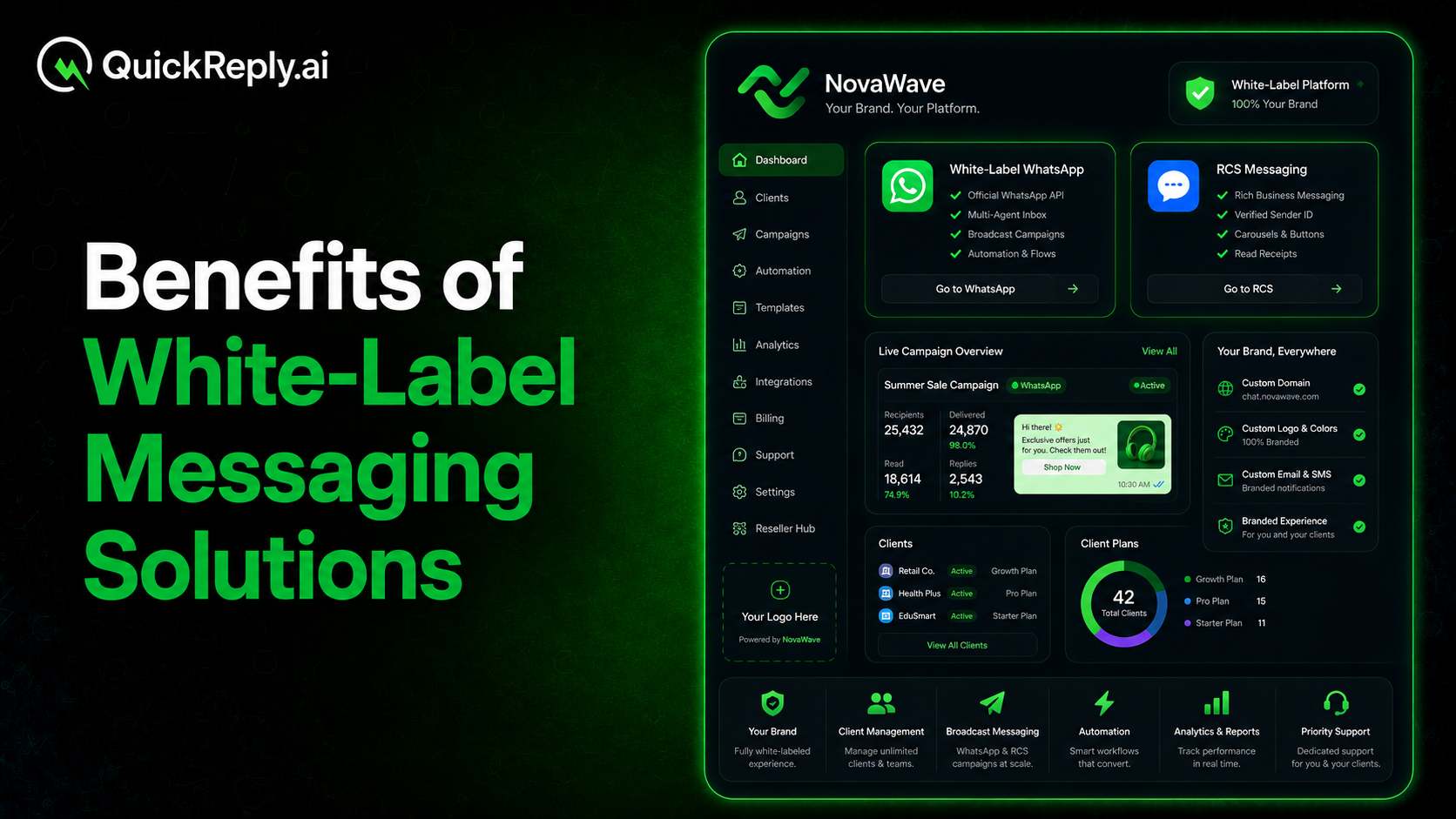
Depending on the provider, partners may be able to customize:

Platform identity

  • Product name
  • Company logo
  • Platform colors
  • Login screen
  • Email branding
  • Help and support details
  • Website domain or subdomain

This creates a consistent experience across the partner’s website, sales materials and client dashboard.

Pricing and packages

Partners may be able to create plans based on features, support, usage or customer type.

For example:

  • Broadcast plan
  • Marketing automation plan
  • Ecommerce recovery plan
  • Lead qualification plan
  • Managed WhatsApp marketing plan
  • Enterprise plan with integrations

The partner may charge subscription fees, setup fees, implementation charges or managed-service fees.

Client management

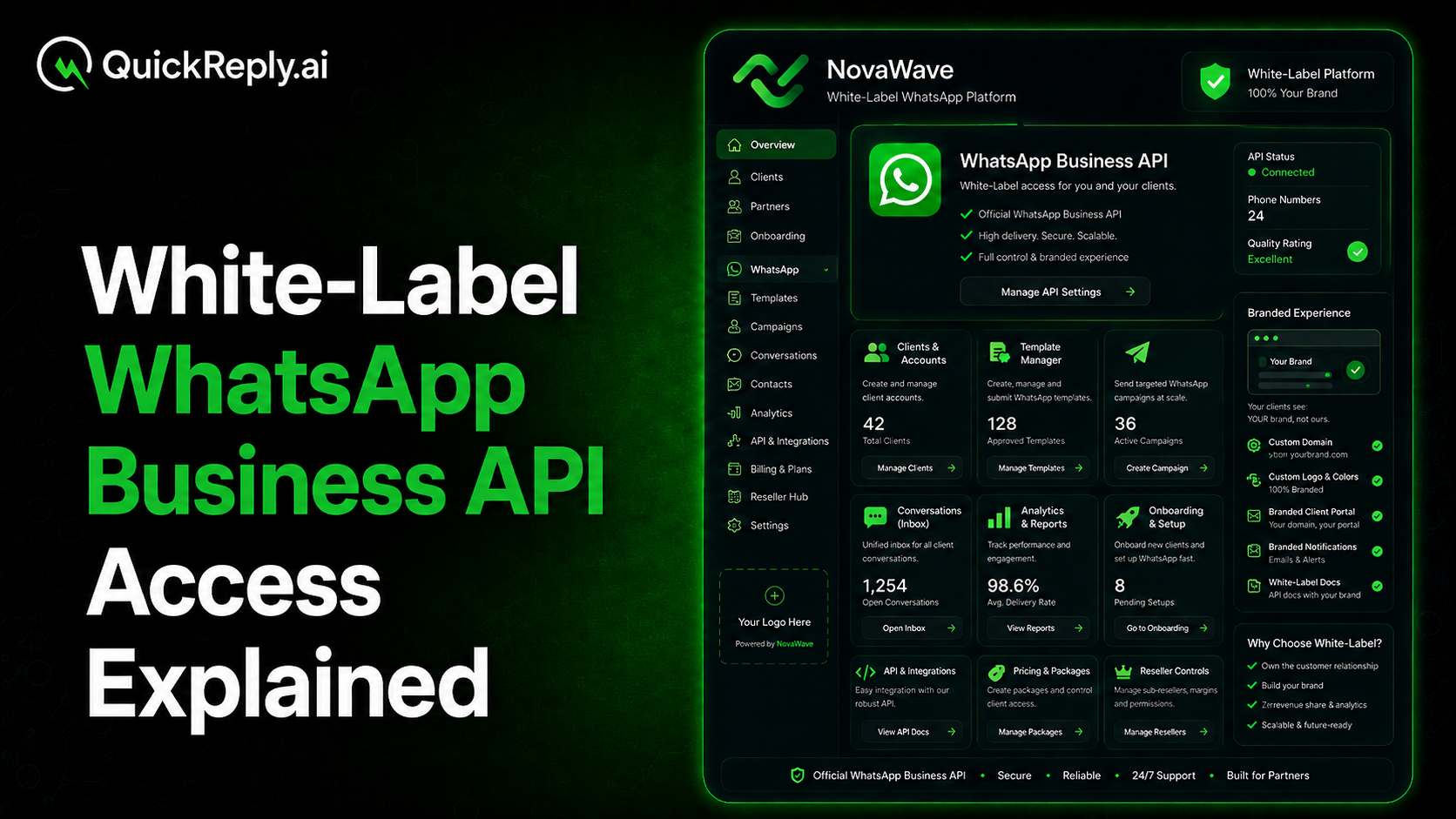
A white-label platform may allow the reseller to manage multiple customer accounts from one administrative environment.

This can include:

  • Creating client accounts
  • Assigning plans
  • Enabling features
  • Adding users
  • Managing access
  • Reviewing usage
  • Coordinating support

Services around the platform

White-labelling also allows agencies to combine technology with their own expertise.

Partners can offer:

  • Campaign planning
  • Copywriting
  • Chatbot development
  • Journey configuration
  • Audience segmentation
  • Reporting
  • Account management
  • Conversion optimisation

The commercial value comes not only from software resale, but from solving specific client problems through technology and services.

What Cannot Be White-Labelled?

White-labelling does not create an independent or unofficial version of WhatsApp.

The reseller may brand the software interface, but the underlying messaging channel remains the WhatsApp Business Platform operated by Meta.

Meta continues to control:

  • Business verification
  • Account setup requirements
  • Phone-number registration
  • Display-name approval
  • Message-template review
  • Messaging policies
  • Quality controls
  • Platform-level restrictions
  • Official business account eligibility
  • Applicable messaging charges

A white-label partner is therefore branding the software, services and commercial experience around WhatsApp. It is not replacing Meta or bypassing WhatsApp policies.

Who Should Consider a White-Label WhatsApp Platform?

White-label access is most relevant for businesses that already have customers, industry expertise or distribution but do not want to build and maintain a messaging product.

Partner Type Potential Offering
Digital marketing agencies Broadcasts, lead nurturing, retention campaigns and managed WhatsApp marketing
Ecommerce and Shopify agencies Cart recovery, order communication, COD confirmation and repeat-purchase automation
CRM and software resellers Lead qualification, sales follow-ups and customer communication
Chatbot consultants Automated journeys, conversational flows and managed chatbot services
SaaS companies WhatsApp functionality without building a messaging infrastructure internally
Business groups and franchise networks A standardised communication platform across subsidiaries or partners

White-labelling is most valuable when the partner already understands the target customer and can package the platform around a defined business outcome.

What Can Partners Offer Through the Platform?

The services a partner can sell depend on the capabilities of the underlying product.

Lead generation and qualification

Businesses can direct prospects from advertisements, websites, QR codes and landing pages into WhatsApp conversations.

Automated journeys can then collect information, understand requirements and route suitable leads to the appropriate team.

For example:

  • An education company can qualify students by course and location.
  • A real-estate business can collect budget and property preferences.
  • A healthcare provider can capture appointment requirements.

Campaigns and broadcasts

Brands can send approved promotional and informational campaigns to opted-in audiences.

Partners can assist with:

  • Segmentation
  • Campaign planning
  • Message creation
  • Scheduling
  • Testing
  • Performance analysis

Chatbots and automated journeys

Chatbots can answer common questions, collect customer details, recommend products or guide users towards the next step.

Journeys may branch according to:

  • Customer responses
  • Profile information
  • Purchase behaviour
  • Campaign engagement
  • Events from external systems

Ecommerce automation

Common ecommerce use cases include:

  • Welcome campaigns
  • Product discovery
  • Cart and checkout recovery
  • Order confirmation
  • Shipping updates
  • COD verification
  • Payment links
  • Upselling and cross-selling
  • Feedback collection
  • Customer win-back

Customer service

A shared team inbox allows sales and support teams to manage conversations from one interface.

Automated replies can handle routine questions, while complex conversations can be transferred to human agents.

CRM and business integrations

Integrations allow businesses to trigger messages and update customer records through their existing systems.

A platform may connect with:

  • Ecommerce stores
  • CRMs
  • Payment systems
  • Workflow tools
  • Custom applications
  • APIs and webhooks

A broader product allows the partner to create more specialised and differentiated services.

How Do White-Label Partners Make Money?

A white-label partner generally purchases access at a partner rate and determines what its own clients will pay.

The difference between the platform cost and client pricing can contribute to the partner’s gross margin. However, software markup is only one source of revenue.

Platform subscriptions

Partners can create monthly or annual plans based on features, users, usage or customer type.

Onboarding and implementation

Clients may need help with:

  • Account setup
  • Business verification
  • Phone-number configuration
  • Integrations
  • Initial campaign planning
  • Platform training

These services can be charged through a one-time onboarding fee.

Chatbot and automation development

Partners can charge separately for building:

  • Lead qualification bots
  • Ecommerce journeys
  • Appointment workflows
  • Customer-support bots
  • Feedback journeys
  • CRM-triggered automations

Managed WhatsApp marketing

Some clients prefer the agency to operate the platform on their behalf.

The partner can manage:

  • Campaign calendars
  • Audience selection
  • Copywriting
  • Broadcast execution
  • Testing
  • Reporting
  • Ongoing optimisation

Consulting and bundled services

WhatsApp services can also be bundled with:

  • Performance marketing
  • Website development
  • Shopify services
  • CRM implementation
  • Social media management
  • Customer-support outsourcing
  • Marketing automation consulting

A partner can therefore operate as a software reseller, managed-service provider or a combination of both.

White-Labelling vs Building Internally

Building an internal platform provides greater control but requires significant engineering and operational investment.

Area Building Internally White-Labelling
Initial launch Requires product development Uses an existing product
Engineering investment High Limited
Product maintenance Managed internally Managed by the provider
Branding Fully controlled Controlled within available options
Pricing Fully controlled Usually set by the reseller
Feature roadmap Built internally Led by the provider
Technical risk Carried internally Shared with the provider
Speed of market entry Generally slower Generally faster
Custom development More flexible Depends on provider capabilities
Client services Built separately Can begin after platform setup

Building internally may suit a large technology company with specialized requirements, sufficient engineering capacity and a long-term product roadmap.

White-labelling is generally better suited to agencies and service providers whose strengths lie in sales, implementation, consulting and account management.

White-Label, Reseller and Referral Models

These terms are often used interchangeably, but they offer different levels of ownership and control.

Referral partner

A referral partner introduces a customer to another company and receives a commission or commercial benefit.

The original provider usually retains control over branding, pricing and the customer relationship.

Reseller

A reseller sells another provider’s product, often at discounted or partner pricing.

The original provider’s brand may remain visible, and the reseller may have limited control over packages and positioning.

White-label partner

A white-label partner sells the platform under its own identity.

It generally has greater control over:

  • Branding
  • Client-facing prices
  • Packages
  • Customer communication
  • Commercial relationships

Before joining a program, businesses should confirm whether the arrangement provides genuine white-label capabilities or is primarily a referral or reseller model.

How to Evaluate a White-Label Provider

Selecting a provider is a long-term product and commercial decision. The following areas should be reviewed carefully.

Branding coverage

Confirm which elements can be customized, including:

  • Product name
  • Logo
  • Colors
  • Domain
  • Login experience
  • Client emails
  • Support information

Also identify where the original provider’s branding may remain visible.

Pricing control

Understand whether the partner can:

  • Set its own prices
  • Create packages
  • Charge implementation fees
  • Retain its margin
  • Control the client billing relationship

The agreement should also explain platform costs, setup fees, messaging charges and minimum commitments.

Product depth

Evaluate whether the platform supports the services you intend to sell.

Agencies offering advanced marketing automation may require:

  • Segmentation
  • Journeys
  • Chatbots
  • Ecommerce automation
  • Analytics
  • Team collaboration
  • Revenue attribution
  • Integrations

Multi-client management

The partner should be able to manage clients without depending on the provider for every routine task.

Review how:

  • Accounts are created
  • Plans are assigned
  • Users are added
  • Features are enabled
  • Access is controlled
  • Usage is monitored

Integrations

Assess integrations with ecommerce platforms, CRMs, payment providers and workflow tools.

APIs and webhooks are also important when clients have custom requirements.

Training and support

The provider should clearly define the responsibilities of both parties.

The partner may handle first-level customer support, while the provider manages product bugs, infrastructure problems and advanced technical escalations.

Security and reliability

Review:

  • Data separation
  • Access controls
  • Authentication
  • Permissions
  • Auditability
  • Monitoring
  • Escalation procedures
  • Platform availability

These areas become especially important when serving larger or regulated businesses.

Commercial terms

The agreement should clearly address:

  • Billing commitments
  • Support coverage
  • Termination rights
  • Client migration
  • Data portability
  • Customer ownership
  • Platform access after termination

Marketing claims should always be reviewed alongside the applicable partner tier and signed agreement.

Why QuickReply.ai Is a Strong White-Label Option

QuickReply.ai offers a white-label program for agencies, CRM and software resellers, chatbot solution providers and businesses that want to launch a branded conversational marketing platform.

Launch under your own brand

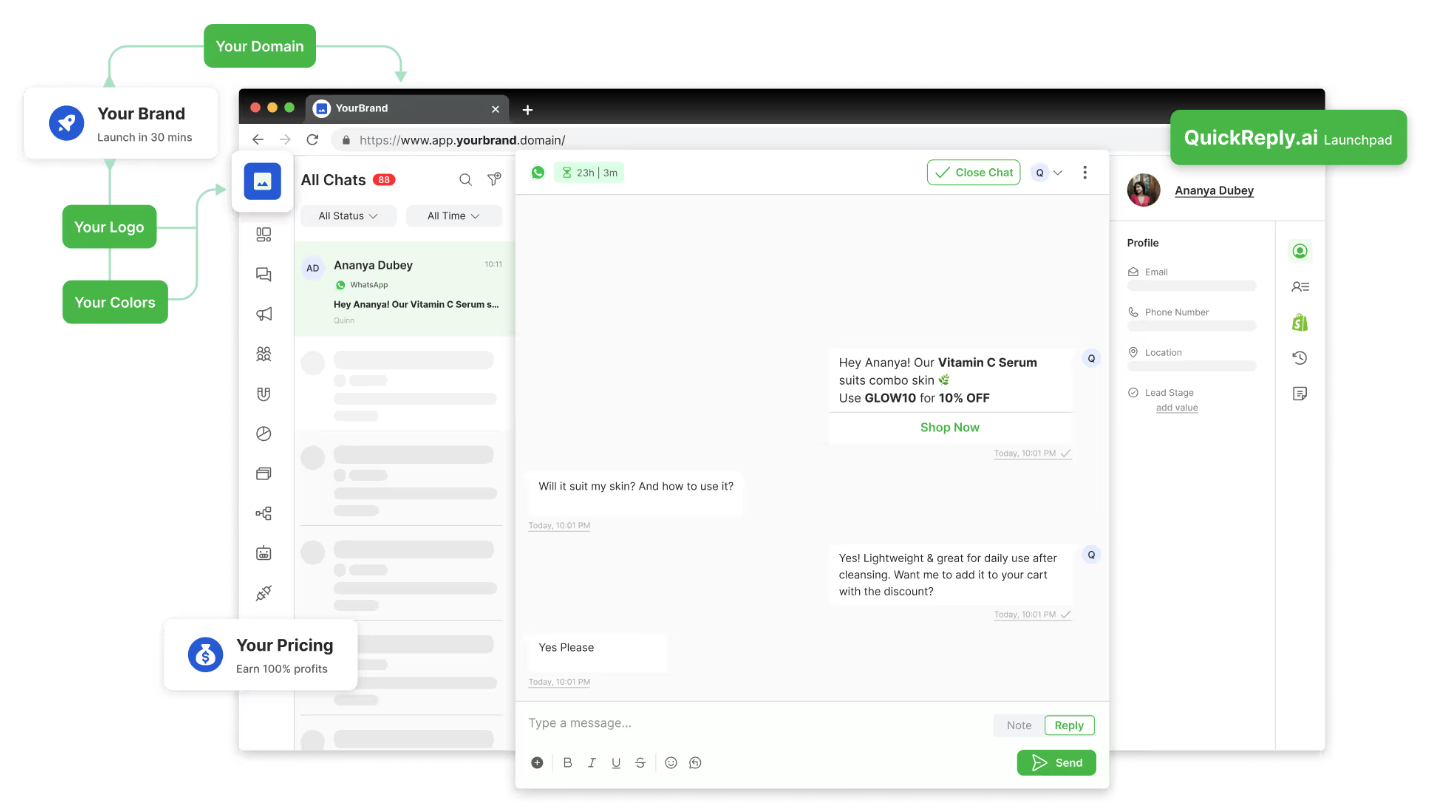
Partners can customize the platform using their company name, logo, colors and domain.

This allows the platform to become part of the agency’s own service portfolio instead of directing clients to an unrelated software brand.

Define your own pricing

Partners can create their own plans, manage customers and decide what clients pay.

This supports recurring revenue without requiring the partner to build and maintain the underlying technology.

Offer more than WhatsApp messaging

QuickReply.ai supports capabilities such as:

  • Broadcast campaigns
  • Customer segmentation
  • Automated journeys
  • Generative AI chatbots
  • WhatsApp forms
  • Interactive catalogues
  • Payment links
  • CRM integrations
  • Feedback collection
  • Service reminders
  • Referral and loyalty campaigns
  • Retention automation
  • WhatsApp-to-RCS fallback

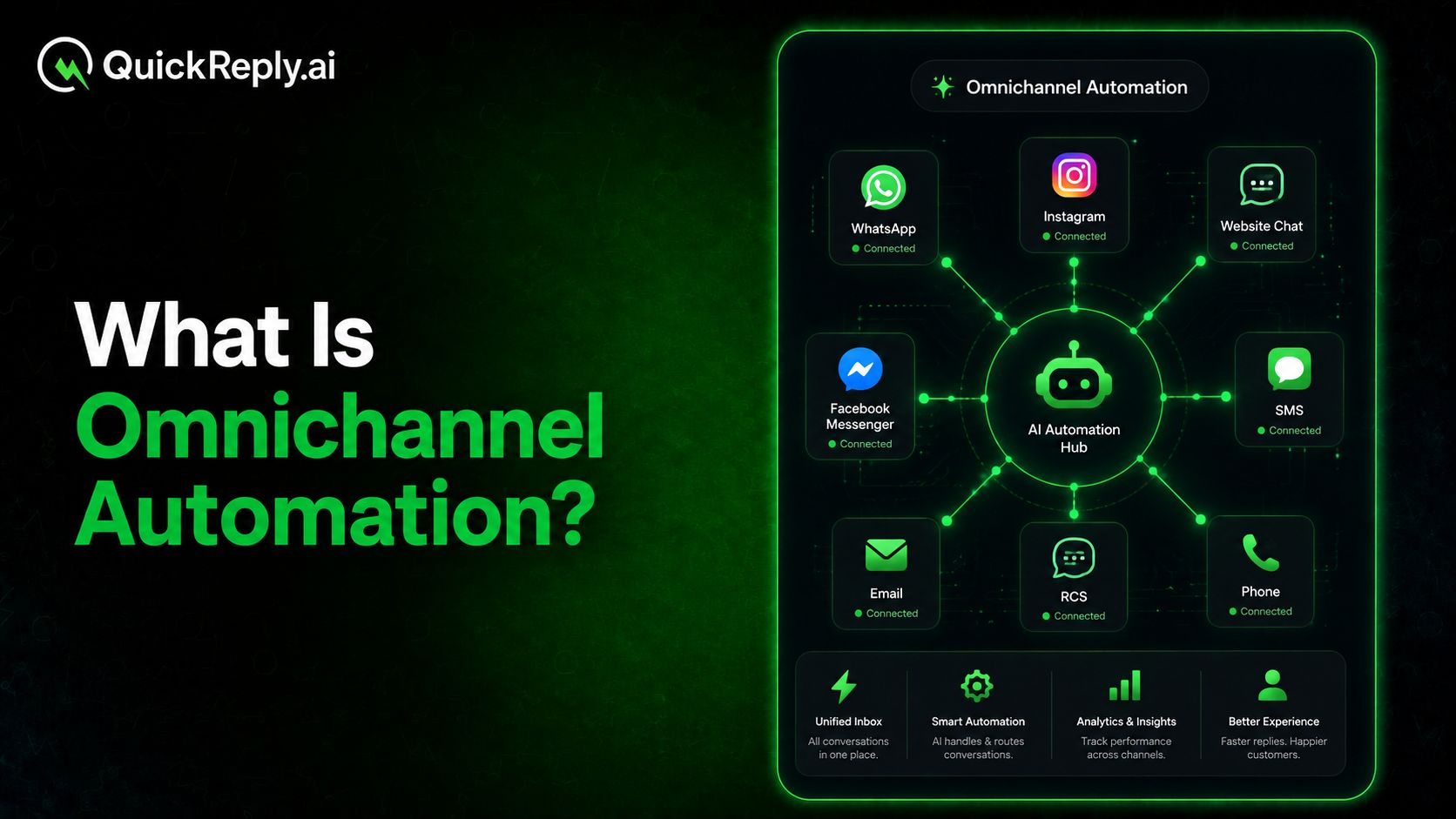
The platform also supports communication through RCS, Instagram, Messenger, SMS and website chat, allowing partners to expand towards omnichannel automation.

Serve different customer segments

QuickReply.ai offers multiple plans for businesses at different stages of maturity.

Depending on the selected plan, partners may offer:

  • Team inboxes
  • Bulk messaging
  • Website widgets
  • Shopify automation
  • Revenue attribution
  • Chatbots
  • Journey builders
  • Feedback collection
  • Payments
  • Chat routing
  • Enterprise security controls

This allows partners to create different packages for smaller businesses, growing brands and enterprise customers.

Receive implementation and technical support

QuickReply.ai provides onboarding assistance, documentation, training and ongoing technical support.

Partners can receive guidance on:

  • Client account creation
  • Meta verification
  • Platform configuration
  • Product implementation
  • Technical escalations
  • Client migration

This structure is useful for agencies that understand customer marketing requirements but do not want to develop deep messaging infrastructure expertise.

Turn 1 time visitor into repeat customer with WhatsApp marketing

Leverage the untapped growth potential of WhatsApp marketing to acquire and retain customers.

Frequently Asked Questions

Is white-label WhatsApp Business API access legal?

Yes, provided the solution uses the official WhatsApp Business Platform and complies with Meta’s policies.

White-labelling applies to the software and services offered around WhatsApp. It does not permit unofficial API access or policy circumvention.

Can I use my own branding and set client prices?

This depends on the provider and partner agreement.

A genuine white-label arrangement should clearly explain which branding elements can be customised and whether the partner controls client-facing packages and prices.

QuickReply.ai allows eligible partners to customise client-facing branding and define their own customer pricing.

Do I need developers to operate a white-label platform?

Routine campaign, chatbot and automation work may not require coding when the provider offers a no-code interface.

Technical expertise may still be required for custom integrations, advanced webhooks or complex data workflows.

Can existing WhatsApp clients be migrated?

Migration may be possible, but the process depends on the client’s current account structure, phone-number setup and existing provider arrangement.

The migration scope and responsibilities should be confirmed before onboarding.

Who owns the client’s WhatsApp Business Account?

Ownership and access should be clearly documented during onboarding.

The client should generally retain control over its core business assets, while the partner or technology provider may assist with account creation, verification and configuration. The exact setup depends on the agreed onboarding model.