What is Generative AI's Impact on Customer Service?

Copied to clipboard!

Customer service teams spend a considerable part of their day answering recurring questions, searching for information, documenting conversations, routing requests and following up with customers.

Traditional customer service automation has helped reduce some of this work. Rule-based chatbots can answer frequently asked questions, collect information and guide customers through predefined processes. However, they often struggle when a customer phrases a question differently, provides incomplete information or asks something outside a programmed flow.

Generative AI is changing this.

Instead of only matching a question with a predetermined response, generative AI can understand the context of a conversation, retrieve relevant information and generate an appropriate response. It can also assist human agents, summarise conversations, analyse support interactions and, when connected with business systems, take actions on the customer’s behalf.

Its impact is therefore not limited to making chatbots sound more human. Generative AI is changing how customer service teams work, how quickly issues are resolved and how businesses scale support without increasing operational costs at the same rate.

According to IBM, 65% of customer service leaders expect the combination of generative AI and conversational AI to improve customer satisfaction. However, the extent of that impact depends on how effectively businesses combine AI with trusted data, structured workflows, and human oversight.

What Is Generative AI in Customer Service?

Generative AI in customer service refers to the use of AI models that can understand customer queries and generate new responses based on the context, available information, and instructions provided by the business.

Unlike a conventional chatbot that selects from a fixed list of answers, a generative AI system can:

  • Understand questions written in different ways
  • Maintain context across a conversation
  • Retrieve information from a knowledge base
  • Draft relevant and natural responses
  • Summarise long conversations
  • Translate or adapt responses for different languages
  • Suggest answers to human agents
  • Analyse customer intent and sentiment
  • Decide when a query should be escalated

When connected to an order management system, CRM, booking platform or helpdesk, an advanced GenAI agent may also complete approved actions rather than only explaining what the customer needs to do.

For example, it could check an order, determine whether it is eligible for return, collect the required information and initiate the return through a connected system.

This is why generative AI’s impact on customer service can be understood across three levels:

  1. Customer self-service: Helping customers find answers and resolve routine issues.
  2. Agent assistance: Helping human agents work faster and more consistently.
  3. Service execution: Allowing AI agents to perform approved tasks across connected systems.

How Is Generative AI Changing Day-to-Day Customer Service Operations?

Gen A Chatbot

The clearest impact of generative AI can be seen in the routine work customer service teams perform every day.

1. Answering Repetitive Customer Questions

A large share of support requests involves recurring questions such as:

  • Where is my order?
  • What is your return policy?
  • How can I reschedule my appointment?
  • Is this product available?
  • What documents do I need?
  • When will my refund be processed?

Traditional chatbots can answer these questions when the wording and response are predictable. Generative AI expands this capability by understanding spelling errors, follow-up questions, and different ways of expressing the same request.

Customers, therefore, do not need to use a specific keyword or navigate a rigid menu to receive a relevant answer.

2. Helping Agents Find Information and Respond Faster

Customer service agents frequently search through policies, help articles, product documents, previous conversations and internal systems before responding.

Generative AI can retrieve the relevant information, summarise it, and draft a contextual response based on the customer’s issue, account history and the organisation’s communication guidelines.

It can help agents:

  • Explain policies in simpler language
  • Provide step-by-step troubleshooting instructions
  • Personalise responses using customer information
  • Adjust the tone of a message
  • Translate responses
  • Maintain consistency across the support team

Agents can review, modify or reject the suggested response before sending it. This reduces the time spent searching and writing without removing human control.

The accuracy of this assistance depends on the quality of the information available to the system. Businesses need current knowledge, reliable customer data and appropriate access controls. Integrations with CRM, transactional and support systems can help GenAI use real-time customer context rather than relying only on static information.

3. Summarising Conversations and Updating Records

Agents often spend additional time documenting a conversation after it has ended.

Generative AI can create a concise summary containing:

  • The customer’s original problem
  • Relevant account or order details
  • Troubleshooting already completed
  • The resolution provided
  • Promised follow-up actions
  • The reason for escalation

This reduces after-conversation work and improves handovers between teams. When a query is escalated, the next agent can understand the issue and continue the conversation without asking the customer to repeat everything.

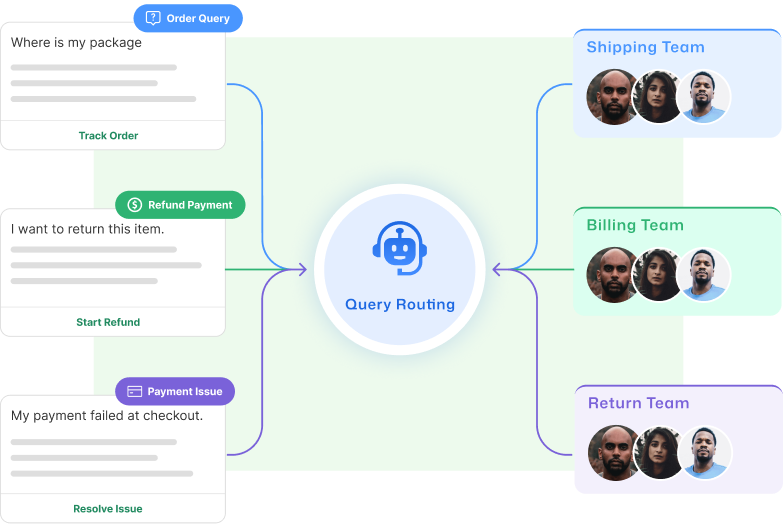
4. Categorising and Routing Customer Requests

GenAI can analyse an incoming conversation to identify:

  • The customer’s intent
  • The product or service involved
  • The urgency of the issue
  • The appropriate department
  • Whether the customer appears frustrated
  • Whether human intervention is required

This allows requests to reach the right team sooner. For example, a billing dispute can be routed to finance, a technical issue to support and a sensitive complaint to a senior representative.

5. Supporting Multilingual Customer Service

Generative AI can interpret incoming queries and help draft responses in the customer’s preferred language.

This makes multilingual support more practical because businesses do not need to create a separate prewritten response for every possible question in every language.

However, responses should still be tested for translation accuracy, tone and local terminology, particularly in healthcare, finance and other regulated industries.

6. Analysing Customer Conversations at Scale

Customer conversations contain valuable information about products, processes and customer expectations.

Generative AI can analyse large volumes of interactions to identify:

  • Common complaints
  • Recurring technical problems
  • Reasons for cancellations or returns
  • Missing knowledge-base information
  • Frequently requested features
  • Products causing confusion
  • Reasons for repeat contacts
  • Areas where agents may need additional training

This allows customer service teams to contribute insights to product, operations and training decisions instead of functioning only as a reactive support department.

How Does Generative AI Improve Customer Service Agent Productivity?

Generative AI improves agent productivity by reducing the time spent searching for information, drafting responses and documenting conversations.

A study involving approximately 5,000 customer support agents found that agents using an AI assistant resolved 13.8% more issues per hour. They spent around 9% less time on each chat and handled approximately 14% more chats per hour, without a statistically significant decline in customer satisfaction.

The productivity gains were highest among less-experienced and lower-performing agents, who recorded improvements of approximately 35%. The research suggests that AI helped these agents apply the language, diagnostic approaches and working practices used by stronger performers.

This can improve customer service operations in three important ways:

  1. Faster Employee Onboarding: New representatives can receive real-time guidance while handling conversations, helping them become productive sooner and reducing their dependence on senior team members.
  2. Greater Service Capacity: By reducing research, writing and documentation time, agents can handle more conversations without a proportional increase in workload or staffing.
  3. More Time for Complex Cases: When GenAI supports routine work, human representatives can focus on unusual problems, sensitive complaints and interactions that require judgement or empathy.

The purpose is not to remove people from customer service. It is to use their time more effectively by allowing AI to assist with repetitive and knowledge-intensive work.

How Does Generative AI Reduce Customer Service Costs?

Generative AI can reduce customer service costs, but savings should not be understood simply as replacing employees with chatbots.

Its more sustainable impact comes from reducing the cost per successfully resolved customer issue.

1. Automating high-volume, low-complexity requests

When AI resolves repetitive informational queries, fewer conversations require direct agent involvement.

This reduces the workload entering the support queue and allows the existing team to handle a larger customer base.

2. Reducing average handling time

Agent-assistance tools reduce the time spent:

  • Searching for information
  • Writing repetitive answers
  • Translating messages
  • Reviewing previous conversations
  • Creating support summaries
  • Updating case notes

Even when a human remains responsible for the resolution, reducing these supporting tasks can lower the cost of each interaction.

3. Improving first-contact resolution

Incomplete or inconsistent responses often cause customers to contact the business again.

GenAI can help agents provide a more complete answer during the first interaction by surfacing relevant context and recommended steps. Fewer repeat contacts reduce queue volume and operational costs.

4. Scaling service without proportional hiring

A growing business may see support demand increase faster than revenue or team capacity.

AI customer service automation can absorb a portion of this additional demand, allowing a team to handle more conversations without adding employees at the same rate.

Lyft reported that its Claude-powered customer care assistant reduced average resolution time by 87% while handling thousands of daily inquiries. The system transferred more complex cases to human specialists when required.

5. Reducing training and supervision requirements

Real-time AI guidance can shorten the time it takes for new representatives to become productive and reduce their dependence on senior agents for routine questions.

6. Preventing avoidable operational errors

Automated workflows can ensure that required details are collected, standard steps are followed and follow-ups are triggered consistently.

However, generative AI does not automatically make customer service cheaper.

Businesses must also account for:

  • AI platform or model costs
  • Data and system integration
  • Knowledge-base preparation
  • Testing and monitoring
  • Human quality reviews
  • Security and privacy controls
  • Incorrect or incomplete resolutions
  • Ongoing maintenance

The right financial metric is therefore not simply the number of conversations answered by AI. It is the cost of achieving a correct, complete and satisfactory resolution.

Real-World Examples of AI-Powered Customer Service Operations

The following QuickReply.ai examples primarily involve structured WhatsApp chatbots and automated workflows rather than fully autonomous GenAI agents. However, they demonstrate the operational foundation that generative AI can extend through better language understanding, contextual responses and more flexible decision-making.

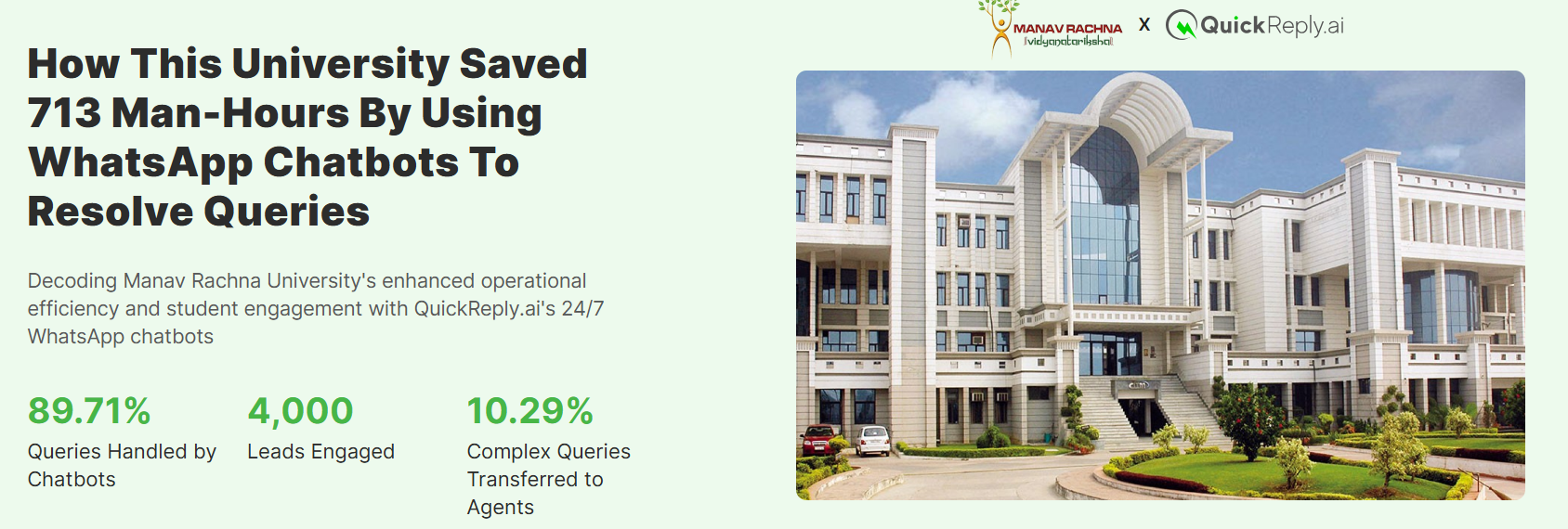
Manav Rachna University: Automating Routine Inquiries

Manav Rachna University introduced 24/7 WhatsApp chatbots to answer recurring questions about programmes, eligibility and fees.

The chatbots handled 89.71% of inquiries, engaged more than 4,000 leads and saved 713 staff hours. Only 10.29% of complex queries required human intervention.

A GenAI layer could extend this model by answering more open-ended academic questions and preparing contextual summaries before escalation.

AAYNA Clinic: Reducing Administrative Work

AAYNA Clinic automated appointment inquiries, confirmations, reminders, rescheduling, lead routing and CRM updates through WhatsApp.

Weekly administrative work fell from 12 hours to three hours, average response time declined from six hours to five minutes, and the no-show rate dropped from 23% to 11%.

This case shows how connecting customer conversations with booking and CRM systems can improve both response speed and operational efficiency.

V6Clinics: Supporting Proactive Customer Communication

V6Clinics used WhatsApp automation for booking support, reminders, rescheduling and post-treatment aftercare.

The clinic reduced weekly administrative work from 13 hours to 4.5 hours, improved response time from three hours and 40 minutes to 24 minutes, and lowered its no-show rate from 27% to 17%.

Together, these examples show how automating routine conversations, data collection and follow-ups can reduce workloads, improve response times and preserve human capacity for more complex interactions.

How Are GenAI Agents Changing Customer Service?

A GenAI customer service agent differs from a response-generating chatbot because it can work towards an outcome.

Consider a customer who says:

“My parcel arrived late, one item is damaged, and I want to know whether I can get a replacement before Friday.”

A basic chatbot may provide links to the delivery and replacement policies.

A GenAI chatbot may understand the issue, generate a more relevant explanation, and guide the customer to a resolution.

A GenAI agent could potentially:

  1. Identify the order from the customer’s profile.
  2. Check its delivery status.
  3. Confirm which product was purchased.
  4. Retrieve the replacement policy.
  5. Ask the customer to upload an image.
  6. Check replacement inventory.
  7. Create the replacement request.
  8. Inform the customer of the expected timeline.
  9. Escalate the case if the request falls outside policy.

This ability to move from answering to acting is likely to produce the next major operational shift in customer service.

However, the degree of autonomy should depend on risk.

An AI agent may be permitted to update a delivery preference or create a return request, but a refund above a particular value may require human approval. Healthcare, legal, and financial requests may require stricter restrictions.

Where Should Businesses Use Chatbots, GenAI Agents and Humans?

Not every request requires generative AI, and not every task should be automated end to end.

Customer interaction Recommended approach
Frequently asked question Traditional or GenAI chatbot
Menu-based product or service selection Structured chatbot flow
Fixed information collection Structured workflow
Open-ended knowledge question GenAI chatbot
Multi-step, low-risk request GenAI agent
Order tracking or appointment status Connected chatbot or AI agent
Payment, refund or account change Controlled workflow with verification
Frustrated customer or sensitive complaint Human agent with AI assistance
Medical, legal or financial decision Qualified human representative
Unusual request outside policy Human review

Structured workflows remain valuable because they provide predictability.

For example, payment authorisation, identity verification and account changes should not depend entirely on freely generated responses. GenAI can understand the request and explain the process, while a controlled workflow performs the actual action.

The most effective operating model is therefore:

Structured workflows for control, GenAI for understanding and flexibility, and human agents for judgement and accountability.

How to Implement Generative AI in Customer Service

Businesses should introduce generative AI gradually, beginning with clear, low-risk use cases rather than automating every interaction at once.

Step 1: Identify Suitable Use Cases

Start with high-volume, repetitive requests supported by clear information, such as order updates, appointment queries, product information, return policies and basic troubleshooting.

Separate informational requests, which require an answer, from transactional requests, which require an action and stronger controls.

Step 2: Prepare the Knowledge Base

Review policies, product documents and support content before connecting them to the AI.

Remove outdated, duplicate or contradictory information, as response quality depends on the accuracy of the source material.

Step 3: Start With Agent Assistance

Use GenAI initially to retrieve information, suggest responses and summarizes conversations for human agents.

This provides productivity benefits while keeping agents responsible for the final response.

Step 4: Automate Low-Risk Interactions

Once response quality is reliable, automate predictable customer queries and connect the system with relevant CRM, helpdesk, ecommerce or booking data.

Provide access only to the information required for each use case.

Step 5: Add Controlled Actions and Escalation Rules

Allow GenAI agents to complete approved tasks such as creating tickets, collecting documents, rescheduling appointments or checking return eligibility.

Transfer the conversation to a human when confidence is low, information is unavailable, the request is sensitive or the action exceeds the AI’s authority.

Step 6: Test, Measure and Expand

Test unusual requests, policy exceptions, frustrated customers and attempts to access restricted information.

Expand automation only when the system consistently provides accurate responses, completes actions correctly and escalates appropriately.

How QuickReply.ai Supports AI-Powered Customer Service

Generative AI becomes more useful when it has access to the right customer context, business systems, and human support workflows. QuickReply.ai brings these elements together across conversational channels such as WhatsApp, Instagram, and website chat.

Conversations that combine structure with flexibility

Businesses can use structured chatbots for predictable journeys such as order tracking, appointment booking, information collection, and frequently asked questions.

For open-ended queries, AI can understand the customer’s intent, use approved knowledge, and generate a more contextual response. This allows businesses to automate routine conversations without forcing every customer through a rigid menu.

Customer context connected with execution

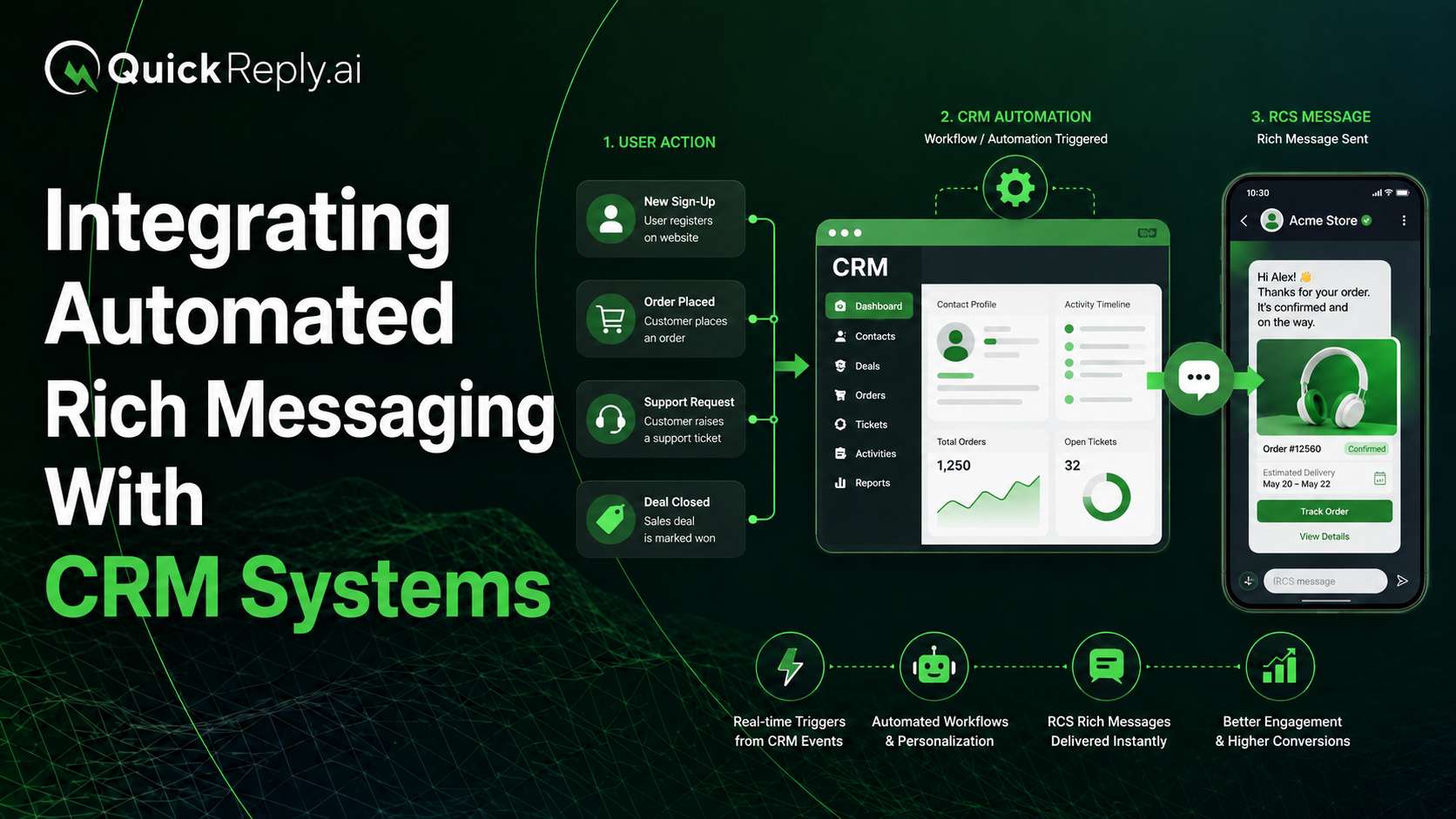
QuickReply.ai can use conversation history, customer attributes, CRM data, and commerce information to make responses more relevant.

It can also connect conversations with automated workflows such as:

This helps businesses move beyond simply answering a customer’s question and connect the conversation with the system where the request needs to be completed.

Continuous handover to human agents

When a conversation requires human judgment, QuickReply.ai can route it to the appropriate agent through a shared inbox.

The agent can see the conversation history and information already collected by the chatbot, allowing them to continue without asking the customer to repeat the issue.

Businesses can also define handover rules based on the type of query, customer responses or the complexity of the request.

By connecting AI-led conversations, customer data, automated workflows and human support in one system, QuickReply.ai helps businesses improve response speed while maintaining control over complex customer interactions.

Turn 1 time visitor into repeat customer with WhatsApp marketing

Leverage the untapped growth potential of WhatsApp marketing to acquire and retain customers.

Frequently Asked Questions

What is generative AI in customer service?

Generative AI in customer service uses AI models to understand customer queries and create contextual responses. It can also retrieve knowledge, assist human agents, summarise conversations and, when connected to business systems, complete approved customer service tasks.

How does generative AI improve customer service?

It improves customer service by answering routine questions, helping agents find information, drafting responses, summarising conversations, supporting multilingual interactions and reducing the time required to resolve customer issues.

How does generative AI reduce customer service costs?

Generative AI can reduce costs by automating repetitive queries, lowering handling time, improving agent productivity, reducing repeat contacts and helping teams manage higher demand without increasing headcount at the same rate.

What is the difference between an AI chatbot and a GenAI agent?

An AI chatbot primarily answers questions and manages conversations. A GenAI agent can interpret a customer’s objective, use connected tools and complete multi-step tasks such as creating a return, changing an appointment or updating a support ticket.

Can generative AI replace customer service agents?

Generative AI can automate parts of customer service, but it should not replace human involvement in every situation. Human agents remain essential for sensitive complaints, policy exceptions, complex decisions and interactions requiring empathy or accountability.

What are the risks of generative AI in customer service?

The main risks include inaccurate answers, outdated information, privacy exposure, bias, inappropriate actions, and poor escalation. Businesses need approved knowledge, access controls, monitoring, and human review to manage these risks.

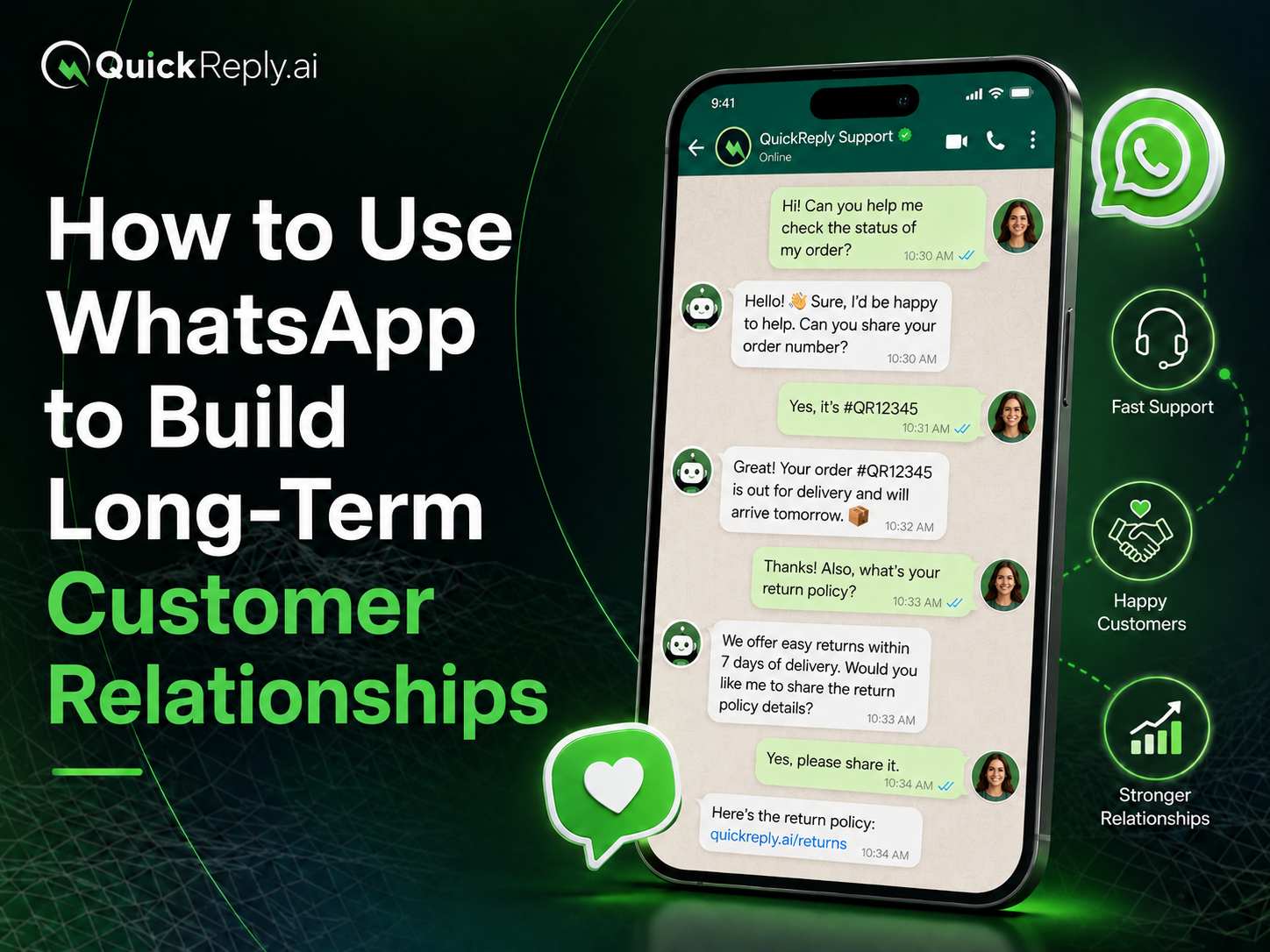
Can generative AI be used for WhatsApp customer service?

Yes. Generative AI can answer free-form questions, assist human agents, and work with structured WhatsApp chatbot flows. It can also be connected with CRM, ecommerce, booking, and support systems to provide more contextual customer service.