Can I send promotional bulk messages using RCS, and what platforms offer this service?

Copied to clipboard!

Yes, You Can Send Promotional Bulk Messages Using RCS

Businesses can send promotional bulk messages using RCS. But there is one important condition: you need to send them through an approved RCS Business Messaging platform that supports brand verification, campaign setup, audience management, and message delivery.

So, if you are thinking of RCS as an alternative to SMS or even WhatsApp for promotional campaigns, you are asking the right question.

RCS gives businesses a more visual and interactive way to reach customers directly inside their phone’s default messaging app. Instead of sending a plain text SMS that says–

“Flat 20% off, shop now.” 

A brand can send a rich promotional message with product images, offer details, CTA buttons, carousels, quick replies, and even guided next steps.

That changes the whole customer experience.

For example, an apparel brand does not have to send a basic text message saying:

“New festive collection is live. Visit our website.”

With RCS, the same brand can show a mini product carousel with new arrivals, add a “Shop Now” button, include a limited-time offer, and let the customer tap directly from the message.

This is why RCS is becoming interesting for brands that want bulk promotional messaging but do not want to rely only on SMS or WhatsApp. 

SMS is easy to send at scale, but it is limited in experience. WhatsApp is powerful for conversations and commerce, but promotional campaigns can become expensive for a limited budget or template-heavy, depending on the use case. 

RCS sits somewhere in the middle. It offers the native reach of mobile messaging with a much richer brand experience.

That said, RCS is not a simple “send to everyone instantly” channel. Businesses still need to think about consent, customer targeting, campaign quality, supported devices, and fallback options. 

Not every customer may be able to receive an RCS message depending on their phone, carrier, and region. A good RCS platform usually helps manage these details so the campaign does not break.

In short, yes, promotional bulk RCS messaging is possible. It is especially useful for brands that want their promotional messages to look more engaging, feel more trustworthy, and drive clearer actions than a normal SMS. In this blog, we will share what platforms you can try to send promotional bulk messages using RCS. 

What Is RCS Promotional Messaging?

RCS promotional messaging is the use of Rich Communication Services to send marketing, offer-based, or campaign-led messages to customers through the native messaging app on their smartphones.

Think of it as the upgraded version of SMS.

SMS lets you send text. RCS lets you send a richer message experience with branding, images, videos, buttons, suggested replies, product cards, and carousels. For businesses, this means promotional communication does not have to look like a plain notification anymore. It can look closer to an interactive shopping or discovery experience.

A promotional RCS message can be used for campaigns like:

  • New product launches
  • Flash sale announcements
  • Festival offers 
  • Back-in-stock alerts
  • Product recommendations
  • Limited-time discounts
  • Loyalty rewards
  • Event promotions
  • Booking or consultation offers

For example, a beauty brand can send an RCS message showing a skincare bundle with a product image, offer price, “Buy Now” button, and “Talk to an Expert” option.

A travel company can send a holiday package with destination images, pricing, and a “View Itinerary” button. 

A healthcare brand can promote a consultation package and let users book directly from the message.

This is where RCS becomes more useful than standard bulk SMS. The message is not only informing the customer. It is also helping the customer take the next step.

Why Are Brands Exploring RCS for Bulk Promotional Campaigns?

For years, SMS was the default channel for bulk promotional campaigns. It was simple, direct, and easy to scale. But the experience was also limited. A plain text message can announce an offer, but it cannot show the product, highlight the collection, guide the customer, or make the campaign feel branded. 

RCS gives businesses a richer way to send promotional messages inside the customer’s native messaging app. A brand can add images, videos, buttons, suggested replies, carousels, and verified sender details. 

This is also one of the reasons why brands are now exploring RCS text messages apart from WhatsApp broadcasts. RCS keeps the native inbox experience of SMS, while adding richer visuals and interactivity closer to WhatsApp-style messaging. 

Another important advantage is campaign tracking. Businesses can track how customers interact with RCS messages, including who viewed the message, clicked a button, opened a product card, or engaged with the campaign in a centralized dashboard. These insights help brands understand customer interest better, create sharper audience segments, and build more effective marketing strategies for future campaigns. 

Here is a simple way to understand the difference:

Channel Best For Message Experience Interactivity Branding Cost Consideration Limitations
SMS Important alerts, OTPs, simple updates, basic promotions with a link or promo code Plain text Very limited Low Usually simple to scale, but ROI depends on clicks and conversions No visuals, no rich buttons, easy to ignore
WhatsApp Two-way conversations, support, commerce, lead nurturing, customer journeys Rich and conversational High Strong, especially with verified business profiles Can become expensive for high-volume promotional campaigns, depending on category and region Requires template approvals for business-initiated messages
RCS Rich promotional campaigns, product discovery, branded offers, and interactive bulk messaging Visual, branded, and interactive Medium to high Strong, with verified sender profiles Can be cost-effective depending on market, provider, and campaign volume Availability depends on country, carrier, device, and platform support

RCS is stronger than SMS when the brand needs visuals, product cards, buttons, and a more engaging promotional experience. WhatsApp is still very strong for deeper two-way conversations, especially in markets where customers already use WhatsApp heavily. But RCS can be a smart additional channel for brands that want to test richer promotional messaging beyond SMS and WhatsApp. 

Top 5 Platforms That Offer RCS Promotional Bulk Messaging

If a business wants to send promotional bulk messages using RCS, it cannot do it directly from a regular phone or messaging app. It needs an RCS messaging platform that can help with brand verification, campaign setup, message delivery, analytics, and customer engagement.

Here are five platforms that offer RCS promotional messaging.

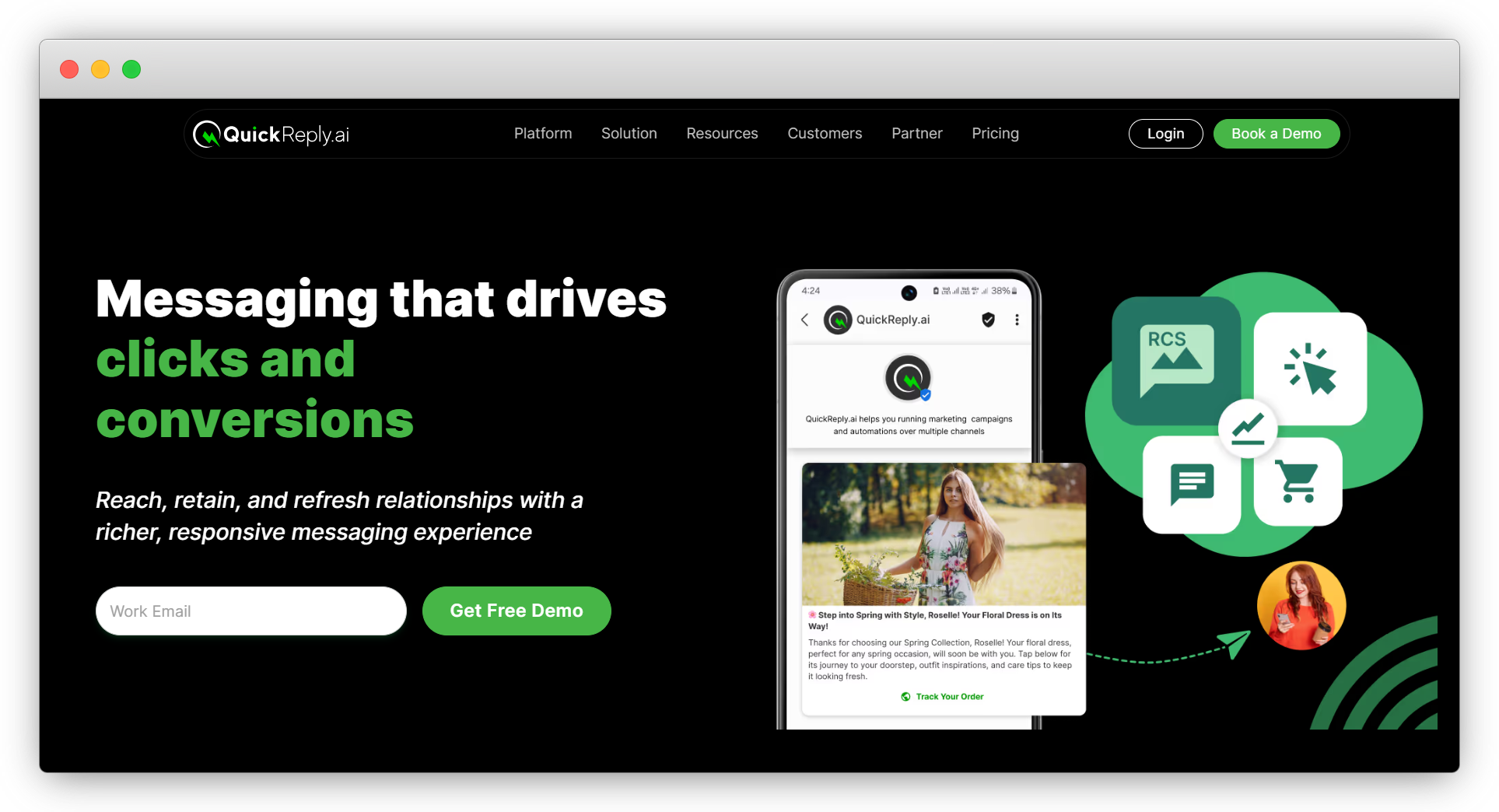
1. QuickReply.ai 

QuickReply.ai is a strong fit for startups and Shopify stores that want to use RCS for promotional campaigns, product discovery, and customer engagement. 

Most promotional campaigns are not just about sending a discount. A brand usually wants the customer to take a clear action, such as:

  • Explore a new collection
  • Claim an offer
  • Complete checkout
  • Revisit an abandoned cart
  • Buy a recommended product
  • Check product availability
  • Talk to support before purchasing

QuickReply.ai is very effective here because it connects RCS messaging with commerce-led journeys. Instead of sending plain promotional text, brands can create richer RCS messages that guide customers toward purchase.

What brands can do with QuickReply.ai RCS

Brands can use QuickReply.ai to send RCS campaigns with:

  • Product images and videos
  • Custom communication workflows
  • Product carousels
  • Clickable buttons like Shop Now, Claim Offer, View Collection, or Get Support
  • Personalized product recommendations
  • Abandoned cart reminders
  • Restock and price-drop alerts
  • Checkout-related nudges
  • Post-purchase engagement messages
  • Keyword-based responses and RCS bots
  • Campaign analytics and engagement tracking

This makes RCS more useful than a one-way broadcast. A customer does not just receive the message. They can interact with it, browse products, click a CTA, or move to the next step.

Best for

QuickReply.ai is best suited for brands that want RCS to work as a conversion channel, not just another messaging channel. It’s best for:

  • Shopify and ecommerce brands
  • D2C brands running promotional campaigns
  • Brands that want product-led RCS campaigns
  • Teams that want segmentation and analytics
  • Businesses exploring RCS beyond SMS and WhatsApp

QuickReply.ai is a strong option for brands to track campaign performance. Businesses can understand who viewed, clicked, and engaged with the message, which will help them improve future campaigns.

2. Infobip

Infobip

Infobip is an enterprise communication platform that offers RCS Business Messaging for branded and interactive customer communication.

It is suitable for businesses that need a large-scale messaging infrastructure across multiple channels. Brands can use Infobip to send RCS messages with rich media, buttons, carousels, and branded sender profiles.

Best for

  • Large enterprises
  • Global messaging operations
  • Omnichannel customer communication
  • Rich media promotional campaigns
  • Businesses already using CPaaS infrastructure

Infobip is a good option for companies that want RCS as part of a larger communication stack across SMS, WhatsApp, email, and other customer engagement channels.

3. Kaleyra

Kaleyra

Kaleyra, now part of Tata Communications, provides RCS messaging capabilities for businesses that want enterprise-grade A2P messaging.

It supports RCS broadcasts and rich business messaging, making it useful for brands that want to send interactive campaigns at scale.

Best for

  • Enterprise messaging
  • RCS broadcast campaigns
  • Rich media customer communication
  • Businesses already using telecom or CPaaS platforms
  • Brands that need scalable A2P messaging

Kaleyra can be a good fit for businesses that want RCS as part of their broader enterprise communication setup.

4. Twilio

Twilio

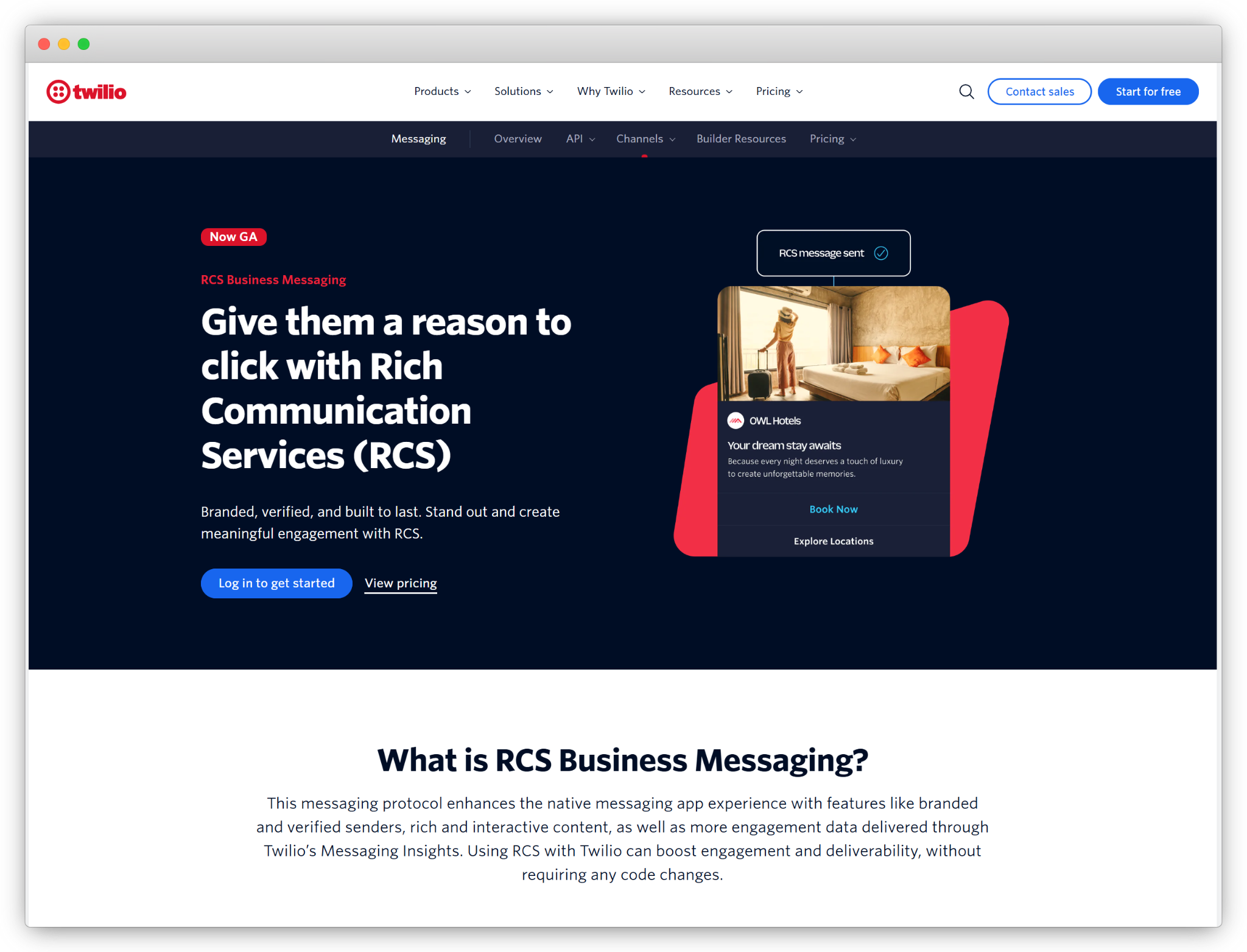
Twilio is a developer-first communication platform. It is best suited for businesses that have technical teams and want to build custom RCS messaging workflows using APIs.

For businesses already using Twilio for SMS or customer messaging, RCS can be added to the existing communication setup.

Best for

  • Developer teams
  • API-led implementation
  • Custom messaging workflows
  • Businesses already using Twilio
  • Teams that want more control over messaging logic

Twilio is a practical choice when the business wants flexibility and has the technical resources to build and manage custom RCS experiences.

5. Sinch

Sinch

Sinch offers RCS for Business APIs that allow brands to send branded, rich, and interactive messages at scale.

It is suitable for companies that need a global messaging infrastructure and want RCS as part of a broader communication strategy.

Best for

  • Global brands
  • API-led RCS messaging
  • Branded customer engagement
  • Large-scale customer communication
  • SMS fallback and delivery-focused workflows

Sinch can work well for businesses that need a reliable messaging infrastructure across different markets and channels.

Quick Comparison of RCS Platforms

Platform Best Suited For Main Strength
QuickReply.ai Startups, D2C brands Commerce-led RCS campaigns, product discovery, cart recovery, segmentation, and analytics
Infobip Large enterprises Global omnichannel messaging infrastructure
Kaleyra Enterprise messaging teams Scalable RCS broadcasts and A2P messaging
Twilio Developer-led teams API-first custom RCS implementation
Sinch Global brands and enterprises Branded messaging APIs and delivery-focused workflows

Which Platform Should You Choose?

The right platform depends on what the business wants RCS to achieve.

Choose QuickReply.ai if the goal is to use RCS for:

Choose platforms like Infobip, Kaleyra, Twilio, or Sinch if the business needs:

  • Enterprise messaging infrastructure
  • API-first implementation
  • Global telecom coverage
  • Custom communication flows
  • Broader CPaaS capabilities

For startups and D2C brands, QuickReply.ai is the most relevant platform to evaluate first because it is built around the actual marketing use cases brands care about: engagement, product discovery, customer action, and conversions.

Turn 1 time visitor into repeat customer with WhatsApp marketing

Leverage the untapped growth potential of WhatsApp marketing to acquire and retain customers.

Frequently Asked Questions

Can I send bulk promotional messages using RCS?

Yes, businesses can send bulk promotional messages using RCS through approved RCS Business Messaging platforms. These platforms help with sender registration, brand verification, message creation, campaign delivery, and performance tracking.

Is RCS better than SMS for promotional campaigns?

RCS is better than SMS when the campaign needs visuals, buttons, carousels, branding, or interactivity. SMS is useful for short and simple updates, but RCS works better when brands want customers to explore products, click CTAs, or engage with the message.

Is RCS cheaper than WhatsApp?

It depends on the country, provider, message type, and campaign volume. RCS may be cost-effective for some promotional use cases, but brands should not compare only message cost. They should also compare click-through rate, engagement, conversions, and overall campaign ROI.

Do customers need to install an app to receive RCS messages?

No, customers do not need to install a separate app. RCS messages are delivered inside the phone’s native messaging app, provided the customer’s device, mobile carrier, country, and messaging app support RCS.

Which platforms offer RCS promotional messaging?

Platforms that offer RCS promotional messaging include QuickReply.ai, Infobip, Kaleyra, Twilio, and Sinch. QuickReply.ai is especially relevant for ecommerce and D2C brands that want to use RCS for product promotions, cart recovery, personalized campaigns, and customer engagement.

Can RCS messages include product images and buttons?

Yes, RCS messages can include rich elements such as product images, videos, carousels, suggested replies, and CTA buttons. This makes RCS useful for promotional campaigns where brands want customers to take quick action.

Can businesses track RCS campaign performance?

Yes, businesses can track RCS campaign performance through supported platforms. Depending on the platform, brands can track views, clicks, engagement, button interactions, and campaign performance. These insights can help create better customer segments and improve future marketing campaigns.

Is RCS useful for ecommerce brands?

Yes, RCS can be highly useful for ecommerce brands because it supports visual and interactive messaging. Brands can use RCS for new launches, abandoned cart recovery, back-in-stock alerts, product recommendations, festive offers, and post-purchase engagement.