Affordable Generative AI Customer Service Solutions for Small Businesses

Copied to clipboard!

One poor customer experience can put a company’s reputation at risk. For small businesses, this risk is even higher because customer delight is often as important as the product itself. A customer who gets a delayed reply, a confusing answer, or no resolution at all may not just leave. They may also share that experience with others.

But managing customer service is not easy for startups and small businesses. Hiring a large support team is expensive, and most small companies already operate with lean teams where the same people handle sales, operations, customer support, and follow-ups.

This is one reason Gen AI tools have become popular among enterprises, startups, and small businesses. They are not useful only because they run on AI. They are also becoming more cost-effective, easier to operate, and available 24/7.

Customers no longer ask only simple questions like “Where is my order?” or “What are your store timings?” They ask about product fit, returns, refunds, delivery delays, discounts, booking changes, warranty issues, and complaints across different channels.

This is where AI agents are becoming practical for small businesses. Unlike basic chatbots that follow fixed flows, generative AI customer service tools can understand customer questions, generate helpful replies, and pass serious issues to a human support agent.

Businesses are already shifting to Gen AI tools. According to the Salesforce report, 88% admits that conversational AI accelerates resolution times, while 87% say it frees service representatives to handle more complex issues. 

In this blog, we will share the top 8 generative AI customer service solutions that you can explore for your support needs, with their features, pricing, and best use cases.

Quick Comparison: Gen AI Customer Service Solutions for Small Businesses 

Here is a quick comparison of the top tools small businesses can consider.

Tool Best for Key AI customer support use case
QuickReply.ai For startups and small businesses that want to use an omnichannel communication platform for customer queries and marketing campaigns. Automating common customer queries on WhatsApp, RCS, Instagram, Messenger, or a website, and handing over complex issues to agents.
Tidio Lyro Small businesses that want to use website chat and ecommerce support. AI agent that answers customer questions using support content and creates tickets when human help is needed.
Chatbase Startups that want a quick AI support bot. Build AI agents trained on website, help docs, and business data.
Zoho Desk with Zia Small teams that are already using Zoho. AI assistance for ticket summaries, reply help, tone analysis, and content generation.
Freshdesk with Freddy AI Small teams that need ticketing plus AI. AI agents, AI copilot, summaries, reply suggestions, and automated resolutions.
Help Scout AI Customer support team using an email-first platform. AI Answers, AI drafts, and support from help content.
Intercom Fin Growing startups and small teams that want advanced AI customer support. AI agent that answers customer queries across chat, email, social, and other support channels.
Gorgias AI Agent Shopify and ecommerce brands. AI support for order, refund, return, product, and customer context queries.

Why Small Businesses Are Looking for Affordable AI Support Now

Small businesses are under pressure from both sides.

On one side, customers expect fast replies. They do not want to wait hours for basic answers related to order status, return policy, appointment availability, product details, or payment issues.

On the other side, small businesses usually work with lean teams where the same people handle sales, support, operations, marketing, and customer follow-ups.

This creates a support gap.

A growing business may receive more customer queries every month, but hiring support agents at the same speed is not always possible. More agents mean more salaries, more training, more supervision, and more tools. For a small business, this can quickly become expensive.

Affordable AI support helps solve this problem by reducing the repetitive workload. A Gen AI customer service assistant can answer common questions, summarize customer issues, suggest replies, and collect important details before a human agent steps in. This does not remove the need for a support team. It makes the team more efficient.

For example, a small ecommerce brand may get 200 daily queries about delivery, returns, product size, COD availability, and refunds. A basic chatbot may fail when customers ask these questions in different ways. A generative AI solution can understand natural language better and respond more flexibly.

That is why small businesses are now looking beyond simple automation. They want tools that are affordable, but also intelligent enough to manage real customer conversations.

What Are Generative AI Customer Service Solutions?

Generative AI customer service solutions are AI-powered tools that help businesses manage customer queries using natural language. Instead of only showing fixed menu options or pre-written answers, these tools can understand the customer’s question, generate a relevant response, and guide the conversation based on context.

For example, a customer may ask:

“Hey, I ordered two days ago, but I still haven’t received tracking details. Can you check?”

A basic chatbot may not understand this unless the customer clicks a specific “Track Order” button. A Gen AI customer service solution can understand that the customer is asking about order tracking, fetch or request the required details, and respond more naturally.

These solutions are useful because customer service conversations are rarely predictable. People may ask the same question in ten different ways. They may mix two concerns in one message. They may sound angry, confused, or urgent. A good Gen AI support tool can identify the intent, respond politely, and decide when the issue should be transferred to a human agent.

In simple terms, these tools help small businesses:

Customer support needs How Gen AI helps
Repetitive questions Answers FAQs instantly
Complex queries Understands customer intent better than fixed bots
Agent workload Reduces manual replies for common issues
Serious complaints Escalates to a human support agent
Customer experience Gives faster and more personalized responses

How Gen AI Helps Small Businesses Reduce Support Costs

For small businesses, customer support costs do not increase only when they hire more people. Costs also increase when teams spend too much time answering the same questions, handling avoidable follow-ups, or manually checking details that could have been automated.

This is where Gen AI can make customer service more affordable and scalable.

A generative AI customer service solution can reduce support costs by handling the repetitive part of customer conversations before a human agent is needed. It can answer common questions, understand customer intent, collect missing details, and guide users to the right next step.

For example, instead of a support executive manually replying to every query like:

  • “Where is my order?”
  • “Can I return this product?”
  • “Is this available in my size?”
  • “Can I reschedule my appointment?”
  • “When will I get my refund?”
  • “Do you have any discount?”

A Gen AI support assistant can respond instantly, using the brand’s policies, FAQs, product information, and customer context.

This directly helps small businesses in a few ways:

  • Reduces repetitive workload: Common questions can be answered automatically without involving an agent every time.
  • Improves first response time: Customers get instant replies instead of waiting for the team to become available.
  • Keeps support available 24/7: The business can answer customers even after working hours, weekends, or holidays.
  • Improves agent productivity: Human agents can focus on complaints, complex requests, high-value leads, and sensitive issues.
  • Reduces hiring pressure: Businesses can manage higher query volume without increasing the support team at the same speed.
  • Improves consistency: AI can follow the same support policy across conversations, reducing errors caused by manual replies.
  • Supports better escalation: If the issue is serious, urgent, emotional, or unclear, the AI can hand it over to a human agent with context.

For a small business, this does not mean replacing the support team. It means using AI to remove unnecessary workload from the team. The right generative AI services and solutions help small businesses deliver faster support while keeping their operational costs under control.

What to Look for in an Affordable Generative AI Customer Service Tool

Before choosing a tool, don’t just compare them by the monthly plan rate. A cheap tool can become expensive later if it does not solve the actual support problem.

Here are the key things to check:

  • Affordable pricing model: Check whether the tool charges by agent seat, conversation, resolution, message volume, or AI usage. Choose a model that matches your support volume.
  • Easy setup: Small teams should not need a large technical team to set up the AI assistant. The tool should be easy to configure using FAQs, help docs, product data, and business rules.
  • Natural language understanding: The AI should understand different ways customers ask the same question. This is important because real customers do not always use clean or structured language.
  • Human handoff: The tool should allow smooth transfer to a support agent when the customer is angry, confused, asking something complex, or needs manual help.
  • Channel support: Check where your customers actually message you. For many small businesses, this could be WhatsApp, website chat, Instagram, Messenger, email, or a mix of channels.
  • Control over AI responses: The business should be able to define what the AI can answer, what it should avoid, and when it should escalate to a human agent.
  • Data privacy and security:
    Since customer service involves personal and order-related information, the tool should handle customer data safely.
  • Scalability: The tool should work when your query volume grows. A small business may start with 100 customer queries a week, but this can quickly grow during campaigns, sales, or festive seasons.
  • Reliable vendor support: Choose a generative AI solutions company that can help with setup, training, optimization, and issue resolution, not just provide the software.

Best Generative AI Services and Solutions for Customer Service

Small businesses may not need the most complex AI platform in the market. They need a customer service tool that is affordable, easy to set up, and practical enough to handle real support conversations.

The best generative AI services and solutions for customer service should help small businesses answer repetitive queries, reduce agent workload, support human handoff, and stay available even when the team is offline. Some tools are better for WhatsApp support, some are better for website chat, and some work better for email or ecommerce helpdesk workflows.

1. QuickReply.ai

QuickReply.ai

QuickReply.ai is a strong option for startups and SMBs that receive a large number of customer queries on WhatsApp or other social channels. Its Gen AI chatbot capabilities help businesses automate common customer interactions such as order tracking queries, product-related questions, store information, appointment booking, and frequently asked support requests. 

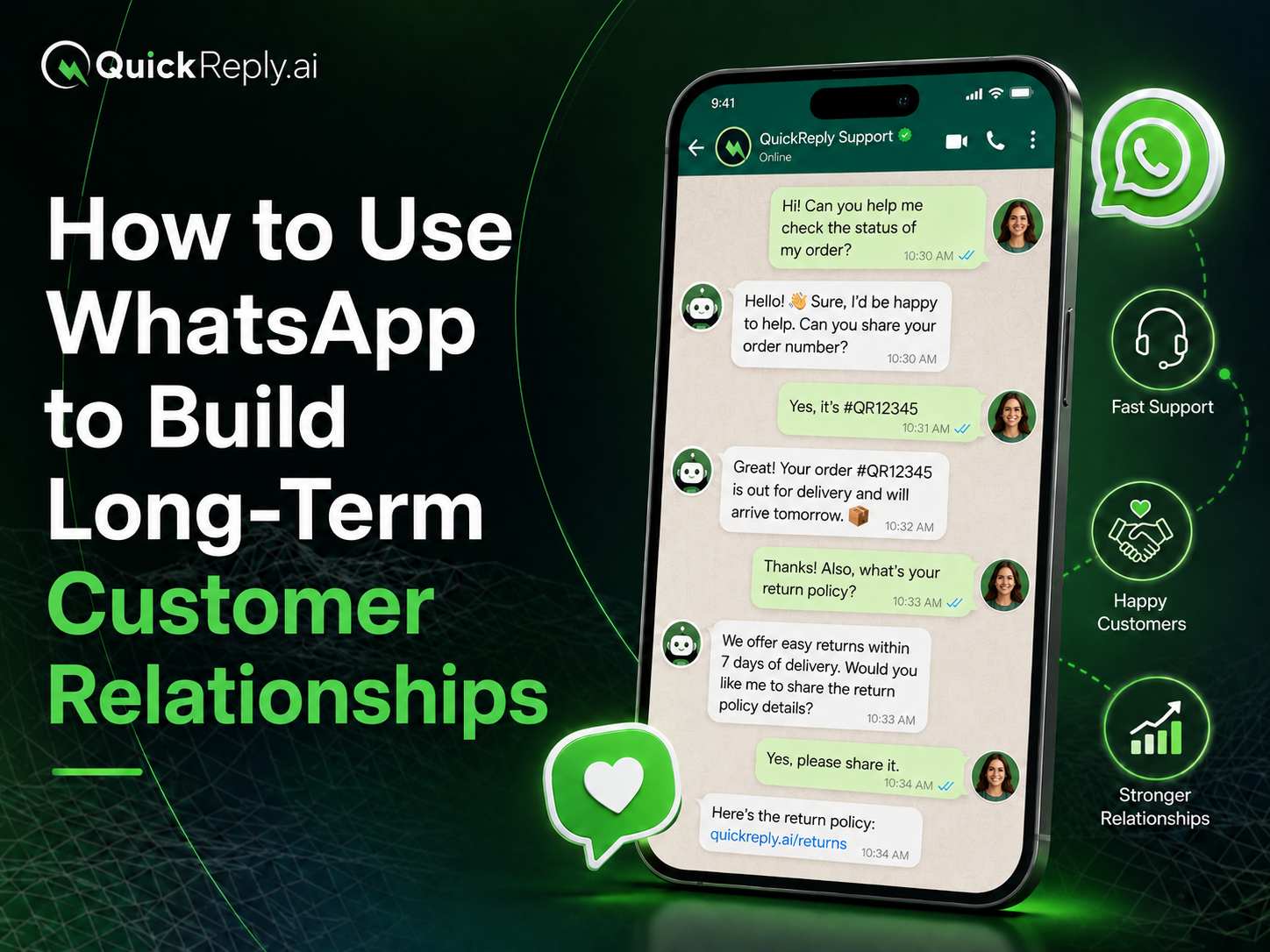
For small businesses, this matters because customer uses WhatsApp and other social channels frequently. A Gen AI customer support setup on WhatsApp or other channels can help answer repetitive questions, collect customer details, and move serious or complex issues to a human support agent.

QuickReply.ai is especially useful for:

  • Ecommerce brands handling orders, delivery, returns, refunds, and product queries on WhatsApp and other channels like Instagram, Messenger, and Website
  • Small businesses that want faster replies without hiring a large support team
  • Teams that want automation plus agent takeover from the same customer conversation
  • Brands that want WhatsApp support to feel conversational instead of robotic
  • Startups that are looking for integration capabilities with popular CRM tools like HubSpot, Salesforce, Zendesk, Zapier, Zoho, etc.

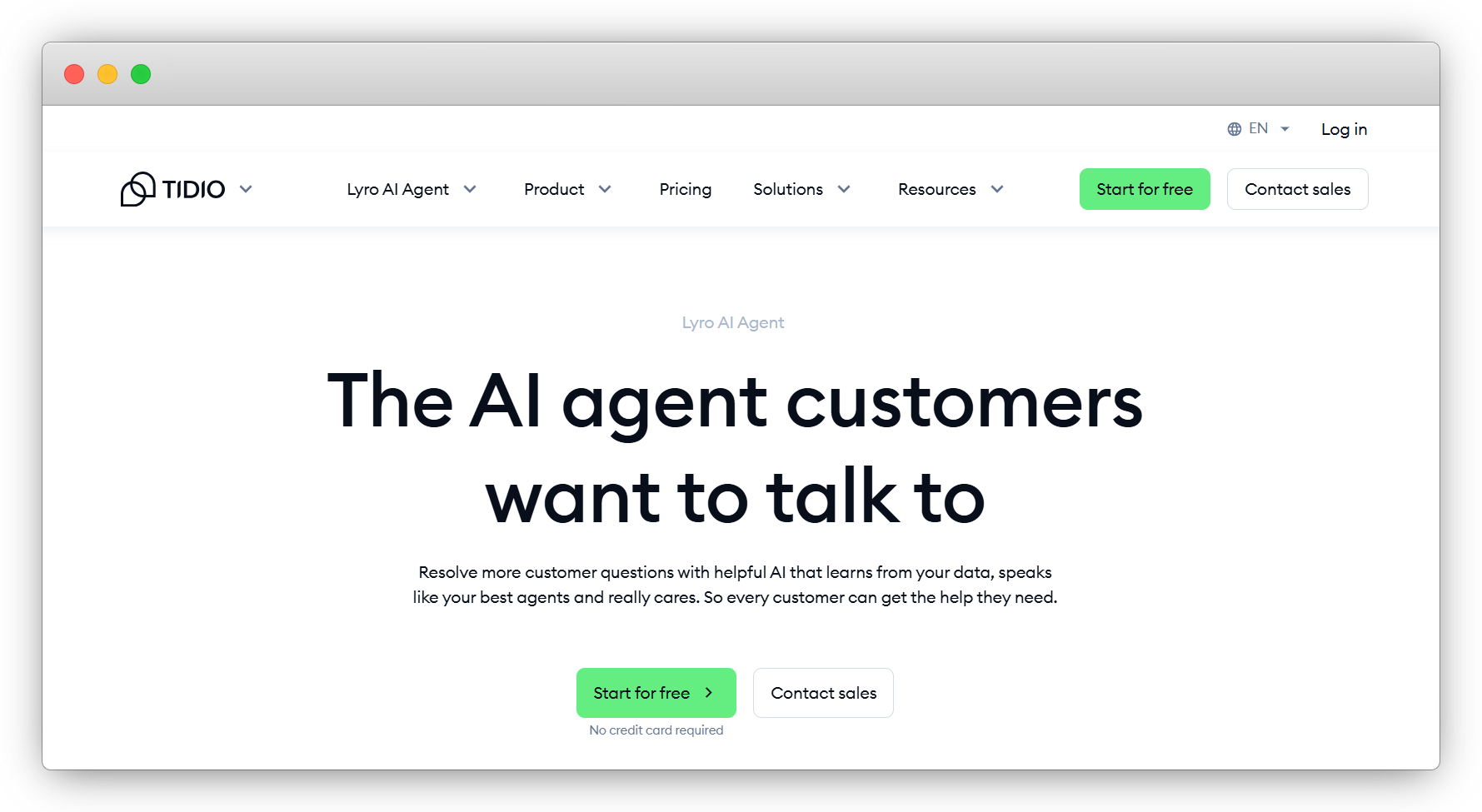
2. Tidio Lyro

Tidio Lyro

Tidio Lyro is another option for small businesses that want an AI customer service agent for website chat and online store support. Lyro can use support content to answer customer questions and provide personalized assistance to multiple customers at once. If the question is outside its knowledge, it can create a ticket for a human agent.

This makes it useful for businesses that want to reduce repetitive live chat queries without fully replacing the support team.

Tidio Lyro is especially useful for:

  • Small ecommerce websites
  • Businesses that receive repetitive website chat queries
  • Teams that want a quick AI setup from existing support content

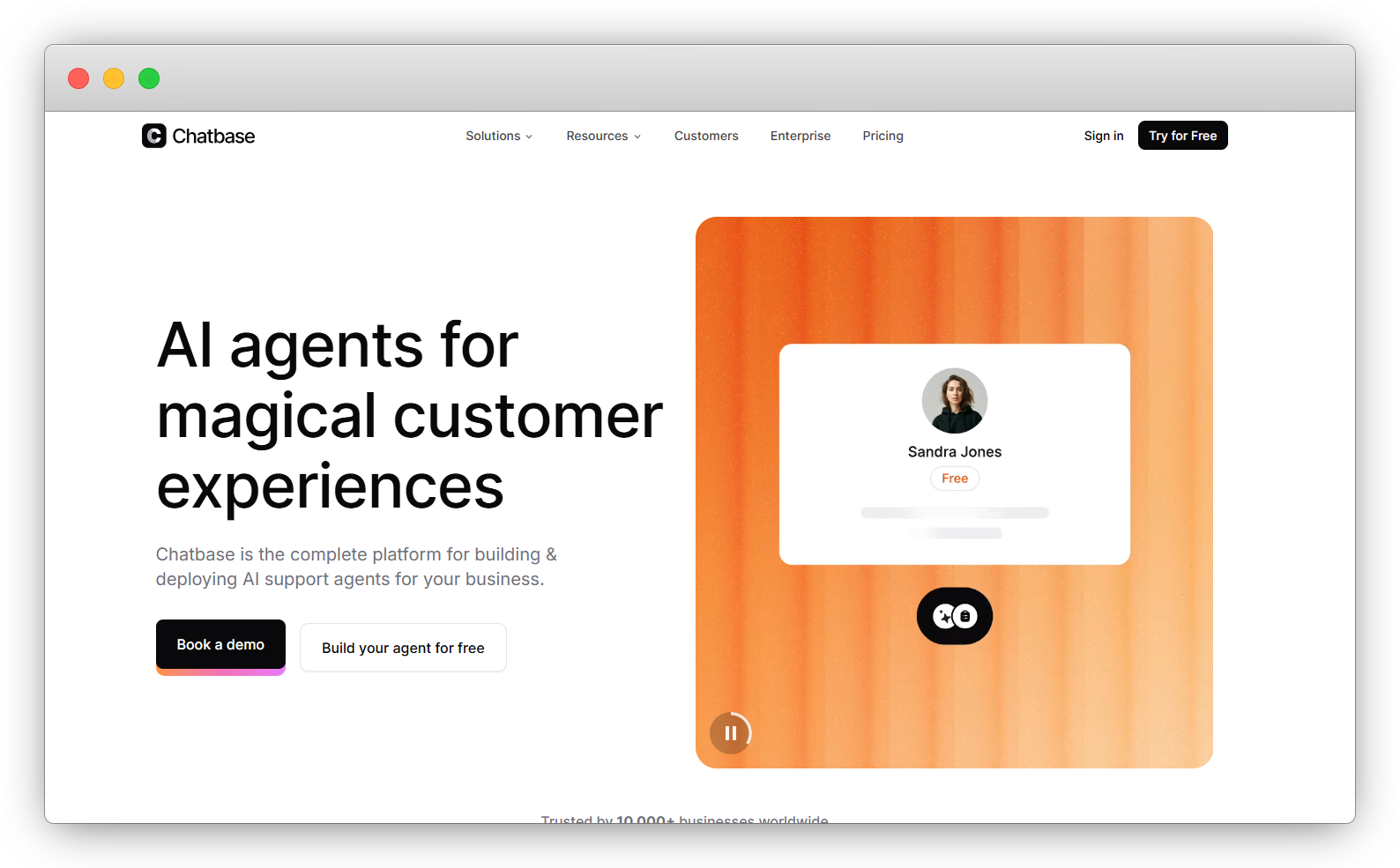
3. Chatbase

Chatbase

Chatbase is useful for startups and small businesses that want to create an AI support agent quickly. It allows businesses to build AI agents trained on their own data, such as website content, help docs, FAQs, and support material. It is a good fit for teams that do not want a full helpdesk setup yet, but still want an AI assistant that can answer common questions.

Chatbase is especially useful for:

  • SaaS startups
  • Early-stage companies with help docs or FAQs
  • Teams that want a fast, no-code AI support bot

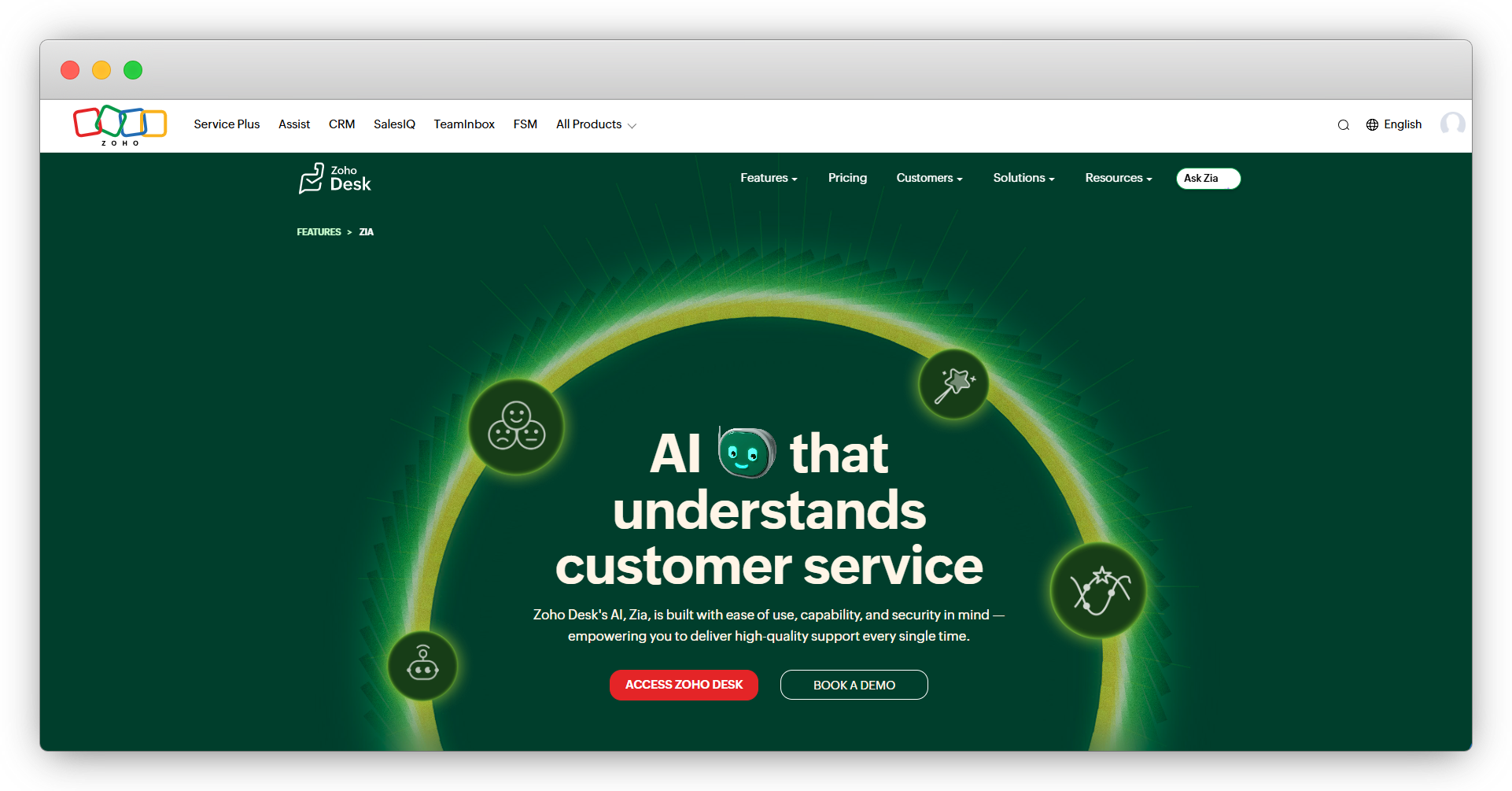
4. Zoho Desk with Zia

Zoho Desk With Zia

Zoho Desk with Zia is another option available for small businesses that want a proper helpdesk system with built-in AI assistance. Zia is an AI assistant designed to improve customer support, with generative AI capabilities like ticket summarization, tone analysis, reply assistance, content generation, and writing assistance built into Zoho Desk. 

This tool helps support agents work faster by summarizing tickets, improving replies, and reducing manual effort.

Zoho Desk with Zia is especially useful for:

  • Small businesses already using Zoho products
  • Teams that need ticketing plus AI assistance
  • Businesses that want affordable AI without adding many separate tools

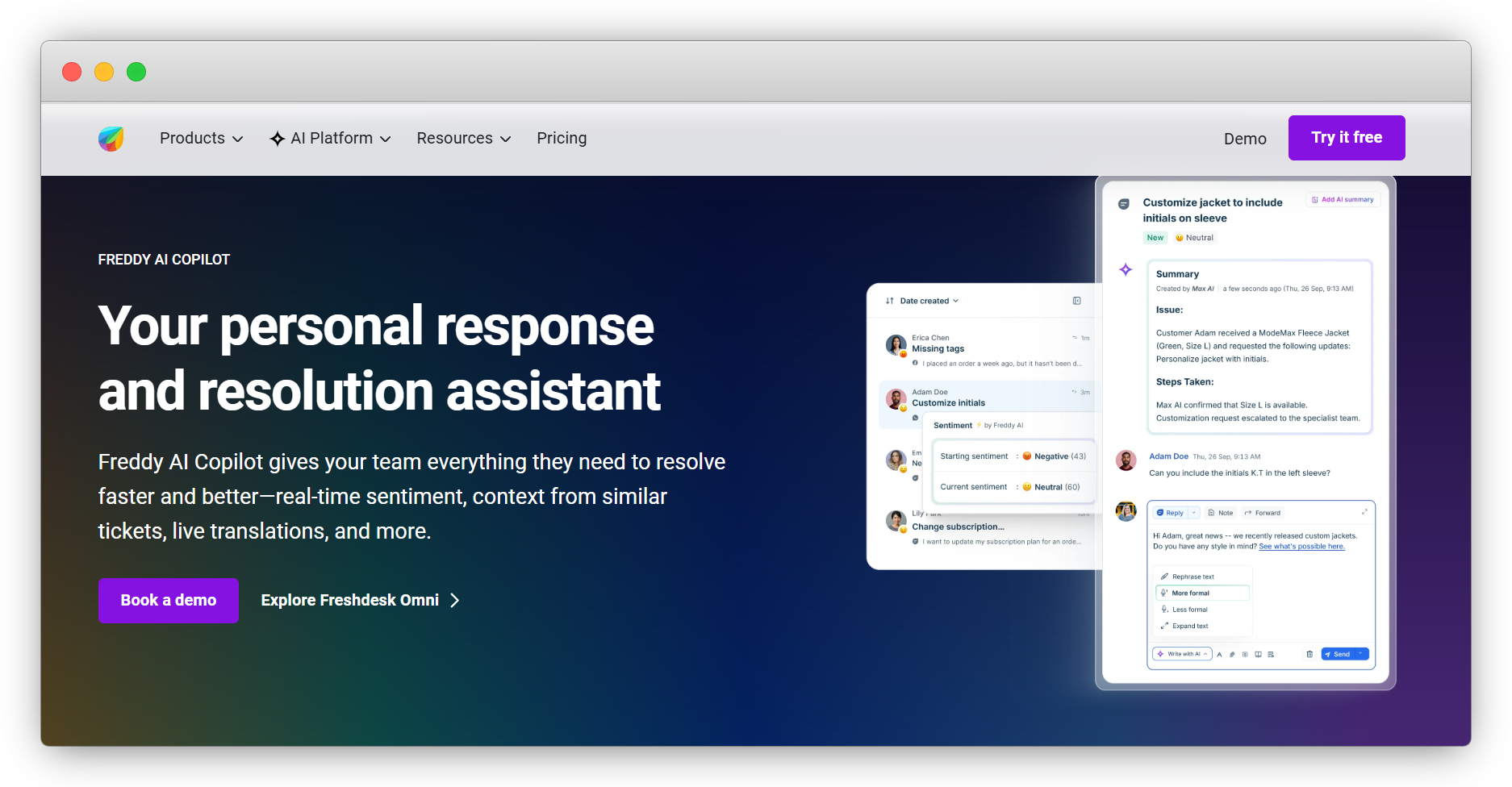
5. Freshdesk with Freddy AI

Freshdesk with Freddy AI Copilot

Freshdesk is a good option for small businesses that want a helpdesk platform and plan to add AI gradually. Freshdesk offers AI agents, Freddy AI Copilot, and AI Insights to help teams resolve repetitive queries, summarize tickets, suggest replies, and improve support productivity. 

Freshdesk is especially useful when customer service starts becoming more structured, and the business needs ticketing, reporting, routing, and agent workflows, along with AI.

Freshdesk with Freddy AI is especially useful for:

  • Small teams moving from shared inboxes to a helpdesk
  • Businesses that need ticketing and AI in one place
  • Teams that want AI summaries, reply suggestions, and agent assistance

6. Help Scout AI

Help Scout AI

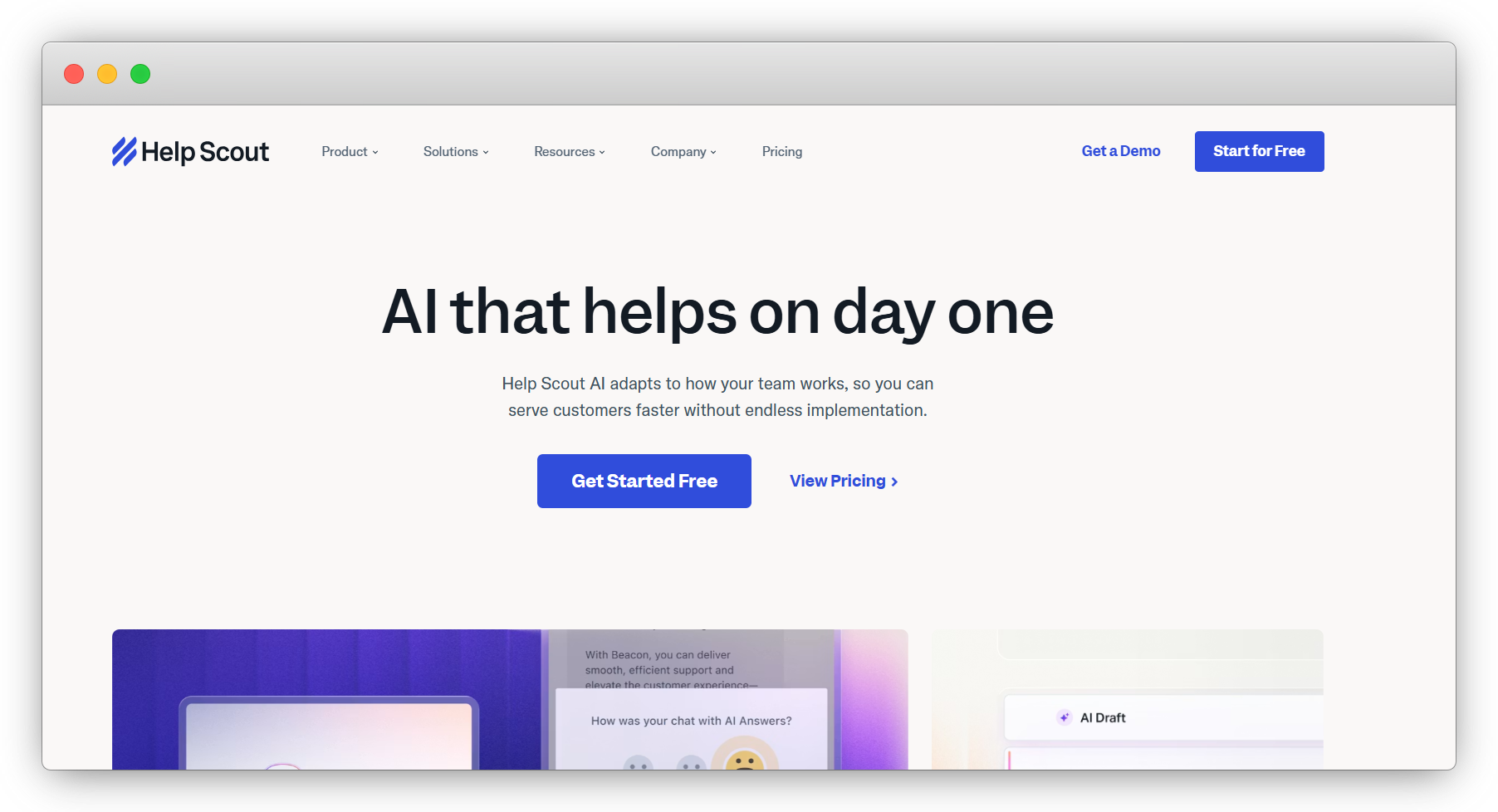
Help Scout is a decent option for small businesses that manage customer support mostly through email, shared inboxes, and help docs. Its AI Answers feature helps customers get answers from help content, while AI Drafts can help support teams create replies faster.

Help Scout is especially useful for:

  • Email-first customer support teams
  • Small SaaS and service businesses
  • Teams that want a clean shared inbox with AI support

7. Intercom Fin

Intercom Fin

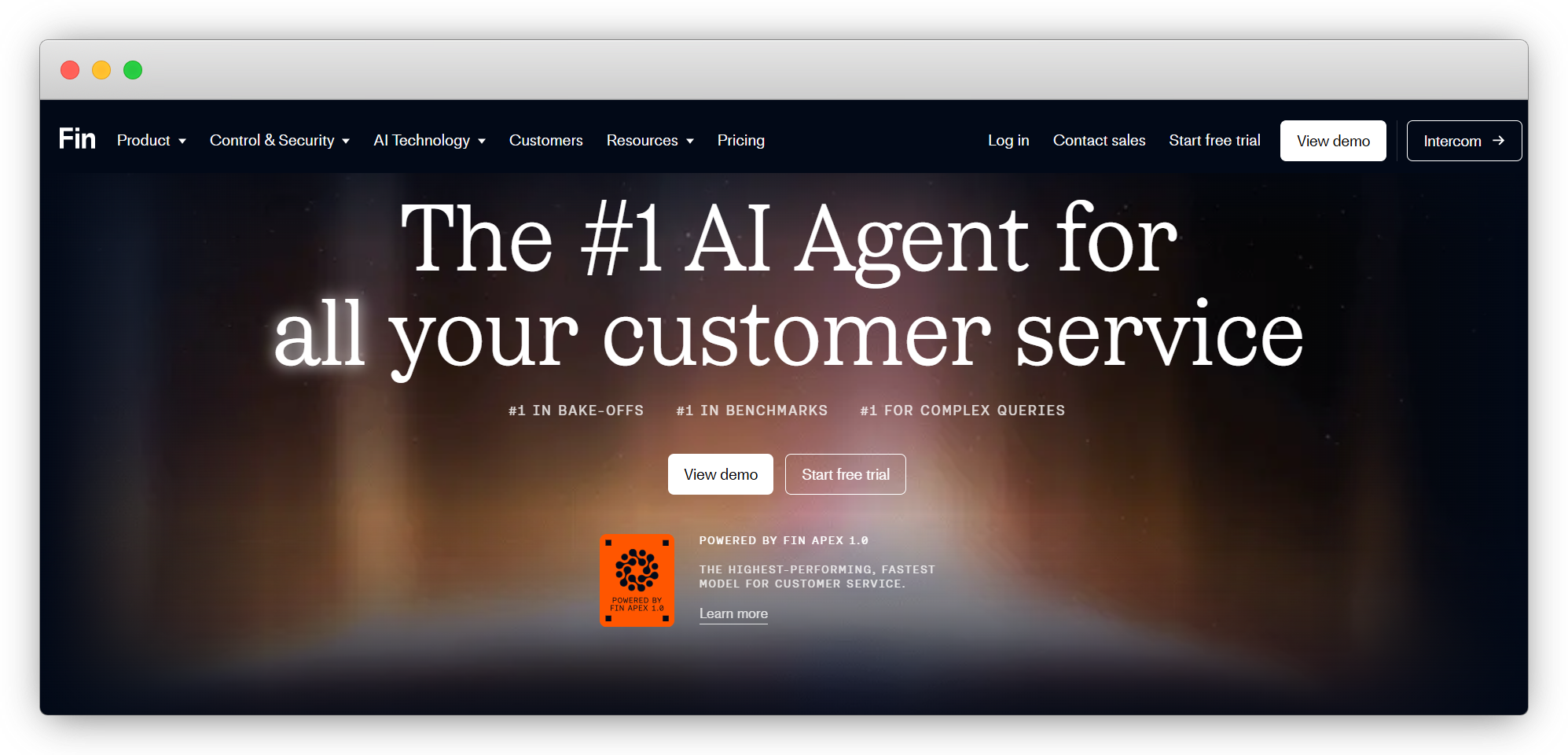
Intercom Fin is another option for growing small businesses that want an advanced AI customer service agent. It is designed to answer customer questions, resolve common queries, and support customers across multiple channels like chat, email, phone, and social. Intercom Fin can be trained on procedures, knowledge, and policies, then tested before going live, which is useful for businesses that want more control over AI responses.

Intercom Fin is especially useful for:

  • Startups that already use Intercom or want to move to an AI-first helpdesk
  • Businesses with a growing volume of chat and email support queries
  • Teams that want AI to answer, escalate, and improve support quality over time

8. Gorgias AI Agent

Gorgias AI Agent

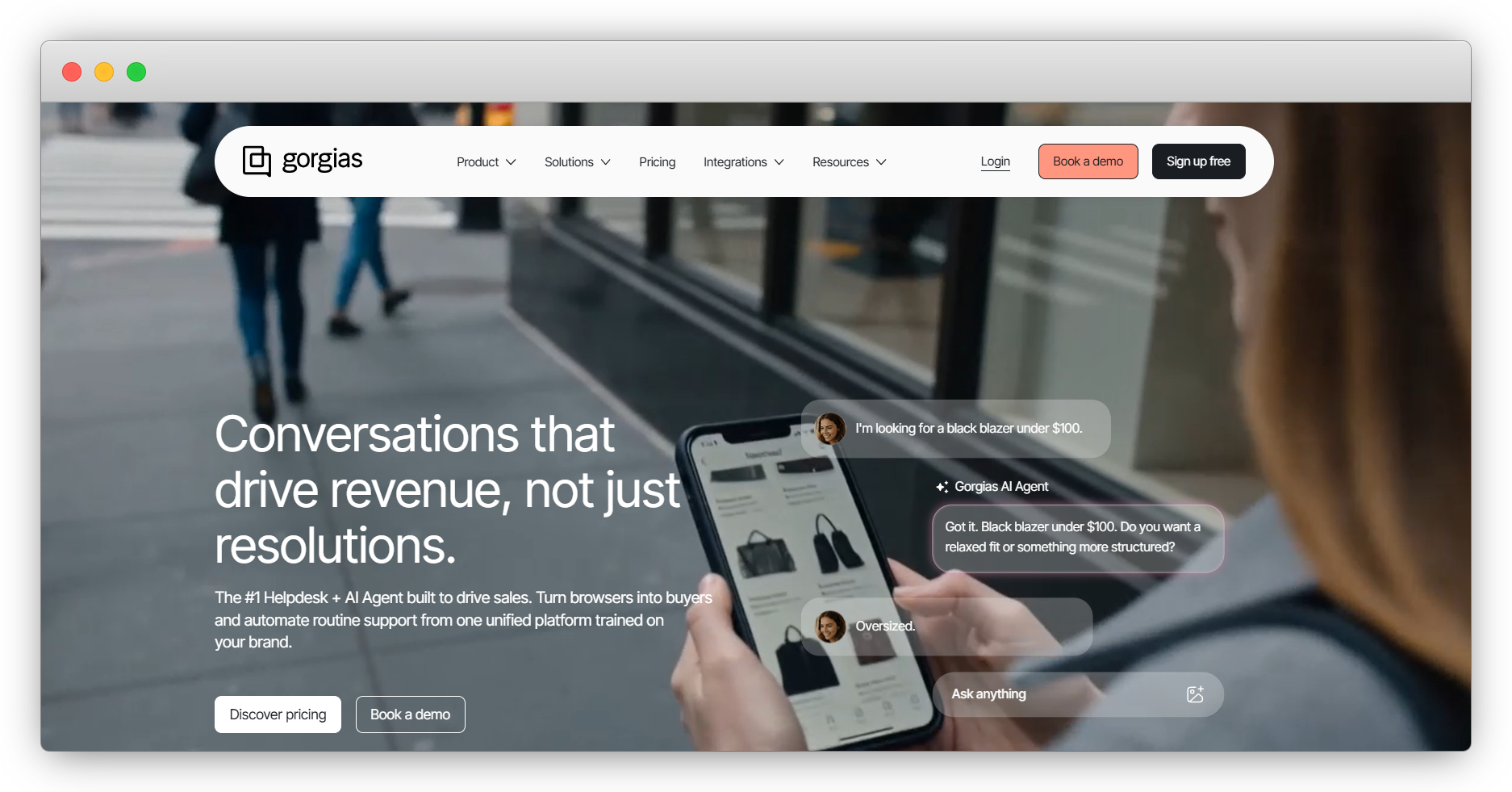
Gorgias is a decent option for ecommerce brands, especially Shopify stores. It combines helpdesk, AI agent, live customer context, and ecommerce support workflows. Its AI Agent is trained on ecommerce, Shopify data, and customer intent, and can escalate conversations to human agents with context. 

Gorgias is especially useful for:

  • Shopify and ecommerce brands
  • Teams that need order and customer context inside support conversations
  • Brands handling repetitive ecommerce support tickets

Avoid Common Mistakes When Choosing AI Customer Service Tools

Choosing an AI customer service tool should not be based only on price or popularity. A tool may look affordable on paper, but if it does not match your support workflow, it can create more confusion than savings.

Here are the common mistakes small businesses should avoid:

  • Choosing only the cheapest tool: Low pricing is useful only when the tool actually reduces support workload. Check what is included in the plan, such as AI responses, chatbot setup, integrations, human handoff, analytics, and support channels.
  • Ignoring where your customers actually message you: If most customers contact you on WhatsApp, Instagram, Messenger, or website chat, do not choose a tool that only works well for email support. Pick a platform that supports your main customer communication channels.
  • Not checking human handoff: AI should not handle every conversation alone. Serious complaints, refund issues, angry customers, payment problems, and high-value queries should move smoothly to a human agent.
  • Using AI without training it properly: A Gen AI tool needs the right business information. Train it using FAQs, product details, return policies, shipping rules, service guidelines, pricing information, and internal support playbooks.
  • Not setting boundaries for AI replies: The AI should know what it can answer and what it should not answer. For example, it should not make false promises about refunds, delivery dates, discounts, or medical, legal, or financial advice.
  • Forgetting customer context: A good AI customer service tool should not answer every customer like a stranger. It should use available context such as order status, previous conversations, booking details, lead stage, or customer type. It should have the capabilities to save and recall the conversation to better responses.
  • Overlooking integrations: If the AI tool does not connect with your ecommerce platform, CRM, helpdesk, payment system, or internal tools, your team may still need to do most of the work manually.
  • Not reviewing AI performance: Small businesses should regularly check which queries AI is solving, where it is failing, what customers are asking most often, and which conversations are getting escalated to agents.
  • Assuming AI will replace the full support team: AI works best when it supports the team, not when it is treated as a complete replacement. The goal is to automate repetitive conversations and let human agents focus on issues that need judgment.
  • Not calculating total cost: Some tools charge by seat, some by conversation, some by resolution, and some by AI usage. Always estimate cost based on your actual support volume, not just the starting plan.

The right AI customer service tool should reduce manual effort, improve customer experience, and fit the way your business already supports customers.

Why Choose QuickReply.ai as an AI Customer Service Solution

Small businesses need customer support that is fast, affordable, and easy to manage. But they also need flexibility because customers do not stay on one channel anymore. One customer may ask a product question on Instagram, another may raise a delivery issue on WhatsApp, and someone else may start a query from the website chatbot.

This is where QuickReply.ai becomes a strong option for small businesses.

QuickReply.ai allows businesses to automate customer support across multiple channels, including WhatsApp, Instagram, Messenger, website chatbots, and RCS. 

For customer service, this means a small business can manage conversations from different channels. Instead of switching between tools, teams can use QuickReply.ai to automate common queries, build chatbot journeys, and hand over complex conversations to agents when needed.

For businesses that want one platform to manage AI-led customer conversations across WhatsApp, Instagram, Messenger, website chatbots, and RCS, QuickReply.ai can work like an omnichannel customer support automation platform. It helps small businesses reduce repetitive support work, improve response speed, and keep human agents available for the conversations that truly need personal attention.

Turn 1 time visitor into repeat customer with WhatsApp marketing

Leverage the untapped growth potential of WhatsApp marketing to acquire and retain customers.

Frequently Asked Questions

What are generative AI customer service solutions?

Generative AI customer service solutions are tools that use AI to understand customer questions and generate helpful replies in natural language. Unlike basic chatbots that depend only on fixed buttons or pre-written scripts, Gen AI tools can understand customer intent, answer common queries, and escalate complex issues to a human support agent.

Why should small businesses use AI for customer service?

Small businesses should use AI for customer service because it helps reduce repetitive support work, improves response time, and keeps support available even when the team is offline. It allows small teams to handle more customer queries without hiring a large support team immediately.

Are generative AI services and solutions affordable for small businesses?

Yes, many generative AI services and solutions are now affordable for small businesses. Some tools offer starter plans, free trials, pay-per-resolution pricing, or low-cost monthly plans. However, businesses should compare the total cost, including agent seats, AI usage, message volume, integrations, and setup support.

Can AI customer service tools replace human support agents?

AI customer service tools should not fully replace human support agents. They work best when they handle repetitive questions and simple tasks, while human agents manage complex, sensitive, urgent, or high-value customer conversations. The best setup is AI plus human support, not AI instead of human support.

What type of customer queries can Gen AI handle?

Gen AI can handle common customer queries related to order status, delivery timelines, returns, refunds, product details, appointment bookings, pricing, discounts, store policies, and basic troubleshooting. It can also collect customer information before passing the conversation to a human agent.

What is the difference between a basic chatbot and a Gen AI customer service tool?

A basic chatbot usually follows fixed flows and works well only when customers choose predefined options. A Gen AI customer service tool can understand natural language, identify intent, generate replies, and manage more flexible conversations. This makes it more useful for real customer support, where people ask questions in different ways.

Which is the best affordable AI customer service tool for small businesses?

The best affordable AI customer service tool depends on your business type and support channel. QuickReply.ai is a strong option for small businesses that want to automate customer support across WhatsApp, Instagram, Messenger, website, and RCS.  

Can AI customer service tools work on WhatsApp?

Yes, some AI customer service tools can work on WhatsApp. For small businesses, WhatsApp support is useful because many customers prefer asking questions directly through messaging. A platform like QuickReply.ai can help automate WhatsApp customer support, answer common queries, and hand over complex conversations to agents.

Is AI customer service useful for ecommerce businesses?

Yes, AI customer service is very useful for ecommerce businesses. It can help answer repetitive questions about order tracking, delivery delays, returns, refunds, size availability, product recommendations, discounts, and payment issues. This reduces support workload and helps customers get faster answers.