How RCS Automation Improves Customer Engagement for Telecom Providers?

Copied to clipboard!

Telecom operators have relied on SMS for years to reach customers at scale. From recharge reminders and bill alerts to plan offers, service updates, OTPs, outage notifications, and usage warnings, SMS has been the default communication channel because it is simple, fast, and widely available.

But the problem is not reach anymore. The problem is engagement.

Most telecom messages look and feel the same to customers. A plain SMS from a telecom provider is often seen as just another promotional message, even when it carries useful information. There is no visual context, no guided next step, and no easy way for the customer to respond meaningfully. 

In most cases, the message either gets ignored or pushes the customer to another channel, such as a call center, website, app, or retail store.

For telecom operators, this creates two major challenges.

First, important communication does not always lead to action. A customer may receive a recharge reminder but may not complete the recharge. They may receive a data-pack offer, but may not understand which plan is right for them. They may receive an outage update but still call support because they need more clarity.

Second, support teams continue to handle repetitive questions that could have been resolved instantly. Customers often contact telecom support for simple issues like balance checks, recharge status, bill details, plan validity, network complaints, SIM activation, roaming packs, or service request updates. When these queries pile up, manual teams spend time on low-complexity issues instead of focusing on cases that genuinely need human assistance.

This is where RCS, combined with automation, becomes valuable for telecom providers.

RCS does not just give telecom operators a better-looking version of SMS. It gives them a two-way communication channel where messages can become interactive service journeys. 

Instead of only sending reminders, offers, or alerts, telecom providers can let customers reply, select options, ask questions, confirm actions, view relevant plans, raise requests, and get instant answers inside the same messaging experience.

With automation, RCS can also handle common customer queries without depending on manual support for every small issue. A customer asking about bill amount, plan expiry, recharge failure, data balance, roaming charges, or service status can be guided through an automated flow and receive an immediate answer. Only complex or unresolved cases need to be moved to a human agent.

For telecom operators, this changes the role of messaging. It is no longer just a broadcast channel. It becomes a customer engagement, support, and self-service channel that can improve response rates, reduce support load, and make routine customer interactions easier to manage.

This blog explores how RCS and automation can help telecom providers move beyond one-way SMS communication and build more useful, interactive, and scalable customer engagement journeys.

What RCS Changes Compared to SMS

SMS has been useful for telecom operators because it is simple, fast, and widely available. It works well when the goal is to send a short update, such as an OTP, recharge reminder, bill alert, or service notification. 

But SMS has one major limitation: it usually ends after the message is delivered.

A telecom operator can send information, but the customer cannot easily continue the interaction from that message. If they want to ask a question, compare plans, check recharge status, raise a complaint, or understand a bill, they are pushed to another channel like the app, website, call center, or store.

RCS changes this by turning telecom messaging into a two-way, action-led experience. It allows telecom providers to send richer messages, guide customers through simple next steps, answer common questions, and automate basic support inside the same messaging thread.

Here is how RCS is different from SMS in a telecom context:

Area SMS RCS Telecom example
Type of communication Mostly one-way. The operator sends the message, and the customer has limited ways to respond. Two-way. Customers can reply, choose options, tap buttons, and continue the conversation. A recharge reminder can include options like “Recharge same plan,” “View other plans,” and “Need help.”
Message presentation Plain text with limited space and no visual structure. Richer format with images, cards, buttons, links, and carousels. A telecom provider can show 3 prepaid plans with validity, data, price, and CTA buttons instead of sending a long text message.
Customer action Usually depends on the customer opening a link, app, website, or calling support. Actions can be built into the message journey itself. A customer can check bill amount, select payment option, and move toward payment from the same conversation.
Support handling Not suitable for resolving customer questions directly. Common queries can be handled through automated flows before involving human agents. Customers can check data balance, plan validity, recharge status, SIM activation, or complaint status without calling support.
Personalization Mostly limited to basic details like name, due date, or generic offer text. Can create contextual journeys based on plan, usage, location, lifecycle stage, or customer query. A customer nearing data exhaustion can receive a relevant data add-on, while a roaming customer can receive international pack options.
Trust and recognition Telecom SMS can easily look like another promotional message. Verified branding and richer formatting make the sender easier to identify. Customers can clearly recognize that the message is from their telecom provider, not an unknown promotional sender.
Engagement tracking Limited visibility beyond delivery and link clicks. Better visibility into reads, replies, button clicks, and journey progress. Operators can see whether customers viewed a plan, clicked recharge, asked for help, or dropped off before completing the action.

The core difference is simple.

SMS helps telecom operators send information.

RCS helps them start and manage useful interactions.

For example, with SMS, a telecom operator may send a message saying:

“Your plan expires tomorrow. Recharge now: [CTA link]”

With RCS, the same message can become an interactive flow. The customer can see their current plan, compare recommended packs, tap to recharge, ask a question, or request support without leaving the messaging experience.

This makes RCS especially useful for telecom providers because customer engagement is not only about sending more messages. It is about helping customers complete small but important actions faster, whether that means recharging a plan, understanding a bill, activating roaming, checking service status, or resolving a basic support query.

RCS does not replace every telecom channel. Customers may still use apps, websites, stores, and call centers for different needs. But it gives telecom operators a stronger messaging layer for everyday interactions that are too important to ignore and too repetitive to send only to manual support teams.

Where Automation Fits In

RCS gives telecom operators a better channel for communication, but automation is what makes that channel scalable. 

Without automation, RCS would still depend on manual teams to respond to customer replies, answer questions, recommend plans, confirm requests, and guide users through the next step. That would not be practical for telecom providers because the volume of customer interactions is too high. 

Automation solves this by making RCS conversations responsive, structured, and useful without requiring a human agent for every small query.

For example, a telecom provider may send an RCS reminder for an expiring prepaid plan. If the customer taps “View Plans,” automation can show relevant recharge options. If the customer taps “Need Help,” automation can ask what they need help with. If the customer says “My recharge failed,” the system can check the recharge status, share the reason, and guide the customer to retry or raise a ticket.

This is where RCS becomes more than a message. It becomes a guided customer journey.

Automation can support telecom engagement in a few important ways.

First, it can handle common support queries instantly. Customers often contact telecom support for repetitive questions like:

Customer query How automation can help through RCS
“What is my current plan?” Show current plan, validity, benefits, and renewal options.
“How much data is left?” Fetch balance details and suggest add-on packs if usage is high.
“Why did my recharge fail?” Check recharge status and guide the customer to retry, wait, or raise a complaint.
“When does my plan expire?” Share expiry date and show renewal options.
“How do I activate roaming?” Show available roaming packs and guide the customer through activation.
“What is my bill amount?” Share bill summary, due date, and payment options.
“What is the status of my complaint?” Fetch ticket status and share the latest update.

These are not always complex issues, but they consume a lot of support bandwidth when handled manually. With RCS automation, telecom operators can resolve many of these questions before they reach a call center agent.

Second, automation can guide customers after they interact with a message. This is especially important because engagement does not stop at the first click. Once a customer taps a button or replies to a message, the system should know what to do next.

For example:

A customer taps “Upgrade Plan”: The automation shows recommended plans based on usage
The customer selects a plan: The automation shares the benefits and price
The customer taps “Confirm”: The automation redirects to payment or completes the request
The customer receives confirmation inside the same conversation

This type of guided flow can be used for recharge reminders, bill payments, add-on packs, roaming activation, SIM upgrades, service requests, and retention offers.

Third, automation can make reminders and offers more relevant. Instead of sending the same message to every subscriber, telecom operators can trigger messages based on customer behavior, usage, plan type, payment cycle, or lifecycle stage.

For example:

Trigger Automated RCS journey
Plan expires in 2 days Send renewal reminder with current plan and recommended alternatives.
Customer uses 90% of data Suggest relevant data booster packs.
Bill due date is close Send bill summary with payment CTA and support option.
Customer enters roaming zone Share roaming packs and activation steps.
Customer has repeated recharge failures Offer troubleshooting steps or connect to support.
Customer has low usage for many days Send personalized engagement or retention offer.

This makes communication more timely and more useful. The customer receives a message that matches their current need, and the telecom operator gets a better chance of driving action.

AI automation and generative AI can add another layer to this experience.

Rule-based automation is useful when the flow is predictable, such as “check balance,” “view bill,” or “renew plan.” Generative AI becomes useful when the customer asks questions in natural language or does not follow a fixed flow.

For example, a customer may not type “Check data balance.” They may write:

“Why is my internet slow?”
“My recharge is done, but data is not working.”
“I am travelling to Dubai tomorrow, what should I activate?”
“I paid my bill, but still got a reminder.”

Generative AI can understand the intent behind these messages, ask follow-up questions if needed, and guide the customer to the right automated flow. It can also summarize the issue for a human agent when escalation is required.

This helps telecom operators create a better support experience without making every customer interaction dependent on manual support. 

However, AI should not work alone in sensitive telecom journeys. It should be connected with clear rules, verified customer data, approved responses, and proper escalation paths. For example, AI can explain available roaming options, but billing details, recharge status, service tickets, and plan changes should come from trusted backend systems.

The best setup is a combination of:

  • Rule-based automation for fixed journeys
  • AI automation for understanding customer intent
  • Generative AI for natural language responses and support guidance
  • Human handover for complex, sensitive, or unresolved issues

This balance is important for telecom providers. It allows them to automate repetitive interactions while still keeping control over accuracy, compliance, and customer experience.

In short, RCS creates the interactive channel. Automation makes that channel practical at telecom scale.

Together, they help operators move from one-way communication to guided engagement, instant support, and smarter customer journeys.

Key RCS Automation Use Cases for Telecom Providers

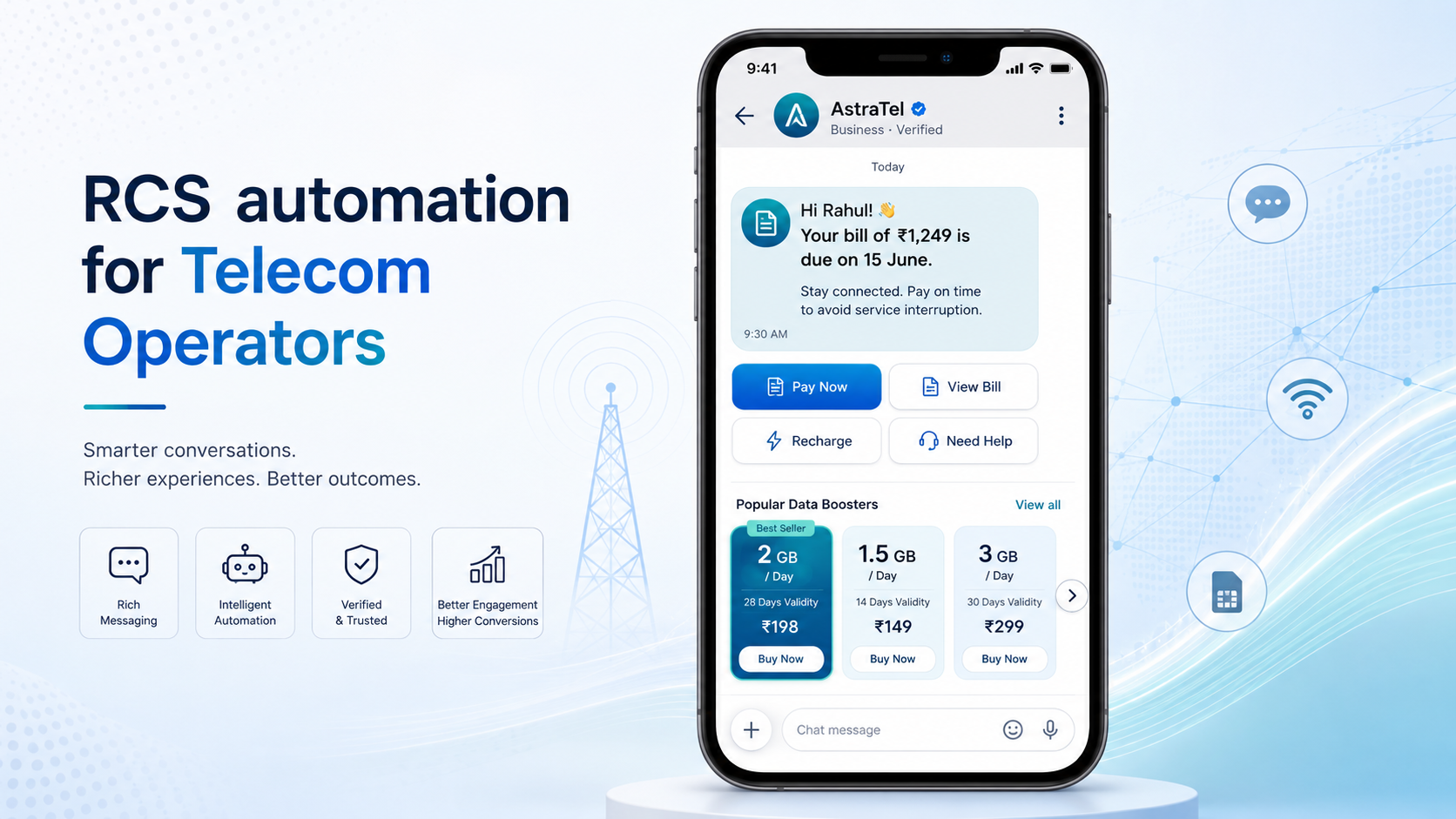
RCS Automation for Telecom Operators

RCS and automation can be useful across many telecom customer journeys. The strongest use cases are not only about sending better-looking messages. They are about helping customers complete routine actions, get quick answers, and avoid unnecessary calls to support teams.

Here are some practical ways telecom providers can use RCS automation to improve customer engagement.

1. Recharge reminders with guided plan selection

Recharge reminders are one of the most common telecom messages. With SMS, the operator usually sends a short reminder with a link. But many customers either ignore it or delay the recharge because the next step is not clear enough.

With RCS, the reminder can become a guided renewal journey.

For example, instead of sending:

“Your plan is expiring today. Recharge immediately: [link]”

The telecom provider can send an RCS message that shows:

  • Current plan details
  • Expiry date
  • Recommended renewal plan
  • Alternative plans based on usage
  • Buttons like “Recharge Same Plan,” “View More Plans,” and “Need Help

If the customer taps “View More Plans,” automation can show a few relevant options instead of making the customer search manually. If the customer taps “Need Help,” the flow can answer common questions like plan validity, data limit, payment failure, or recharge status.

This makes the reminder more useful because it does not stop at awareness. It helps the customer move toward action.

2. Bill payment reminders and payment support

Postpaid bill reminders are important, but they often create follow-up questions. Customers may want to know why the bill amount is higher than usual, what the due date is, whether their payment was successful, or how to download the bill.

With RCS automation, telecom operators can send a bill reminder that gives customers useful options inside the same conversation.

Example flow:

Step RCS automation experience
Message sent “Your bill of ₹1,249 is due on 15 June.”
Options shown “Pay Now,” “View Bill Breakup,” “Download Bill,” “Need Help”
Customer taps “View Bill Breakup” Automation shows plan charges, add-on charges, roaming charges, taxes, and previous dues.
Customer taps “Need Help” Automation asks whether the issue is related to payment, charges, due date, or bill download.
Escalation If the issue is complex, the conversation is routed to a support agent with context.

This reduces unnecessary support calls for simple billing questions while giving customers a clearer path to payment.

3. Data balance alerts and add-on pack recommendations

Telecom operators already send usage alerts when customers are close to exhausting their data. But a plain SMS alert usually gives limited context and often fails to guide the customer to the right add-on.

RCS can make these alerts more actionable.

For example:

“Hi, you have used 90% of your daily data. Need more data for today?”

The message can show add-on options like:

Pack Benefit Validity CTA
₹29 Data Booster 2GB data 1 day Activate
₹49 Data Booster 5GB data 1 day Activate
₹98 Data Pack 6GB data 7 days Activate

If the customer selects a pack, automation can confirm the choice, share payment or activation steps, and send confirmation once activated.

This use case is valuable because the message is triggered at the right moment. The customer has an immediate need, and RCS helps the telecom provider respond to that need without making the customer search for options.

4. Roaming pack activation

Roaming is another strong use case because customers often need clarity before they travel. They may not know which pack to activate, what countries are covered, what the charges are, or whether roaming is already active.

RCS automation can guide customers through this journey.

For example, when a customer lands in another country or searches for roaming details, the operator can send:

“You seem to be travelling internationally. Would you like to view roaming packs for your location?”

The customer can choose:

  • View roaming packs
  • Check current roaming status
  • Understand charges
  • Talk to support

Automation can then recommend packs based on destination, travel duration, and customer plan type.

Example:

“Here are the recommended roaming packs for UAE.”

Pack Benefits Validity Action
1-Day Pack Calls + 1GB data 24 hours Activate
7-Day Pack Calls + 5GB data 7 days Activate
30-Day Pack Calls + 15GB data 30 days Activate

This helps telecom operators reduce confusion around roaming charges and gives customers a faster way to activate the right pack.

5. Common support query automation

A large part of telecom support volume comes from repetitive questions. These questions are important to customers, but they do not always need a human agent.

RCS automation can handle these common support journeys directly.

Examples include:

Customer need Automated RCS response
Check current plan Shows plan name, validity, benefits, and renewal options.
Check data balance Shows remaining data and suggests add-on packs if needed.
Recharge failed Checks transaction status and guides the customer to retry or wait.
Bill not updated after payment Checks payment status and shares expected update time.
SIM not working Shares troubleshooting steps and option to raise a ticket.
Complaint status Shows latest ticket status and expected resolution time.
Network issue Collects location, issue type, and device details before escalating.

This is where RCS automation becomes a support layer, not just a marketing channel. It helps customers resolve small issues quickly while reducing the pressure on call centers and manual support teams.

6. Plan upgrade and cross-sell journeys

Telecom operators regularly promote higher-value plans, family packs, OTT bundles, data boosters, and international calling packs. But generic promotional SMS often gets ignored because it does not explain why the offer is relevant.

With RCS automation, offers can be based on customer behavior and presented in a more guided way.

For example:

A customer frequently runs out of data before the end of the plan cycle.

Instead of sending a generic upgrade message, the operator can send:

“You have used extra data 4 times this month. A higher-data plan may be more suitable for you.”

The RCS message can show:

  • Current plan
  • Recommended upgrade
  • Extra benefits
  • Monthly cost difference
  • CTA to compare plans

The customer can then tap:

  • “Compare Plans”
  • “Upgrade Now”
  • “Remind Me Later”
  • “Ask a Question”

Automation can answer basic questions like validity, total cost, benefits, and activation time. If the customer still needs help, the journey can be passed to a sales or support agent.

This makes upsell communication more relevant and less intrusive.

7. Service outage and network update journeys

When there is a network issue or service outage, telecom support teams usually receive a high volume of calls from affected customers. Many of these calls are from customers asking the same basic questions: what happened, when will it be fixed, and whether they need to do anything.

RCS can help operators communicate proactively.

Example message:

“We are aware of a network issue in your area. Our team is working on it.”

The RCS journey can include:

  • Issue status
  • Expected resolution time
  • Troubleshooting steps
  • Option to get notified when resolved
  • Option to report if the issue continues

If the customer taps “Report Issue,” automation can collect details like location, device type, network mode, and issue type before creating a support ticket.

This gives customers better visibility and reduces repeated calls for the same outage.

8. SIM activation, KYC, and document-related journeys

SIM activation, KYC updates, eSIM activation, and document verification can involve multiple steps. When instructions are sent through SMS, customers may miss a step or contact support for clarification.

RCS automation can make these journeys easier to follow.

For example, a SIM activation journey can guide the customer through:

  1. Confirm mobile number
  2. Check activation status
  3. Share the required steps
  4. Provide troubleshooting help
  5. Escalate if activation is delayed

Similarly, for KYC or document updates, RCS can send clear instructions, show required documents, answer FAQs, and confirm submission status.

This is useful for telecom providers because these journeys are operationally important and often create avoidable support tickets when customers do not understand the next step.

9. Customer feedback and issue follow-up

After a support interaction, recharge, plan upgrade, or complaint resolution, telecom providers can use RCS to collect quick feedback.

Instead of sending a basic SMS link, RCS can ask:

“Was your issue resolved?”

Options:

  • Yes, resolved
  • No, still facing issue
  • Need a callback

If the customer chooses “No,” automation can ask for the issue type and route the case back to support with context. If the customer chooses “Need a callback,” the system can collect a preferred time slot.

This helps telecom operators close the loop instead of treating every interaction as complete once a message is sent.

10. Churn prevention and retention journeys

Telecom operators can also use RCS automation to identify and engage customers who may be at risk of churn. These signals may include low usage, repeated complaints, failed recharges, plan expiry without renewal, or declining engagement.

Instead of sending a generic retention offer, the operator can trigger a journey based on the customer’s situation.

For example:

Churn signal RCS automation journey
Plan expired and not renewed Send renewal options with a limited-period benefit.
Repeated network complaints Share ticket status, apology note, and escalation option.
Low usage for several weeks Ask if the customer needs a lower-cost plan or support.
Multiple failed recharge attempts Offer payment help or alternate payment options.
High bill shock Explain bill breakup and suggest a more suitable plan.

This makes retention communication more meaningful. The telecom provider is not just pushing another offer. It is responding to a specific reason that may cause the customer to leave.

Overall, these use cases show why RCS and automation work well together for telecom providers. RCS gives operators an interactive channel, while automation helps them manage high-volume customer interactions at scale.

The result is a messaging experience that can support marketing, service, support, payments, and retention from one channel.

Benefits for Telecom Providers

For telecom providers, RCS automation is not only about improving how messages look. The bigger value is operational. It helps telecom operators make routine customer communication more interactive, measurable, and easier to manage at scale.

Here are the key benefits.

Benefit What it means for telecom providers Example
Better response to routine communication Messages can include clear next steps instead of only sharing information. A recharge reminder can show plan options and guide the customer to renew the plan.
Reduced support load Common questions can be answered through automated flows before involving human agents. Customers can check bill amount, data balance, recharge status, or complaint status without calling support.
Faster issue resolution Customers can be guided step by step based on their query or selected option. If a recharge fails, automation can check the status and suggest the next action.
More relevant offers Offers can be triggered based on customer behavior, usage, plan type, or lifecycle stage. A customer using 90% of their data can receive a relevant data booster offer.
Improved customer journey visibility Telecom teams can track replies, clicks, drop-offs, and customer actions inside the journey. The operator can see how many customers viewed a plan, clicked recharge, or asked for help.
Better use of human support teams Agents can focus on complex cases while automation handles repetitive queries. Network complaints, billing disputes, and escalations can be routed to agents with context.
Stronger retention opportunities At-risk customers can be engaged with timely and relevant support or offers. A customer with repeated complaints can receive ticket updates, support options, and retention assistance.

The biggest advantage is that telecom providers can use messaging as an active service channel, not just a broadcast channel.

Instead of sending more messages and hoping customers respond, operators can create guided journeys where every interaction has a clear purpose. This can be a recharge, a payment, a plan upgrade, a support query, a complaint update, or a feedback request.

RCS automation also helps telecom operators manage scale better. Telecom customer bases are large, and even a small percentage of customers raising basic queries can create heavy support pressure. Automating common interactions can reduce that pressure without making the experience feel incomplete.

How to Implement RCS Automation Safely

RCS automation can improve telecom engagement, but it needs to be implemented carefully. Telecom communication often includes billing information, customer identity, service status, payment links, and support cases. This makes accuracy, consent, privacy, and escalation very important.

A safe implementation should focus on control, clarity, and proper routing.

Implementation area What telecom providers should do
Start with high-volume, low-risk use cases Begin with FAQs, recharge reminders, plan expiry alerts, bill summaries, data balance checks, and complaint status updates.
Use verified data sources Billing details, recharge status, plan validity, and complaint updates should come from trusted backend systems, not guessed responses.
Keep AI within clear boundaries Use AI to understand customer intent and guide the conversation, but avoid letting it invent plan details, charges, or policy answers.
Create clear escalation paths If the customer is angry, confused, or asking about a sensitive issue, the flow should route the conversation to a human agent.
Avoid over-messaging Do not use RCS only as another promotional channel. Send messages based on customer need, lifecycle stage, or useful triggers.
Make consent and opt-out easy Customers should clearly understand why they are receiving messages and how they can stop receiving promotional communication.
Monitor journey performance Track where customers click, reply, drop off, ask for help, or get escalated to support.
Review automated responses regularly Telecom plans, pricing, policies, and support rules change often, so automated flows should be updated frequently.

A good way to start is to divide RCS automation into three categories:

  1. Service journeys: These include bill details, recharge status, complaint status, network updates, SIM activation, and plan validity.
  2. Engagement journeys: These include recharge reminders, data booster suggestions, roaming pack recommendations, plan upgrades, and renewal nudges.
  3. Support journeys: These include FAQs, troubleshooting, payment issues, service requests, and escalation to human agents.

This approach helps telecom operators avoid a common mistake: using RCS only for promotional campaigns. The real value of RCS automation comes when it supports customer service, engagement, and revenue journeys together.

AI and generative AI can also be added gradually. For example, telecom providers can first use rule-based flows for fixed queries like “check balance” or “view bill.” Once the basic journeys are stable, AI can be used to understand natural language queries such as “Why is my internet not working?” or “I paid my bill but still got a reminder.”

This keeps the experience useful without losing control over accuracy.

Automate Your Customer Engagement With QuickReply.ai

Telecom providers do not need RCS only to send better-looking messages. They need a way to turn customer communication into automated, measurable, and useful journeys.

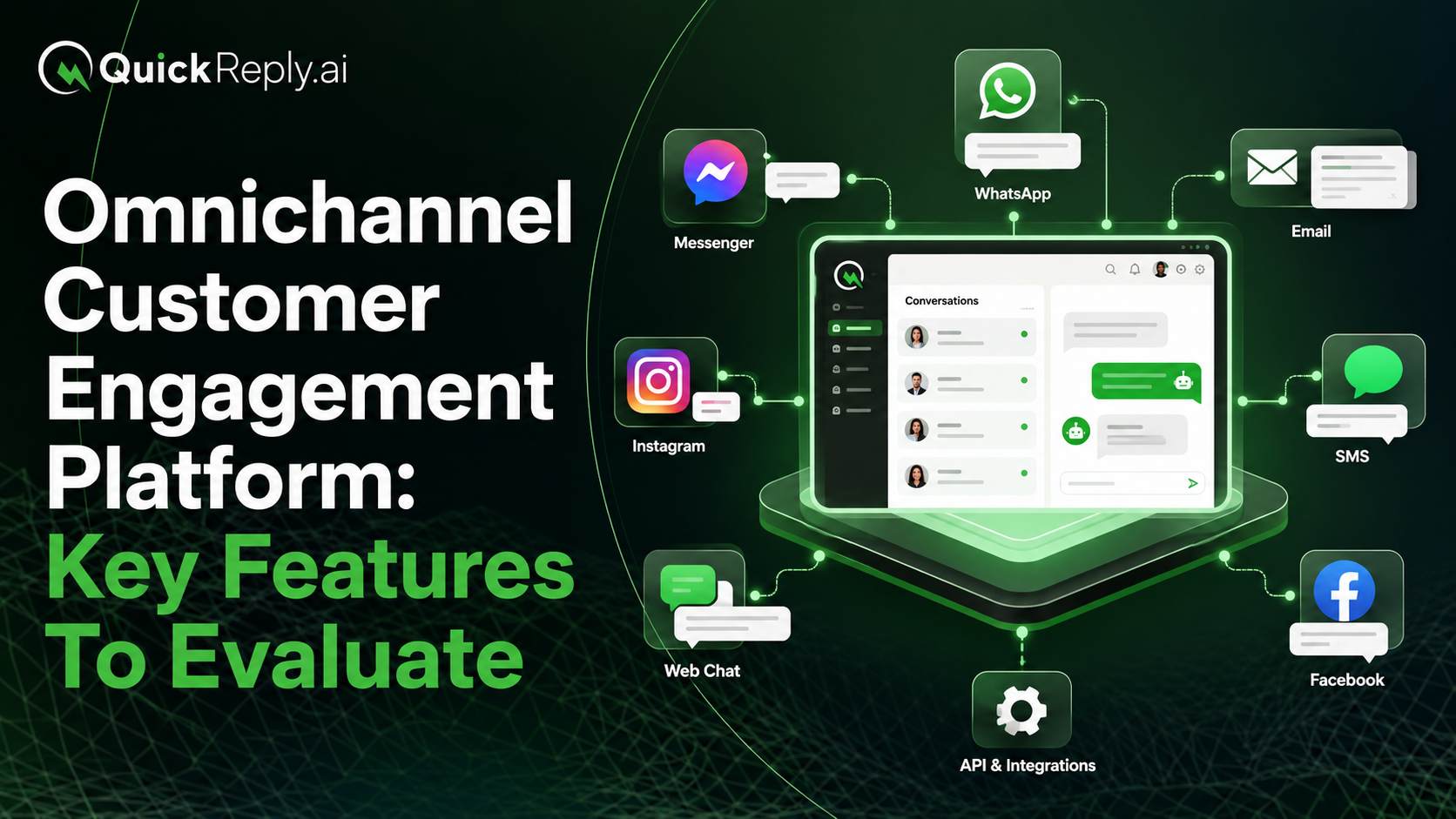
QuickReply.ai is a popular RCS messaging software that helps businesses automate customer engagement across channels, including WhatsApp, Instagram, Messenger, SMS, and RCS. With QuickReply.ai, telecom providers can build automated journeys for reminders, offers, customer support, FAQs, service updates, and follow-ups from one platform.

For example, a telecom operator can use QuickReply.ai to:

  • Send RCS recharge reminders with plan options
  • Automate replies for common customer queries
  • Guide users through bill payment or recharge support flows
  • Trigger offers based on usage, plan expiry, or lifecycle stage
  • Route unresolved cases to human agents
  • Manage customer conversations across multiple messaging channels
  • Track engagement, clicks, replies, and journey performance

This is useful for telecom teams because customer engagement does not happen in one fixed place anymore. Some customers may respond to RCS. Some may prefer WhatsApp. Some may still rely on SMS. QuickReply.ai gives telecom providers a way to automate these interactions without managing every channel separately.

With the right RCS automation setup, telecom providers can reduce repetitive support queries, make reminders more actionable, personalize offers, and help customers complete routine actions faster.

Turn 1 time visitor into repeat customer with WhatsApp marketing

Leverage the untapped growth potential of WhatsApp marketing to acquire and retain customers.

Frequently Asked Questions

How can RCS improve customer engagement for telecom providers?

RCS improves customer engagement by making telecom messages interactive. Instead of sending only plain text alerts, telecom providers can include buttons, cards, suggested replies, and automated flows. This allows customers to check plans, recharge, view bills, raise support queries, or get answers inside the same conversation.

Is RCS better than SMS for telecom customer communication?

RCS is better than SMS when the goal is interaction, support, or guided action. SMS is still useful for basic alerts, OTPs, and short updates. But RCS is more suitable for journeys where the customer may need to respond, choose an option, ask a question, view details, or complete an action.

Can RCS automation reduce telecom call center load?

Yes, RCS automation can reduce call center load by handling frequent and repetitive queries. Customers can check data balance, plan validity, bill amount, recharge status, complaint status, roaming options, or SIM activation steps through automated RCS flows. Human agents can then focus on complex or sensitive issues.

What telecom use cases are best suited for RCS automation?

The strongest telecom use cases for RCS automation include recharge reminders, bill payment reminders, data balance alerts, plan upgrades, roaming pack activation, service outage updates, SIM activation, KYC updates, complaint status tracking, customer feedback, and churn prevention journeys.

How can AI be used in RCS automation for telecom providers?

AI can help RCS automation understand customer intent, respond to natural language queries, guide customers to the right flow, and summarize issues before human handover. For example, if a customer says, “My recharge is done, but internet is not working,” AI can identify the issue, ask follow-up questions, and route the customer to the right troubleshooting or support journey.