RCS vs SMS for Marketing Broadcasts: Benefits, Differences, and When to Use Each

Copied to clipboard!

You have probably seen this on your phone already.

A message from a brand does not look like a plain SMS anymore. It has a logo, a verified sender name, a product image, quick reply buttons, and options like “Choose Plan,” “Claim Discount,” “Track Order,” or “Talk to Support.”

A few years ago, most of us would ignore plain text promotional messages. They looked generic, sometimes suspicious, and often forced us to click a shortened link without much context. For marketers, that created a clear problem: SMS had reach, but it did not always create enough engagement.

That is where RCS has changed the conversation.

RCS, or Rich Communication Services, gives brands a richer way to communicate with customers inside the native messaging app. Instead of sending only text, brands can send interactive, visual, branded, and action-oriented messages.

But this does not mean SMS is dead. SMS still has one major advantage: reach. It works on almost every phone and does not depend heavily on rich messaging support.

So, the real question is not simply, “Is RCS better than SMS?”

The better question is:

For marketing broadcasts, when does RCS give you a better business outcome than traditional SMS?

Let’s break that down clearly.

Quick Answer: Is RCS Better Than SMS for Marketing?

RCS vs SMS: Key Differences

Yes, RCS is better than SMS when your marketing broadcast needs engagement, branding, visuals, buttons, product discovery, and measurable actions.

SMS is better when your priority is maximum reach, urgent delivery, simple alerts, or communication with users who may not have RCS support.

A practical way to think about it is this:

SMS is delivery-first. RCS is experience-first.

SMS helps you send a message to a large audience quickly. RCS helps you make that message more useful, more trustworthy, and easier to act on.

For modern marketing broadcasts, this difference is important. Customers are not just receiving messages. They are comparing offers, checking products, choosing plans, booking appointments, and making purchase decisions. A plain text message can inform them, but an RCS message can guide them toward action.

What Is RCS Messaging?

RCS messaging is a modern messaging standard that upgrades the traditional SMS experience.

With RCS, brands can send messages that include images, videos, rich cards, carousels, suggested replies, action buttons, and verified sender details. Customers can interact with these messages directly from their phone’s messaging app.

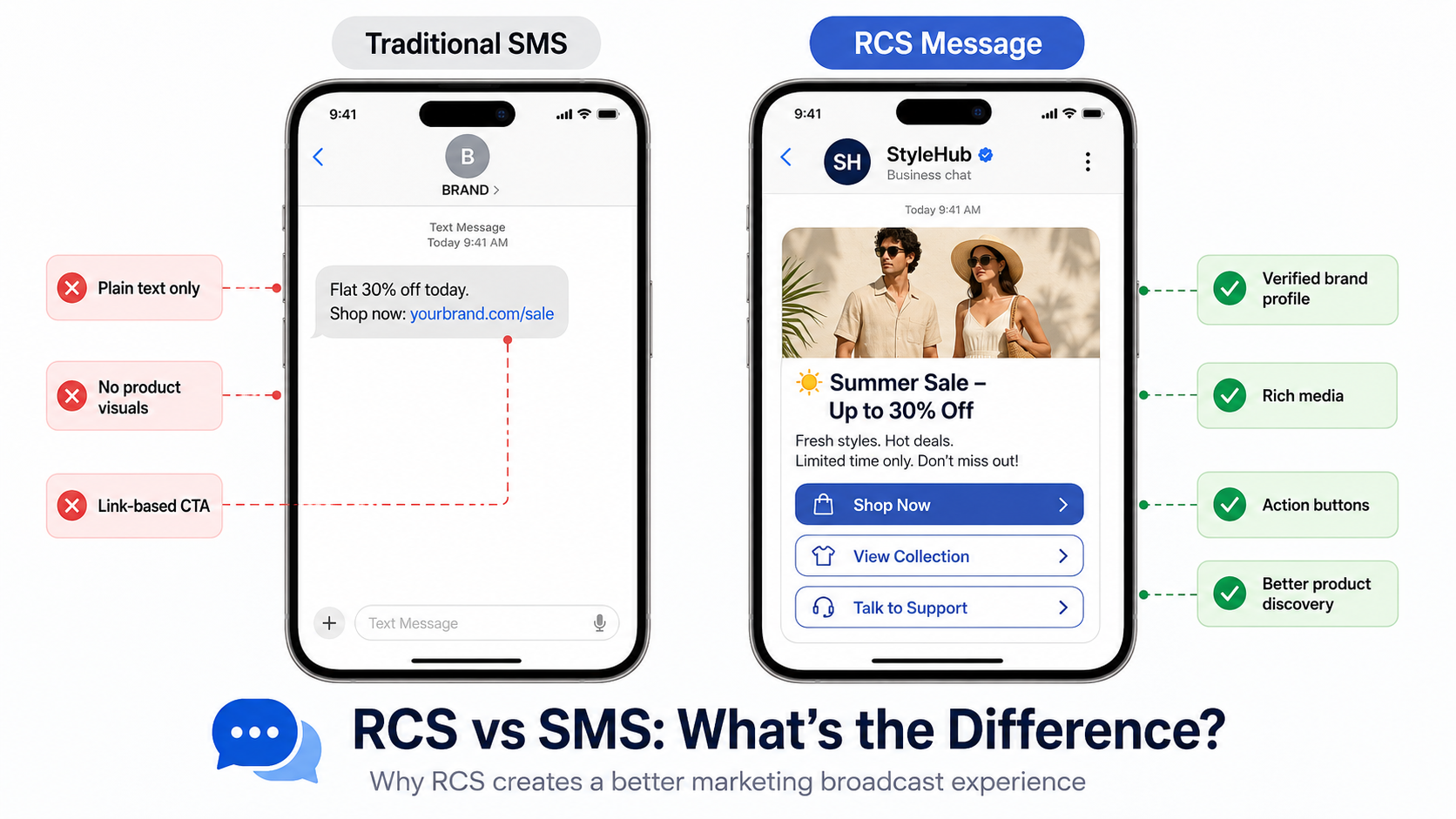
For example, instead of sending this SMS:

“Flat 30% off today. Shop now: bit.ly/xyz”

A brand can send an RCS message with:

  • Brand logo
  • Product image
  • Offer headline
  • Discount details
  • “Shop Now” button
  • “View Collection” button
  • “Talk to Support” option

This makes the message feel less like a random promotional alert and more like a mini landing page inside the messaging inbox.

That is the biggest shift RCS brings to marketing broadcasts. It turns a one-way text blast into an interactive brand experience.

What Is Traditional SMS Marketing?

SMS marketing is the process of sending promotional or transactional messages to customers through standard text messaging.

It has been used for years because it is simple, fast, and widely supported. Almost every mobile phone can receive SMS. That is why brands still use it for OTPs, delivery alerts, payment reminders, appointment confirmations, and short promotional offers.

SMS works very well when the message is short and direct.

For example:

“Your order has been shipped.”
“Your OTP is 482917.”
“Your appointment is confirmed for 5 PM.”
“Sale ends tonight. Use code EXTRA10.”

But for marketing broadcasts, SMS has clear limitations.

It is mostly plain text. It has limited branding. It cannot show product visuals inside the message. It depends heavily on links. It does not offer rich buttons or interactive product cards. It also gives marketers limited engagement data compared to richer channels.

This is why SMS is still useful, but not always enough for campaigns where the goal is customer engagement or conversion.

RCS vs SMS for Marketing Broadcasts: Quick Comparison

Feature Traditional SMS RCS Messaging Why It Matters for Marketing
Message format Plain text Rich media, cards, carousels, buttons RCS creates a more engaging experience
Brand identity Limited sender ID Verified business profile with logo/name Helps build trust
CTAs Mostly links Buttons and suggested actions Reduces action friction
Product discovery Text description only Images, cards, carousels Helps customers understand offers faster
Analytics Limited Better engagement and interaction tracking Helps optimize campaigns
User experience One-way and basic Interactive and conversational Better for guided journeys
Reach Very high Depends on device, carrier, and RCS support SMS still wins on universal reach
Best use case Alerts, OTPs, simple updates Marketing, product discovery, lead journeys Use based on campaign goal

Key Benefits of RCS Over SMS for Marketing Broadcasts

1. RCS Makes Marketing Broadcasts More Visual

Marketing is not only about delivering information. It is about making the customer notice, understand, and act.

This is where SMS struggles. A plain text message can tell customers about a product or offer, but it cannot show the product properly.

RCS solves this by allowing brands to include rich media such as product images, videos, GIFs, and rich cards.

For example, if a fashion brand is launching a new collection, an SMS can only say:

“New summer collection is live. Shop now.”

An RCS message can show the collection visually, include product cards, display the discount, and give customers buttons to explore the category directly.

This is a major advantage for ecommerce, travel, education, real estate, healthcare, and any business where visuals help the customer make a decision.

A customer is more likely to understand a product, plan, course, package, or offer when they can see it instead of only reading about it.

2. RCS Builds More Trust With Verified Brand Identity

One major problem with SMS marketing is trust.

Many promotional SMS messages look similar. Customers often receive messages from unknown sender IDs, shortened links, or generic text. This can make them cautious, especially when the message asks them to click a link or make a payment.

RCS improves this experience through verified business profiles. A brand can display its name, logo, and verified identity inside the messaging experience.

This matters because trust directly affects action.

If a customer sees a familiar brand logo and a verified sender, they are more likely to believe the message is genuine. This is especially useful for industries where trust is critical, such as banking, insurance, healthcare, education, travel, and high-value ecommerce.

For marketing broadcasts, trust is not just a branding benefit. It is a conversion benefit.

A customer who trusts the sender is more likely to click, reply, book, buy, or continue the conversation.

3. RCS Reduces Click Friction With Buttons

Most SMS marketing campaigns depend on links.

The problem is that links add friction. The customer has to read the message, trust the link, click it, wait for the page to load, understand the landing page, and then take action.

RCS reduces this friction by allowing brands to use buttons and suggested actions inside the message.

For example, instead of asking the customer to click a link, an RCS message can show buttons like:

  • Shop Now
  • Claim Offer
  • Book Appointment
  • Track Order
  • View Plans
  • Talk to Expert
  • Find Store
  • Pay Now

This may look like a small difference, but it changes the customer journey.

The customer does not have to figure out what to do next. The action is already presented clearly.

For marketing broadcasts, this is extremely useful because every extra step reduces the chances of conversion. RCS gives marketers a cleaner path from message to action.

4. RCS Improves Product Discovery With Rich Cards and Carousels

SMS is not built for browsing. RCS is much better suited for it.

With rich cards and carousels, brands can show multiple products, offers, plans, or options inside a single message.

This is useful when the customer needs to choose from more than one option.

For example:

  • An ecommerce brand can show best-selling products.
  • An education brand can show different courses.
  • A telecom brand can show recharge plans.
  • A travel brand can show holiday packages.
  • A healthcare brand can show diagnostic packages.
  • A real estate brand can show property options.

This makes RCS especially valuable for marketing broadcasts where the goal is not just to announce something, but to help the customer explore.

In SMS, you may have to send one link and hope the customer visits the page. In RCS, you can bring part of that discovery experience directly into the messaging inbox.

That is a big difference.

5. RCS Gives Marketers Better Campaign Insights

SMS gives marketers limited visibility.

You may know whether a message was delivered. You may track link clicks separately. But the overall engagement picture is often incomplete.

RCS can offer richer engagement signals, such as whether the message was delivered, whether it was read, which buttons were clicked, and how the customer interacted with the message.

For marketers, this is valuable because broadcasts should not be treated as one-time blasts. They should be optimized.

If you know which product card got the most clicks, which button performed better, or which segment engaged more, you can improve your next campaign.

This changes marketing broadcasts from guesswork to measurable engagement.

For example, if one RCS campaign shows that customers are clicking “Talk to Expert” more than “Buy Now,” that tells you something important. Maybe the product needs more explanation. Maybe customers need assistance before purchase. Maybe the next broadcast should educate before selling.

SMS does not usually give this level of interaction insight.

6. RCS Enables Two-Way Conversational Marketing

Traditional SMS broadcasts are often one-way.

The brand sends a message. The customer either clicks, ignores, or replies manually. There is usually not much guided interaction.

RCS makes broadcasts more conversational.

A brand can ask a question and give the customer simple options to respond. Based on the response, the brand can guide the customer to the next step.

For example:

“Are you looking for a prepaid or postpaid plan?”
Buttons: Prepaid / Postpaid
“Which category are you interested in?”
Buttons: Men / Women / Kids
“Do you want to book a counselling session?”
Buttons: Yes / Later / Talk to Advisor

This makes RCS powerful for lead qualification, product recommendation, appointment booking, feedback collection, and customer support.

The biggest benefit is that the customer does not have to type long responses. They can simply tap.

For marketing broadcasts, this can improve participation because the effort required from the customer is low.

7. RCS Creates a Better Customer Experience Without Another App

One reason messaging works so well is convenience.

Customers do not always want to download an app, visit a website, fill a form, or wait on a call. They want quick answers and simple actions.

RCS supports this behavior by keeping the experience inside the native messaging app.

The customer can receive a message, view the offer, tap a button, choose an option, ask a question, or continue the journey without immediately switching platforms.

This is important because marketing performance often depends on convenience.

If the customer has to move through too many steps, they drop off. If the journey is simple, they are more likely to continue.

RCS helps brands make the broadcast feel less like an interruption and more like a guided interaction.

8. RCS Is Better for High-Intent Marketing Journeys

Not every broadcast needs RCS.

If you are sending a short alert, SMS may be enough. But if the customer is expected to compare, choose, explore, book, or buy, RCS becomes more useful.

For example, RCS works well for:

These are high-intent journeys. The customer may already be interested, but needs one more nudge, more information, or a simpler path to action.

In such cases, RCS gives marketers more tools to influence the decision.

SMS can remind. RCS can guide.

That is the real difference.

When Should You Use RCS Instead of SMS?

You should use RCS when the campaign needs more than plain text.

Use RCS when:

  • The offer needs visuals
  • The product needs an explanation
  • The customer needs to choose from the options
  • You want buttons instead of plain links
  • You want to build trust with verified branding
  • You want better engagement tracking
  • You want customers to reply or interact
  • The campaign is focused on conversion, not just awareness

For example, if you are promoting a new clothing collection, RCS is a better fit than SMS because visuals matter. If you are asking users to choose a mobile plan, RCS is better because buttons and comparison cards make the experience easier. If you are running an abandoned cart campaign, RCS can show the product and give a direct action button.

In all these cases, RCS does more than deliver a message. It helps the customer move forward.

When Is SMS Still the Better Choice?

SMS is still very relevant.

In fact, for some use cases, SMS may still be the better option.

Use SMS when:

  • You need maximum reach
  • The message is urgent
  • The message is very short
  • The audience may not have internet access
  • RCS support is uncertain
  • You are sending OTPs, alerts, or simple reminders
  • The campaign does not need rich media or interaction

For example, an OTP does not need a carousel. A delivery alert does not always need a rich card. A payment reminder may only need a short message and a link.

SMS is simple, reliable, and widely supported. That is why it continues to be important.

The mistake is not using SMS. The mistake is using SMS for campaigns where the customer experience clearly needs more.

The Best Approach: RCS-First With SMS Fallback

For most brands, the best answer is not RCS vs SMS.

The best answer is RCS-first with SMS fallback.

This means you send an RCS message to users who can receive it. If RCS is not supported on the customer’s device, network, or messaging app, the message falls back to SMS.

This approach gives you the best of both worlds.

You get the richer experience of RCS where possible, and you protect reach with SMS where RCS is not available.

This is especially important because RCS adoption depends on device support, carrier support, user settings, and region. SMS does not have the same dependency.

So, a smart broadcast strategy should not completely remove SMS. It should use SMS as the reach layer and RCS as the engagement layer.

Conclusion 

The biggest benefit of RCS over traditional SMS is not just that it looks better.

The real benefit is that it helps brands communicate in a way customers are more likely to trust, understand, and act on.

RCS gives marketers richer visuals, verified branding, buttons, carousels, better engagement data, and two-way interaction. These features make it better suited for marketing broadcasts where the goal is conversion, product discovery, lead generation, or customer engagement.

SMS still has an important role. It is simple, widely supported, and useful for urgent or short messages.

So, the right choice depends on the campaign goal.

If your goal is to reach, use SMS.
If your goal is engagement, use RCS.
If your goal is both, use RCS with SMS fallback.

For modern marketing broadcasts, RCS is not just an upgrade to SMS. It is a better way to turn a message into an experience.

Turn 1 time visitor into repeat customer with WhatsApp marketing

Leverage the untapped growth potential of WhatsApp marketing to acquire and retain customers.

Frequently Asked Questions

Is RCS better than SMS for marketing broadcasts?

RCS is better than SMS when your marketing broadcast needs visuals, buttons, branding, product cards, carousels, and customer interaction. SMS is still better when your priority is maximum reach, urgent delivery, or simple text-based communication. For most brands, the best approach is to use RCS where supported and SMS as a fallback.

Does RCS have better reach than SMS?

No. SMS still has better reach because it works on almost every mobile phone and does not need RCS support. RCS depends on device compatibility, messaging app support, carrier support, and internet connectivity. That is why brands should use SMS fallback when running RCS campaigns.

Can RCS improve marketing campaign conversions?

RCS can improve the chances of conversion because it gives customers more context and clearer actions. Product images, branded messages, CTA buttons, carousels, and quick replies can reduce friction in the customer journey. However, conversion still depends on the offer, audience, timing, message quality, and campaign strategy.

Is RCS useful for ecommerce marketing?

Yes, RCS is highly useful for ecommerce marketing. Brands can use it for product launches, sale campaigns, abandoned cart recovery, back-in-stock alerts, repeat purchase campaigns, and order-related engagement. Rich cards and carousels make it easier to show products directly inside the customer’s messaging app.

What types of businesses should use RCS marketing?

RCS is useful for businesses that need visual, interactive, and action-led communication. This includes ecommerce, retail, telecom, travel, healthcare, education, real estate, BFSI, and service-based businesses. It works especially well when customers need to compare options, choose a plan, book an appointment, or explore products.

Is RCS more expensive than SMS?

RCS pricing can vary based on the provider, country, message type, campaign volume, and operator support. In many cases, RCS may cost more than SMS, but it can also offer better engagement and richer campaign performance. Brands should compare the cost against the expected business outcome, not only the message price.

Should brands replace SMS completely with RCS?

No, brands should not replace SMS completely. SMS is still important for OTPs, urgent alerts, service updates, and audiences where RCS support is limited. A better strategy is to use RCS for rich marketing broadcasts and keep SMS as a fallback or for simple high-reach communication.

What is SMS fallback in RCS messaging?

SMS fallback means that if a customer cannot receive an RCS message, the message is sent as a regular SMS instead. This helps brands protect campaign reach while still delivering a richer RCS experience to users who support it.

When should I choose SMS instead of RCS?

Choose SMS when the message is short, urgent, and does not need visuals or interaction. SMS is better for OTPs, delivery alerts, payment reminders, appointment reminders, and critical service updates. For campaigns where customers need to view products, compare options, or take action through buttons, RCS is usually a better fit.